the power of pants

Fooled ya! This post isn’t really about pants at all. Well, I guess it’s about “pants,” the tag.

WordPress has this feature by which you can check out other posts from WordPress blogs with the same tag. And for each tag, it will also show you a list of “related tags,” in case you want to follow up with other posts on similar topics. For example, for the tag “politics,” you currently get the following list of tags:
news, blogroll, life, culture, personal, religion, iraq, music, media and books

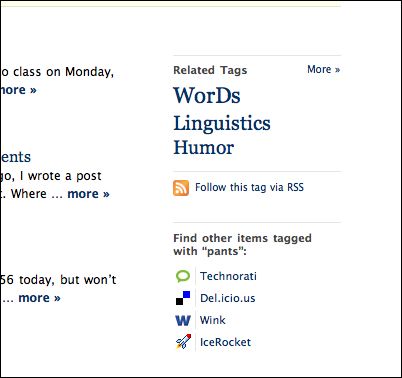
Recently, I decided to add the tag “pants” to my recent posts on pants. I am pleased to inform you that right now, at least, if you click on the “pants” tag, you get to see the following “related tags:”

  1. words
  2. linguistics
  3. humor

pants_tags.jpg

Those are actually the only related tags WordPress lists right now. (You’d expect to see “trousers” or “slacks”, perhaps “shirts” or even “fashion”…)

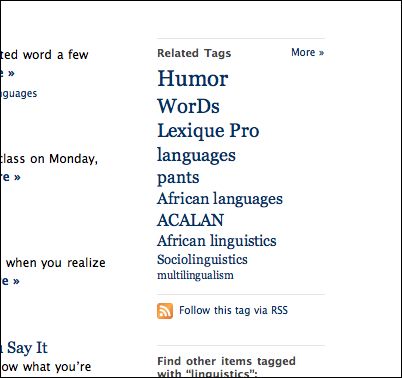
What I find even funnier, is that I see that the list of related tags for “linguistics“, which has related tags such as “languages”, “sociolinguistics,” and other terms you might expect, also includes “pants”. My friends, that is the power of pants.

linguistics_tag.jpg

By the way, this suggests to me that perhaps looking at blog tags would not be the most reliable means of investigating, say, semantic networks. (Though it could lead to lots of entertainment.)

return of the promised pants

I’m so embarrassed. I ran off to class on Monday, with my pants only half-way up. I mean, my pants post. I promised you some pants, and then I left you hanging. So, here I am again. Back with the pants.

Before I begin with the in-depth pants analysis, let’s pull our pants back up:

a. Listen to the pants. The file pair_of_pants.wav (and the streamed mp3 version of the same) contains two productions of the word pants, one “normal,” and one “funny.” (Before I tell you which is which, I’ll let you try the pants on yourself for size. I mean, judgements.)

Streamed version of pair_of_pants.mp3:

pair_of_pants.wav soundfile (can be downloaded):

b. pants methods. To recap:

The two productions of pants were spoken by a female native speaker of American English who was wearing pajama pants at the time of the recording. Each of the two versions of pants is of a similar length (roughly .7 seconds from the onset of the [p] burst), and produced in citation form with a similar f0 contour (H* L-L% in ToBI terms).

c. The funny pants. In my head at least, the second pants version is way funnier than the first. Especially when used in a sentence, such as “you’re not wearing pants:”

not_wearing_pants.mp3

d. Look at the pants. Let’s return to our citation form examples.

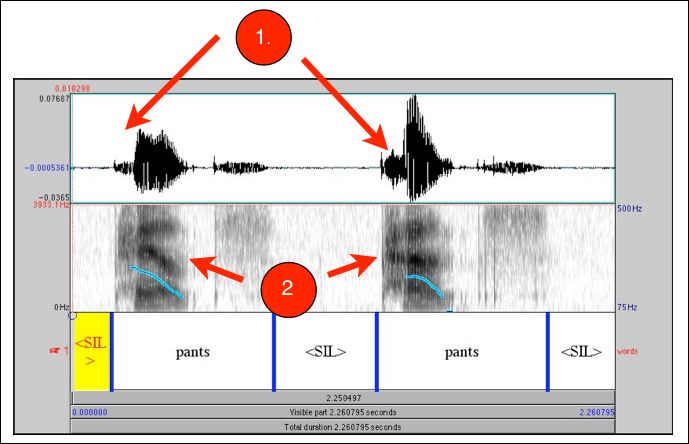
Figure 1: pair_of_pants.wav with accompanying Praat TextGrid, and some arrows and stuff
Note: The display shows waveform (top panel) and spectrogram with overlayed f0 track in blue (middle panel). The third panel, the TextGrid, shows orthographic transcription.
pair_of_pants_marked.jpg

e. Pants analysis. A couple of acoustic differences between the two versions are quite striking: 1) differences in aspiration and 2) differences in the second formant.

  1. differences in aspiration. Check out the much higher amplitude aspiration noise in the second version (on the right). The arrows marked with “1” point to this in the waveform. Further, you can hear the aspiration ([h]-ness) continuing through the vowel, which is produced with a much breathier voice than the first version.
  2. differences in the second formant. (Note: if you’re not used to reading spectrograms, the first 3 formants show up as more-or-less horizontal dark smudgy lines. The first formant is on the bottom. The second formant, marked with the red arrows marked with “2”, is the middle dark smudgy line.) In the “normal” pants version, the second formant falls rather steeply throughout the vowel (indicating that the vowel is diphthongized). In the “funny” pants version, the second formant stays pretty much horizontal.

f. Pants conclusions. Pants is a funny word. I like to say the word pants.

Here are the pants I promised you.

Way back when, long, long ago, I wrote a post about pants. The pants post. Actually, the “Pants!” post. Where I talked about the word pants, how I like saying “pants”, how pants is a funny word. And I, therein, made a promise to do some acoustic pants analysis:

When discussing pants, it’s also important to pronounce pants properly. I produce pants with very strong aspiration on the [p]. There seems to be a bit of difference in the vowel, too. I’ll plan to make some recordings so that I can do a bit of pants analysis.

It’s taken me a bit of time to get back to you with the promised pants. I hadn’t figured out a great way to incorporate soundfiles into my posts. And for a post on the particulars of pants production, one really neads to have an accompanying pants soundfile. Thanks to a new WordPress feature, I am now easily able to embed soundfiles. Even pants soundfiles. Especially pants soundfiles. I now promise you to include more pants soundfiles than ever before. This blog can become known as the one with pants.

So, here are the pants I promised you. The image below shows a screenshot of the soundfile pair_of_pants.wav displayed in praat, which I have additionally marked up a bit with arrows and such. The file pair_of_pants.wav contains two productions of the word pants, one “normal,” and one “funny.” (Before I tell you which is which, have a listen, and you be the judge. Listen to the pants yourself.)

Streamed version of pair_of_pants.mp3:

pair_of_pants.wav soundfile (can be downloaded):
pair_of_pants.wav

Figure 1: pair_of_pants.wav with accompanying Praat TextGrid, and some arrows and stuff
pair_of_pants_marked.jpg

The two productions of pants were spoken by a female native speaker of American English who was wearing pajama pants at the time of the recording. Each of the two versions of pants is of a similar length (roughly .7 seconds from the onset of the [p] burst), and produced in citation form with a similar f0 contour (H* L-L% in ToBI terms).

Okay, I have to run off to class now, without finishing my pants analysis. I hate to leave you hanging with my pants half done, but there it is. More indepth pants analysis is coming soon…

…or else…

Tomorrow I have to go into Boston to meet with two of my professors. One of them is my advisor, and the other is actually the head of my graduate program. The deal is, I owe them both work. I’m feeling a little like my debts are being called in. I’m not sure what the consequences will be if I don’t make good. I can’t see them sending someone out to rough me up…

I know that they mean this to be a way to help me move forward with my studies and career-related work. Things have been a bit slower in that area for the past 10 months or so due to an increase in my family size. However, I have not been completely inactive in this area. And I have not been otherwise on vacation. (Actually, I feel ready for a vacation right about now.) However, I still must justify my existence as a grad student by giving a report on two projects that I owe.

Debt One:
My incomplete. Or really, I should say My Incomplete. Incompletes are not things to be undertaken lightly. It seems so harmless to ask for a bit of extra time. But this is all an illusion. I knew that going in. I’d had an incomplete before, and it haunted my dreams for over a year before I managed to tackle that monster. This one was only supposed to lead to a delay of a few weeks. A month or two at most. But the class ended last December. And BUreaucracy dictates that I must finish within a year.

Once upon a time, sometime in early to mid December of last year, I was almost finished with this paper for my Field Methods class. I was working on the topic of intonation. Things were going well. Progress was being made. I was enjoying getting into the data. Then, out of the blue, inconvenience struck. Struck me down. It was actually a pregnancy-related thing, involving pointless and very time-consuming medical tests. And more detrimental to my progress, a whole lot of distracting irritation with the whole process. It only set me back a couple of days, but at a time that I didn’t have a couple of extra days to spare due to other work deadlines rapidly encroaching. So I made that fatal step and asked for the incomplete. I estimated I could finish the paper in about 8 hours. The plan was to get back to it in January or February. January flew by in a rush of very exciting work. And when February hit, I was as big as a house. And apparently never managed to muster up the necessary motivation. Sigh.

Now many moons have passed, and it will take me more than 8 hours to finish. Because I must refamiliarize myself with all of it. And probably redecide what I want to say. But here’s what I have for data:

  1. 224 .wav format soundfiles of short utterances of Palestinian Arabic produced by a native speaker. They consist of single words, short phrases, short sentences and a few longer sentences and utterances. These include questions and declaratives with varying focus patterns.
  2. All have been labelled in Praat, using TextGrids with time-aligned labels for intonation (using ToBI-based labels), broad IPA transcription, word-by-word glosses, and translation. Some files have additional comments.
  3. I’ve made a small, simple Filemaker database of the files and labels so far, with codings for type of utterance and context.

I have a very rough outline of the paper, which includes a bit of background, some dicussion points, and some pretty pictures of a few examples, but not yet any description/discussion of those examples (or even examples for many of the types I’d like to discuss.) I have an additional partially labelled eliciation session with the native speaker which contains cool data that I hate to entirely leave out. I’d like to finish labelling and coding it. (However, I think this may be something I’ll have to forego.) What I need to do is discuss the examples, fill in the background section, and summarize my findings. (Basically, “write the damn paper.”)

Debt Two:
The project I owe my other professor is either a script or a collection of scripts to help process large quantities of data. The plan is to go from a long soundfile (usually about 30 minutes) to a database with details on individual tokens, and short soundfiles of individual utterances. Happily, this is not new territory for me. It’s also a project that I find very appealing. So far, what I have is a collection of scripts, mostly written by other people, that I have started modifying for our nefarious purposes. Right now, there are several Praat scripts (for chopping big files, and then for getting acoustic measurements based on TextGrid labels). I also have a Perl script (which I mostly wrote myself!) which collects labels from TextGrid tiers that I have used to dump labels into a Filemaker database for my ToBI-related work. I’m thinking that I may be able to do away the Perl script, once I learn more about Praat scripts. Right now, I haven’t figured out a good way to collect labels from point tiers. Most scripts I’ve seen have made more use of interval tiers. But I figure I’ll find the answer with a bit more digging.

So there it is. Those are (some of) my outstanding debts. I’m hoping the plan for tomorrow is to work out some sort of payment plan. Before the debts are sent to the collection agencies. (Hmm. Another sense of the word collection.)