pidgin post

When I was 14 years old, I lived in Hawaii for a few months. My mother was in a relationship with a man who lived in Honolulu, and in December of 1985, she decided we should all move there: my mother, my sister and me. (Perhaps was in part in response to the impending threat of another bitter Colorado winter.)

While I have moved many times in my life, this move was among the most dramatic.

My mother’s boyfriend, who we’ll call C, had a condo in Honolulu, right around Waikiki, in the shadow of Diamond Head. It was about as different a setting as you could get from the antique log house we’d been renting in Colorado. (Though that house too was in the shadow of a mountainous landmark, being in Manitou Springs, at the foot of Pike’s Peak.) We arrived there a couple of days before Christmas, leaving the biting cold and blizzards behind us for beaches and balmy weather. There was also much greenery, contrasting vividly with the white and grey we’d flown away from, and there were palm trees around town wrapped in red ribbon to resemble candy canes, an almost surreal reminder that the season had not changed. Aside from the transition in climate and surroundings, we went through a bit of culture shock, too. While Hawaii is a state, the 50th to join the union, back in 1959, it is also a place of multiple cultural heritages. European and mainstream American culture are blended with various Asian and Pacific island cultures, including a strong steak of indigenous Polynesian cultures. This is reflected in many of the customs and traditions practiced by those who call Hawaii home: food, clothing and music, for a start. And also language.

One of the first people we met in Honolulu was a young neighbor of C’s. I don’t remember how old he was, exactly. Maybe 13 or so. Close to my age, definitely younger than my sister’s advanced 16 years. I’m sad to say that I no longer remember his name (though I could probably unearth it), but I do vividly remember some of the conversations we had with him. He sort of took us under his wing, these 2 clueless haolie girls fresh off the mainland. While he spoke in English, with the local accent, he’d also sometimes demonstrate for us another type of speech. He referred to it as “pigeon.” At one point, I remember him warning us that if we ran into groups of local teens speaking pigeon, we should keep our distance. Such kids were often looking for trouble, our new friend told us.

It wasn’t till years later, at some point in my formal linguistics education, that I learned that what he’d really been saying was “pidgin,” not “pigeon.” A pidgin is a contact language, meaning a sort of blend of two or more languages, and used to facilitate communication between groups of speakers of different native languages. The pidgin in Hawaii developed from contact between speakers of English and Hawaiian, as well as settlers who were native speakers of Cantonese, Japanese, Portuguese and Filipino languages. The resulting mix sounds, to Mainlander ears, a bit like a foreign language with a few recognizable English words thrown in.

And what I learned even later was that what is colloquially known as Pidgin in Hawaii is no longer technically a pidgin, but a creole. A creole is also a type of contact language. However, a pidgin is generally an “initial” contact language. That is to say, it develops at an earlier stage in the contact between populations. Sometimes, a pidgin will develop into a creole. What this means is that both the language and the population have achieved the stability of having native speakers of that language. Not all pidgins turn into creoles, but it does seem that all creoles developed out of pidgins. (What is known in Hawaii as Pidgin is more formally known as Hawaiian Creole English, by the way. But that’s just a technical term, really, as far as I’m concerned. Those in the know, the locals, know that this language they speak is Pidgin.)

Pidgins, creoles and other contact languages are a fascinating and complex area of study in linguistics.¹ Sociolinguists, in particular, have been interested in their development and use in social context. There are many creoles spoken around the world, such as Haitian Creole (kreyòl ayisyen), which is “based” on French, or Cape Verdian Creole (Crioulo caboverdiano), which is “based” on Portuguese. I won’t get into all the details at this point, but I do feel I should make one point, and explain my “scare quotes.” Many people have assumed, when hearing a creole, that speakers are incompetent users of the (usually European) language from which it takes much of its vocabulary. Eg., that Kreyol is just “broken” or simplified, French. However, creoles are far more complex than this, and often the syntax² is based on an unrelated language, such as an African language. So knowing French will not enable you to produce a sentence in Haitian Creole, even though it may enable you to understand much of the vocabulary. This misunderstanding has historically led to discrimination against native speakers of creoles, especially in the area such as education and employment, based on the assumption that the speakers were merely poor speakers of, for example, French.

So there we have it. My pidgin post. Which is really, as it turns out, mostly about creoles. Sorry about the lack of respectable references. I meant to dig up my sociolinguistics textbook, but it’s managed to get itself buried in the recesses of our home. And seeing as it’s getting late, I should be getting to bed. But those of you who know this stuff better than I do, feel free to jump in and elaborate.

———————–
¹ Of course, I’m prone to call just about every aspect of language fascinating and complex. But pidgins and creoles are way cool!

² Syntax, in case you haven’t been subjected to it, is the backbone of the word order and grammatical rules of a language.

and they were like, “yeah, whatever, it’s the quotative like”

So here I was, sitting here with my laptop when I should’ve gone to bed. And having just finished a task of actual work, I continued to poke around on my laptop, looking around what other folks have written. And then (dude!), what catches my eye but a post on the quotative like.

As you may know, I’m all over the quotative like. So I couldn’t help but to check it out. And what’s more, I learned that there’s even a recent New York Times Magazine column on the topic. And I was like, “Woohoo! Quotative like is hitting the mainstream!”

The article’s a quick read, and generally fairly accepting of the quotative usage of like. However, I don’t entirely agree with the author’s categorization of the quotative like as a function word:

O.K., the new like is hot and it’s useful, but is it legit? Aren’t some rules of grammar or usage being broken here?

Linguists and lexicographers say no. It’s natural, they say, for words to take on new roles. In this case, a “content word” (one that means something) has become a “function word” (one that has a grammatical function but little actual meaning). Academics call the process “grammaticalization.” It’s one of the ways language changes.

I would tend to categorize the quotative “like” as a content word, not a function word. But it’s a bit tricky. But it does make me ponder the origins of the usage. I wonder if it arose from the hedge-like interjection form of “like.” You know, the one that, like, people toss in that doesn’t, like, add a lot of meaning? I can imagine an origin based on a usage like (such as) “…and then he said, like, ‘no way.'” or “I thought, like, ‘his use of that discourse marker was infelicitous in that context.'” If my hunch is right, then this would be a case of a word becoming more contentful…

the weekly pants

After my most recent post of seriousness, and being too tired/sleep-deprived just now to put together coherent thoughts, I feel compelled to return to our regularly scheduled silliness. And what could be sillier than pants?

I also feel that while this blog boasts more posts on pants that the average blog, I can do better. I’m sure I can bring you more pants. With that goal in mind, I’ll try to post on a pants topic once a week. I won’t commit to a day. I’ll just surprise you with pants some day each week, out of the blue. Pants! And besides, every day of the week should be pants day.

To get the pants rolling (can pants roll?), I’ll share a tidbit from a lovely book called Unfortunate English: The Gloomy Truth Behind the Words You Use, by Bill Brohaugh. This book, given to me by the friend who was recently brave enough to be one of our house guests, contains some very entertaining etymological goods. According to Unfortunate English, pants are “a garment that has its origins in buffoonery and farce:”

The word traces back to commedia dell’ arte, an old Italian theatre form (beginning in the 1500s) combining improvisation and standard bits actors could weave in at appropriate moments. One of the stock characters in this theatre form was Pantalone, a mean, miserly merchant and a bit of a dirty old man.[…]

The Pantalone character wore tight-fitting trousers or leggings. Trousers like those worn by Pantalone were called pantaloons in the 1600s, and by the 1700s the word was applied to trousers (as opposed to knee breeches) in general. By the mid-1830s, the word had been shortened to pants… (p. 75)

Another point made by the author is that because of the associations with the dirty old man Pantalone character, a comic figure, the term pantaloons has roots in “making light of old folk:”

…by the 1600s the word pantaloon meant “old codger.” (p. 76)

It’s interesting to see how pantaloon’s descendent pants has matured, having now lost this meaning of mockery of the matured.

throwing blame

As I headed out from an appointment on Wednesday, I walked passed a recently delivered newspaper on the ground outside the office building. It was folded up inside a clear plastic bag. The following headline jumped out at me:

ICE¹ sweep nets 5 local immigrants
Officials say those who commit crimes deserve ticket out of town

I bent over to get a better look, and to read the portion of the article² that was visible through the plastic. I was disturbed. The headline and the article seemed to suggest that immigrants are criminals.

A closer reading of the article revealed that in fact the individuals who had been arrested were charged with various crimes, some of them more serious than others, and in addition were immigrants. (Well, actually, they were tracked down because they were immigrants who had committed these crimes.)

At the same time, the article did contain various subtle and not-so-subtle suggestions that illegal immigrants are somehow menacing. Take this section about the reactions of a local police chief:

“I don’t have a problem with them going around and trying to round up these illegal immigrants,” said [town] Police Chief […]. “Illegal immigration just can’t be tolerated.”

With two convicted criminals from his town arrested, the chief said it’s high time the government start getting illegal aliens off the streets. The group has largely been overlooked in the past, “creating a problem on a couple of angles that people don’t want to look at,” he said.

[Town] Police are seeing some crimes increase with illegal immigration, particularly unlicensed automobile operation charges.

One overarching problem I have with the article is the way the discourse is framed. A careful reading of the article shows that the particular individuals arrested had been convicted of crimes. But let’s face it. Not everyone takes the time to read articles closely. It would be all too easy for a reader to be left with the impression that immigrants are more likely to commit crimes, and that illegal immigrants are particularly threatening. Consider this phrase, taken out of its context:

crimes increase with illegal immigration.

No discussion of the complexity of the issues and no contrary viewpoints were offered. The tone of the article is congratulatory towards the ICE. A casual reader would have the impression that the general public attitude towards this ICE sweep is of approval. That the issues are clearcut. Even that the arrest of these individuals is just the surface of the festering problem of “criminal aliens”.

The article, as well as many ostensibly neutral reportings of issues relating to immigration in the media, reflects a subtle undercurrent of anti-immigrant sentiment. (And don’t even get me started on the venomous hardcore anti-immigration set.)

This increased xenophobia quite honestly reminds me of other dark times in our world’s history. When things look dark, whether it’s because of plague or economic depression or threats of war, people look for someone to blame. When the issues are complex, it is hard to pinpoint the source of the problem. What it is easy to do is pick some group to shoulder the blame. Communists. Gypsies. Jews. Witches.

Our country is at war. Gas prices and living expense are rising. Homelessness and unemployment rates are high. Many people are finding it hard to make ends meet. People want answers. People want solutions. But because these are not quick or easy to achieve, people want to blame. It’s so much easier to blame the other, because blaming those that are too close to us seems not to accomplish anything. Lately, immigrants, especially those that have violated current immigration laws, have been offered up and targeted for blame.

The issue of immigration is one that I think about often, though I have not yet ventured to write on the topic. It’s been hard to work myself up it, even though I have many thoughts I’d like to write down. For the most part, though, I write about fairly lightweight topics on this blog. This is because I write primarily for my own amusement and for the potential entertainment of others. I like to write with humor, even when the topics touch on seriousness. But I just can’t find anything funny about the growing hate and intolerance evidenced in the discussion of immigration issues.

—————————————–

¹ US Immigration and Customs Enforcement

² Note: The online headline reads: Immigrants face deportation³

³ Note (added later): I forgot to mention that I stopped to buy my own copy of the paper on my way home, so that I could read the article more closely. Which is how I noticed the two different headlines.

6 weird things about me

In exchange for getting YTSL of Webs of Significance to subject herself to the 5 questions meme, which she has graciously already posted about, I have offered myself up to be tagged by her for the 6 weird things meme. (Yes, I realize these are not your traditional meming behaviors. However, I don’t expect we’ll be fined by the International Meme Police. I do sometimes worry about being persecuted by the International Mime Police though. My “walking against the wind” is appallingly bad.*)

Anyhow, here is a list of 6 weird things about me.

  1. I was a weird kid, and had a variety of colorful fantasies. I’m sure most kids did, but somehow, I think mine may have been a bit weirder than normal. For example, when I was around 9 or 10 years old, I used to imagine that as an adult, I’d choose to regularly wear full blown Victorian-style gone-with-the-windian hoop-skirted dresses. Because as an adult I’d have full choice over what I’d wear.
  2. artichokes.jpg

  3. My favorite food is a vegetable. I love artichokes. Not to say that I don’t have other food loves. But artichokes are tops. I’m talking fresh, steamed, prickly, spiky, alien-looking thistle buds. My deep, abiding love for artichokes dates back to my youth, and was considered to have been no_pizza1.jpg
  4. decidedly odd by other kids. When other American kids were asked for favorite foods, they’d almost universally answer “pizza.” But me, I’d answer “artichokes.” I actually didn’t even like pizza as a kid. (Yes, another weirdness. I got over it.) I remember a school project once where the kids of my 5th or 6th grade class had to put together a newspaper. As a new kid at the school, I was interviewed. The “editors” chose to put the headline for the resulting article on the front page: “Girl Likes Artichokes”. It almost could have been a Weekly World News article.

  5. I once lost my sense of smell. I don’t remember for how long. Might have been a couple of weeks. It came back gradually. When it first came back, I could smell only one thing: cherry scones. (I’ve been meaning to write this story, but I think I’ll save the details for later.)
  6. I can sing a bunch of TV theme songs for shows that I’ve never watched. For example, “77 Sunset Strip” and “Flipper”, or one of my favorites to sing, “Surfside 6“. (Keep in mind that the indented parts are sung in my best bimbo voice.):

    Surfside 6
           What’s that?
    Surfside 6
           an address?
    Surfside 6
           for a houseboat?
    Surfside 6
           and where is it?
    In Miami Beach
    da da da, da da da
    cha cha cha
    cha

  7. My name is spelled in Esperanto. (In a way that speaks more to the weirdness eccentricity of my parents than of myself…) In case you haven’t heard of Esperanto, it’s an artificially created international language. Much like the dodo, it is most frequently referenced in jokes about obsolescence, obscurity and extinction.
    cf:

    Esperanto is a joke. It’s for cranks. You can tell it’s for cranks because, on the few occasions you hear about it, you hear that it is “not just for cranks”.

    or

    cynics have mocked it as an idealistic cult for linguistic weirdos.

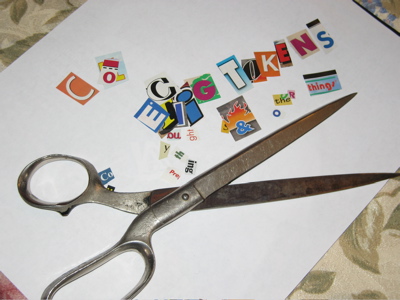
  8. I can get quite compulsive about my hobbies. And I have a weird sense of humor. This is a combination that some people have found disturbing. For example, consider this incident from a recent visit to the in-laws. John and my mother-in-law and I were sitting at the kitchen table late at night, talking. I noticed a “Clipper magazine”, a hideous thing made up entirely of ads, with coupons to clip. When I saw the magazine sitting there, with me sitting around with my hands unoccupied, I had this overwhelming urge to clip the letters. I thought I could make a banner for the blog. When I asked my mother-in-law if I could cut up her magazine, she asked why. As I have felt it best to hide the existence of my blog from her, I had to come up with a plausible reason: “I need to write a ransom note.”

    scissor.jpg

Okay, them’s my 6 weird things. Others might claim that there are additional weird things about me. John says my little toes are weird. So I suppose they could have been items 5 and 6.

Now I believe I’m supposed to tag 6 other people, according to the rules:

People who are tagged should write a blog post of 6 weird things about them as well as state this rule clearly. In the end, you need to choose 6 people to be tagged and list their names. Don’t forget to leave a comment that says ‘you are tagged’ in their comments and tell them to read your blog.

Okay, this is definitely the hard part. Maybe I should just go around to random blogs and leave the “you are tagged” bit. Or maybe I’ll just go around leaving comments telling random people to read my blog. That would be oh-so-smooth. Or I could send notes with cut up letters telling people to read my blog…or else.

So, I think I’ll go with some people I haven’t attempted to tag before, but believe to have some weirdness to them. (And I mean that as a compliment.):

  • jeanerz of Jean Crawford, Starr Linguist
  • KC of Where’s My Cape?
  • NotSoSage of NotSoSage
  • Jaŋari of Matjjin-nehen
  • and

  • Lori of Celebrating the Absurd
  • And since she’s seemed moderately amenable to this sort of thing in the past,

  • jenny of baggage carousel 4.
  • If any of you don’t want to play, I can untag you. Or you can just ignore the tag (which is what often happens). If someone out there does want to play (either this game or some future one) please let me know.

    ——————————–
    *I’m trying to figure out a way to throw in this quote about miming by Paula Poundstone, who said:

    The saddest thing about me talking all the time is that I am a gifted mime. I could have had a brilliant career. I just couldn’t shut up!

    and

    Look at me, I’m in a box!

    geek, nerd or dork?

    I wrote a bit a couple of weeks ago about clique taxonomies, especially as they pertain to the high school movie genre. In my research, I came across some interesting tidbits, which I thought I’d share.

    Most high school clique taxonomies make some reference to individuals who are not considered popular: the “outcasts” or “outsiders.” Most commonly, these “others” are labelled geeks, nerds or dorks. (Though the terms dweeb and spaz or spazz are not uncommon.) The use of these terms has usually been extended past the high school age, when clique membership becomes less clear. Interestingly, the taxonomies for these groups have become hotly debated.

    For example Militant Geek (“Militant Geek Custom Shirts: Propaganda for a Geek Friendly Future”) offers these words of concern:

    An alarming trend that we’ve noticed at the Militant Geek HQ is the sloppy usage of the terms ‘geek’, ‘nerd’, and ‘dork’. It was almost as if certain individuals assumed that they meant the same thing! For the record Geeks are those that have technical aptitude, nerds are bright but socially awkward, and dorks are just inept excuses for protoplasm.

    This site has even offered up a “handy comparison chart” to help people understand the differences in the classifications.

    Coyote of Not funny…ever offers these words of wisdom in a post called Geek Dweeb or Spaz?

    Dork – (Pronounced “Door’k” From the Latin “Murdockious”) A Dork, like the Spaz has all the knowledge and ability of a Geek or a Nerd, but has NO clue

    Buckethead of The Ministry of Minor Perfidy offers definitions and discussions in the similarly-titled though differently-punctuated post Geek, Dweeb, or Spaz?

    Nerd: the nerd is base type, from which all the others are derived. Nerds are bright, and lacking in social skills. They have odd interests. They are dilettantes, and usually end up consumed by counterproductive pursuits like the SCA, Star Wars collectables, and Star Trek conventions. Some nerds can achieve purpose in life translating the arcane thoughts of the geeks to the mundane normal people. Nerds are hapless, though they often have a goofy charm.

    90028549v8_240×240_front_color-black.jpg

    And this is just the tip of the iceberg! Whether it’s the Wikipedia entry for geek an “ask yahoo” response to the fundamental question “What’s the difference between a nerd, a geek, and a dork?” or a discussion board topic on a site called Geek Culture. You can even get t-shirts that help you with the terms, like the cafépress “geek hierarchy” shirt:

    Geek Hierarchy: Geek > Nerd > Dork. Geeks design it, Nerds buy it, Dorks break it.

    Do you wonder where you fit into the picture? Do you have leanings of geekery, or hints of nerdiness? Or are you just a total dork? There are tests to help! (Well, to help you figure out if you are a nerd or a dork. Finding help with being a dork is another question.)

    Okay, I’ll have to post about the tests later. I’d better get to work.

    high school movies and clique taxonomies

    It’s no wonder I’ve been having traumatic high school flashbacks. In my class on Monday, there was an extended discussion of terms used to categorize cliques (and outcasts) at the various schools that people had attended. (Keep in mind, for most of the students in the class I’m taking, high school was fairly recent history.) This was all relating to our assigned reading, primarily a text by Penelope Eckert about an ethnographic study she’d done in an American high school. The Eckert text (the same one that had a sentence that made me laugh out loud) discusses the terms Jocks and Burnouts, terms used by the teenagers in the Detroit area suburban high school she studied.

    So the kids (yes, I’m freakin’ old) in the class were all relating the terms used in their schools. “We had jocks and greasers” or “we had preppies and townies”. Terms like “skaters” and “band kids” were bandied about. To be honest, I don’t remember all of what they said. I was too busy feeling old and having flashbacks to various movies that make reference to clique structure and terminology. Which is basically every American high school movie ever made.

    But lets go over some examples, with the terminology:

    1. The Breakfast Club (1985)
      This movie featured 5 students of differing categories: Jock, Princess, Criminal, Basket Case and Brain.
    2. Ferris Bueller’s Day Off (1986)
      This quote about sums it up:

      Grace: Oh, he’s very popular Ed. The sportos, the motorheads, geeks, sluts, bloods, waistoids, dweebies, dickheads – they all adore him. They think he’s a righteous dude.

    3. Heathers (1989)
      This movie has the exclusivity (and cruelty) of the popular clique taken to the extreme, with the 4 members (3 of whom are named Heather) called “The Heathers”.
    4. Clueless (1995)
      I don’t remember what terms this movie used explicitly, but I found this reference to the clique structure:

      On paper, Clueless would sound like just about any other high school comedy. It’s got the popular girls and the jocks, the dreamboats and the bitches, the stoners and the slackers.

    5. 10 Things I Hate About You (1999)
      One character gives a tour to another, a new kid at the high school, and explains the who’s-who of cliques:

      Over there you’ve got your basic beautiful people. Now listen. Unless they talk to you first, don’t bother.

      This movie went for somewhat exaggerated cliques, with Audio-video Geeks, Coffee People, White Rastas, Urban Cowboys and Future MBAs.

    That’s all I got for now. I’ll have to do more research into this issue at some point. (Translation: I’ll watch some high school movies.) I am on the lookout for new references on this subject matter. If anyone has any clique terminology to add, whether based on your own ethnographic studies, knowledge of the literature, or familiarity with bitchin’ high school movies, please let me know.

    Hey, you! What’s-yer-face!

    I have a sort of strange confession to make. I don’t know what to call my mother-in-law. I’ve actually known her for almost 15 years. And in that time, I’ve deftly (and sometimes not so deftly) avoided calling her by any term of direct address. I’ve been “you-ing” her for over a decade. She’s of a generation and disposition that doesn’t really invite someone of my age calling her by her first name. She’s never suggested that I do. And I’m of a generation and disposition where calling someone I know well “Mrs. X” seems wrong. At some point, maybe shortly after John and I got married (the first time), she started signing cards “Ma & Pa X”. While I appreciate the effort to give me some forms of address, albeit many years after first running into the issue, I just can’t manage Ma or Pa. They sound straight out of Little House on the Prairie. And nobody else calls them that. John calls his mother “Mom.” (I call my own mother “Mom.” I don’t want to call John’s mother “Mom.”)

    So I have to say I found it pretty funny to come across this in my class reading:

    Knowing how to address your father-in-law (or mother-in-law) has often been a problem for many people: Mr Smith is sometimes felt to be too formal, Bill too familiar, and Dad pre-empted or even ‘unnatural’. The arrival of grandchildren is sometimes seen as a way out, it being easier to call a father-in-law Grandad than Dad. (Wardhaugh, p. 269)*

    Tomorrow, we are heading down to NY to visit Grammy and Grampa. Problem solved.

    Yes! This is why people have kids!

    Brought to you by Great Moments in Family Planning.

    *Wardhaugh, Ronald. 1992. An Introduction to Sociolinguistics. Second Edition. Cambridge, USA: Blackwell.

    size matters

    I am, of course, talking about matters of dimension.

    I was talking to a friend today over the phone. Phoebe was singing happily in the background, and it was a beautiful sound. I wanted to record it, and lamented not having a recording apparatus at hand. Whenever I break out my laptop, my preferred means of recording sound, Phoebe gets distracted by it, and clams up. So no recording.

    So anyhow, I was telling my friend that I’d like to get a solid state recorder, which is an electronic device that records into solid state memory. (“Non-rotational media,” as John said when I asked.) I just saw one that my advisor has earlier this week, and it was a nice compact size, especially compared to one I’d seen that another professor works with. I explained to my friend that the device was “about the size of a first-generation iPod,” and compared it to the larger recorder, which was “about the size of an old dial-up modem.”

    Which made me realize what funny size comparisons I’d given, and reflect upon how such comparisons are so culturally-based. And in this case, sub-culturally-based. I mean, I just compared these items to two out-of-date pieces of technology. If I’d been talking to my mother-in-law, for example, these comparisons would have been meaningless. It can actually be pretty hard to come up with helpful size descriptors without resorting to actual dimensions in some sort of metric. I mean, do we really want to say “it’s rougly 10 by 6 by 1.5 centimeters” or “maybe 6 inches by 8 inches, and 2 or 3 inches deep”?

    Anyhow, here are some possible item pairs to approximate the size of the devices I was describing. (My friend and I came up with some of them, and then John and I added some later, and then I’ve added a few more.) Of course, these are pretty culturally-dependent, too:

    The larger item would be:

  • about the size of a box of Wheat Thins
  • more-or-less the size of the 3rd Harry Potter book in hardcover (thicker than the first one, but not as thick as the fifth)
  • around the size of the tape drive from a TRS-80
  • The smaller one is:

  • about the size of a half-sandwich, not too thick though
  • about the size of a “bath-sized” bar of Ivory soap
  • roughly the size of a cassette case
  • a bit bigger than of a pack of cigarettes
  • a bit smaller than a package of HoHos