Dude? Dude!

Wanna know something kinda funny? I had occasion to mention a beer commercial during a work/research meeting this afternoon.

We were talking about an experiment we will be running, which will involve getting people to judge whether two similar-sounding spoken utterances of the same text are being produced with the same intonation contour (or the same meaningful “tune”). Because, as you probably realize, you can say the same words a whole bunch of different ways. Or the same single word, even.

(Thanks to tabba for sharing the video, which I hadn’t seen before. Dude.)

make like a tree

I’m quite fond of trees. You might even say that I identify with them. To celebrate their arborial grandness, and to follow up on the squirreliness of last week’s list, I bring you a Themed Thing list of Trees.

  • The Lorax, by Dr. Seuss. This beloved book features Truffula trees, and is a parable (?) about the impact of excessive deforestation, industrialization and consumerism. The Lorax is a little creature who voices the warnings. “I speak for the trees.”
  • The Giving Tree, Shel Silverstein. A book about a boy, who takes serious advantage of a generous tree. The tree gives, and the boy/man takes and takes. And takes. Till all that’s left of the tree is a stump. And this is supposed to be a moving tale of generosity. An environmentalist friend of mine from college once said of it, “I think it’s misguided.”
  • the_lorax.jpgthe_giving_tree.jpg

  • A Tree Grows in Brooklyn, a coming of age novel by Betty Smith.
  • The Tree of Man, a novel by Australian Author (and winner of the Nobel Prize for Literature), Patrick White.
  • tree-hugger: A term used to refer to environmentalists, especially those who look to protect forests. Sometimes used pejoratively, but embraced by others.
  • Arbor Day A holiday for planting and caring for trees. And maybe for hugging them. In the US, it’s celebrated in April. (The next one is April 25th, 2008. Only 168 shopping days left.)
  • Christmas Tree A possibly Pagan-derived holiday tradition of decorating a tree with ornaments and lights and such. Usually a pine tree.
  • lost_pants_tree.jpg

  • syntactic trees (tree structures) Diagrams representing hierarchical structure are often described as trees. People studying syntax spend a fair amount of time drawing tree diagrams of sentences.
  • family tree The tree is used as a metaphor to describe relationships within a family, especially when drawing a diagram of relatedness.
  • Trees are prominent in mythologies and foklore from many cultures, including many variations on a mystic Tree of Life.
  • family_tree.jpg yggdrasil.jpg dryad11.jpg
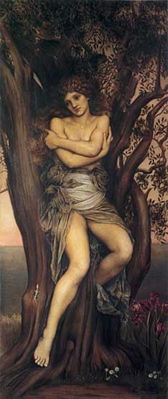
    A German woodcut of a family tree, the Yggdrasil, and The Dryad by Evelyn De Morgan

  • Dryads, tree nymphs (or wood nymphs) from Greek mythology. They are among the magical creatures to be found in the Chronicals of Narnia. See also “The Dryad”, a story be Hans Christian Anderson
  • In Greek Mythology, Daphne is turned into a laurel tree while trying to escape the clutches of an amourous Apollo.
  • The Ents, from the Lord of the Rings trilogy by J. R. R. Tolkien. Big tree people.
  • “Shaking the Tree”, an album by Peter Gabriel. Also a song with Youssou N’dour. [YouTube]
  • “barking up the wrong tree” An idiom alluding to a dog chasing a cat up a tree, but mistaking the location of said cat. It means “acting based on some mistaken impression”
  • “can’t see the forest for the trees”An expression to describe when someone is too caught up in the details to understand the larger context.
  • Then there’s the playground chant:

    X & Y sitting in a tree
    K-I-S-S-I-N-G

  • how to talk like a pirate

    jolly_roger.jpgWell, it’s finally arrrived. Today, September 19th, is Talk Like a Pirate Day. You’ve gotten yourself a pirate name, and brushed up on your pirate job skills. But are you still unclear on how best to talk like a pirate? Have no fearrrr.

    There arrre many avenues to explore in learrrning how to talk like a pirate. An important resource is the “how to” page of the official Talk Like a Pirate Day website. There you can learrrn the basics (the 5 “A”s), more advanced pirate terminology (don’t confuse your hornpipe with your bunghole), and even advance all the way up to pick-up lines like this one:

    How’d you like to scrape the barnacles off of me rudder?

    In case you don’t have time for such intensive language study, you may find one of several translators handy, like this one or this other one. This one acts as more of a phrase book, and allows you to produce such eloquent discourses as this:

    Ahoy, me proud beauty! Be that th’ market? I’ve a fierce fire in m belly t’ have a bit of a lie-down’

    Of course, it’s also important to work on your arrr, long considered to be one of the hallmarrrks of pirate speech. (If you’d like to learn the history of this phenomenon, The Language Log discussed this a couple of yearrrs ago.)

    Here’s what you do to say “arr”:

    1. Step one: Say “ah”. (Your vowel may vary by dialect; [ɒ], [a] and [ɑ] are probably all legitimate.) You’ll probably want to put in a glottal stop at the start [ʔ].
    2. Step two: Quickly lower your third formant to produce the [ɹ] sound. This can be accomplished by curling the tongue back (retroflex “r”) or by bunching your tongue up (bunched-tongue “r”)

    Now, if you want to say “arrr” like a pirate, the instructions above are just a starting point. To produce the piratical “arrr” tha we’ve come to expect. (Cf. Geoffrey Rush saying “arrr” in Pirates of the Caribbean), you really need to growl it. And for me, at least, this seems to possibly involve some pharyngeal frication, and possibly also some additional voice quality modifications. I’m not sure what I’m doing (not really just creakiness or breathiness), but it sure as hell isn’t modal phonation. A really effective arrr will also be quite loud: push the air strongly through those vocal folds, dammit. On top of all of this, you’ve got to really drag it out, especially the [ɹ] part. (Keep that 3rd formant down.) Arrrrr!!!!!

    In an experimental study, subjects (N=2) produced both “normal” and piratical arrrs. Piratical arrrs were between 2 and 3 times the duration of “normal” arrrrs. See figures 1 and 2, below.

    Figure 1: Arrrr! vs. ar, speaker A (male)
    j_arrrr.jpg

    Figure 2: Arrrr! vs. ar, speaker B (female)
    a_arrrr.jpg

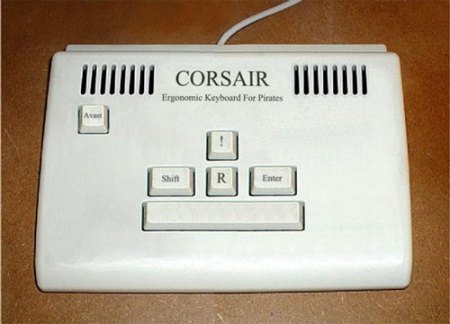
    And in case you don’t have occasion to speak out loud today, you might try some pirate-style typing.
    piratekeyboard1.jpg

    RRRRRRRRRRRRRR!!!!!!!

    pidgin post

    When I was 14 years old, I lived in Hawaii for a few months. My mother was in a relationship with a man who lived in Honolulu, and in December of 1985, she decided we should all move there: my mother, my sister and me. (Perhaps was in part in response to the impending threat of another bitter Colorado winter.)

    While I have moved many times in my life, this move was among the most dramatic.

    My mother’s boyfriend, who we’ll call C, had a condo in Honolulu, right around Waikiki, in the shadow of Diamond Head. It was about as different a setting as you could get from the antique log house we’d been renting in Colorado. (Though that house too was in the shadow of a mountainous landmark, being in Manitou Springs, at the foot of Pike’s Peak.) We arrived there a couple of days before Christmas, leaving the biting cold and blizzards behind us for beaches and balmy weather. There was also much greenery, contrasting vividly with the white and grey we’d flown away from, and there were palm trees around town wrapped in red ribbon to resemble candy canes, an almost surreal reminder that the season had not changed. Aside from the transition in climate and surroundings, we went through a bit of culture shock, too. While Hawaii is a state, the 50th to join the union, back in 1959, it is also a place of multiple cultural heritages. European and mainstream American culture are blended with various Asian and Pacific island cultures, including a strong steak of indigenous Polynesian cultures. This is reflected in many of the customs and traditions practiced by those who call Hawaii home: food, clothing and music, for a start. And also language.

    One of the first people we met in Honolulu was a young neighbor of C’s. I don’t remember how old he was, exactly. Maybe 13 or so. Close to my age, definitely younger than my sister’s advanced 16 years. I’m sad to say that I no longer remember his name (though I could probably unearth it), but I do vividly remember some of the conversations we had with him. He sort of took us under his wing, these 2 clueless haolie girls fresh off the mainland. While he spoke in English, with the local accent, he’d also sometimes demonstrate for us another type of speech. He referred to it as “pigeon.” At one point, I remember him warning us that if we ran into groups of local teens speaking pigeon, we should keep our distance. Such kids were often looking for trouble, our new friend told us.

    It wasn’t till years later, at some point in my formal linguistics education, that I learned that what he’d really been saying was “pidgin,” not “pigeon.” A pidgin is a contact language, meaning a sort of blend of two or more languages, and used to facilitate communication between groups of speakers of different native languages. The pidgin in Hawaii developed from contact between speakers of English and Hawaiian, as well as settlers who were native speakers of Cantonese, Japanese, Portuguese and Filipino languages. The resulting mix sounds, to Mainlander ears, a bit like a foreign language with a few recognizable English words thrown in.

    And what I learned even later was that what is colloquially known as Pidgin in Hawaii is no longer technically a pidgin, but a creole. A creole is also a type of contact language. However, a pidgin is generally an “initial” contact language. That is to say, it develops at an earlier stage in the contact between populations. Sometimes, a pidgin will develop into a creole. What this means is that both the language and the population have achieved the stability of having native speakers of that language. Not all pidgins turn into creoles, but it does seem that all creoles developed out of pidgins. (What is known in Hawaii as Pidgin is more formally known as Hawaiian Creole English, by the way. But that’s just a technical term, really, as far as I’m concerned. Those in the know, the locals, know that this language they speak is Pidgin.)

    Pidgins, creoles and other contact languages are a fascinating and complex area of study in linguistics.¹ Sociolinguists, in particular, have been interested in their development and use in social context. There are many creoles spoken around the world, such as Haitian Creole (kreyòl ayisyen), which is “based” on French, or Cape Verdian Creole (Crioulo caboverdiano), which is “based” on Portuguese. I won’t get into all the details at this point, but I do feel I should make one point, and explain my “scare quotes.” Many people have assumed, when hearing a creole, that speakers are incompetent users of the (usually European) language from which it takes much of its vocabulary. Eg., that Kreyol is just “broken” or simplified, French. However, creoles are far more complex than this, and often the syntax² is based on an unrelated language, such as an African language. So knowing French will not enable you to produce a sentence in Haitian Creole, even though it may enable you to understand much of the vocabulary. This misunderstanding has historically led to discrimination against native speakers of creoles, especially in the area such as education and employment, based on the assumption that the speakers were merely poor speakers of, for example, French.

    So there we have it. My pidgin post. Which is really, as it turns out, mostly about creoles. Sorry about the lack of respectable references. I meant to dig up my sociolinguistics textbook, but it’s managed to get itself buried in the recesses of our home. And seeing as it’s getting late, I should be getting to bed. But those of you who know this stuff better than I do, feel free to jump in and elaborate.

    ———————–
    ¹ Of course, I’m prone to call just about every aspect of language fascinating and complex. But pidgins and creoles are way cool!

    ² Syntax, in case you haven’t been subjected to it, is the backbone of the word order and grammatical rules of a language.

    and they were like, “yeah, whatever, it’s the quotative like”

    So here I was, sitting here with my laptop when I should’ve gone to bed. And having just finished a task of actual work, I continued to poke around on my laptop, looking around what other folks have written. And then (dude!), what catches my eye but a post on the quotative like.

    As you may know, I’m all over the quotative like. So I couldn’t help but to check it out. And what’s more, I learned that there’s even a recent New York Times Magazine column on the topic. And I was like, “Woohoo! Quotative like is hitting the mainstream!”

    The article’s a quick read, and generally fairly accepting of the quotative usage of like. However, I don’t entirely agree with the author’s categorization of the quotative like as a function word:

    O.K., the new like is hot and it’s useful, but is it legit? Aren’t some rules of grammar or usage being broken here?

    Linguists and lexicographers say no. It’s natural, they say, for words to take on new roles. In this case, a “content word” (one that means something) has become a “function word” (one that has a grammatical function but little actual meaning). Academics call the process “grammaticalization.” It’s one of the ways language changes.

    I would tend to categorize the quotative “like” as a content word, not a function word. But it’s a bit tricky. But it does make me ponder the origins of the usage. I wonder if it arose from the hedge-like interjection form of “like.” You know, the one that, like, people toss in that doesn’t, like, add a lot of meaning? I can imagine an origin based on a usage like (such as) “…and then he said, like, ‘no way.'” or “I thought, like, ‘his use of that discourse marker was infelicitous in that context.'” If my hunch is right, then this would be a case of a word becoming more contentful…

    thought I’d share

    Sometimes, I make myself laugh. This is what I just wrote:

    Examples 17 through 22b were coded as “reconstructed dialog.” However, the dialog was obviously constructed rather than reconstructed as the interlocutors are styrofoam packing peanuts:

    17. They’re all “Pauly, don’t you want to try just one of us?”

    One of the questions on my takehome final is a brief study of the usage of the quotative be+all, a close relative of the quotative be+like. We’ve been given a small corpus of 50 examples of this quotative, including some from blogs. Such as this excerpt from this one:

    People who eat pennies are stupid. I mean, it’s obvious what’s going to happen. Your body isn’t going to be able to digest a damn penny, okay? Same goes for shards of glass or thumbtacks or pieces of errant plastic or even little lego pieces. I’m past that. I’ve moved on. Matured. But when it comes to these damn packing peanuts they call out to me like they know what I’m thinking. They’re all “Pauly, don’t you want to try just one of us?”” and I’m all “No thanks Mr. Packing Peanut, I think you’ll just give me a stomach ache” and they’re all “Oh, c’mon — what’s the worst that could happen?” and I’m all “I could get sick” and they’re all “Sicker than when you got food poisoning from Pizza Hut?” and I’m all “How did you know about that?” and they’re all “We’re packing peanuts, Pauly — we know all.”

    Let this be a warning to all of you. Anything you write and publish on the web could turn into data fodder for linguists, or even worse, linguistics students. Bwahahaha.

    Oooh. There’s something I could research: the distribution of spellings of evil laughs on the web. There seems to be a bit of variation in the onset (bwahahaha vs muahahaha vs buahahaha vs mwahahaha) not to mention variability in the number of “ha”s. (We can get from two “ha”s, as in bwahaha, all the way up to…I’m not sure how many. I got as far as googling

    “bwahahahahahahahahahahahahahaha”

    and was amused to get 7180 hits, and this:

    Did you mean: mwahahahahahahahahahahahahahaha

    Hey, remember how I said I like sleep, and should be in pretty good shape to get some tonight? Not if I keep screwing around like this. So I’m all “I totally need to get back to work.”

    collecting tokens

    The word token has many meanings, having synonyms such as symbol, memento, or representative:

      1. I give you this squid as a token of my affection.
      2. I’ll keep these pants forever as a token of my holiday escapades.
      3. I posted this photo of a duck in the dishwasher as a token of the many pictures I’ve taken of random things.

    A token can also be a conventionalized object, such as a metal coin or plastic figure, used in place of money for some transactions or used in some sort of group activity, like a game.

      4. I’m not sure what to do with my old subway tokens now that they’ve started using Charlie Cards.
      5. My old Monopoly game was missing half its tokens.

    In my world, though, the most frequent use of the word token is the meaning used in linguistics. (Interestingly, the about.com page, with all its various links and definitions from those various sources, doesn’t even mention linguistics.) In linguistics, a token is an instance of some form that is being studied, an item of a particular category or class. It is commonly discussed in terms of the type-token distinction, which has its roots in philosophical usage:

    Type (metaphysics)

    A type is a category of being. A human is a type of thing; a cloud is a type of thing (entity); and so on. A particular instance of a type is called a token of that thing; so Socrates was a token of a human being, but is not any longer since he is dead. Likewise, the capital A in this sentence is a token of the first letter of the Latin alphabet.

    According to the Stanford Encyclopedia of Philosophy,

    The distinction between a type and its tokens is an ontological one between a general sort of thing and its particular concrete instances (to put it in an intuitive and preliminary way).

    In linguistics (and in related speech and language research) the term token is used to refer to any single instance of some phenomenon or category that’s under investigation, and type is used for some category of which a token is a member. The type-token distinction is often used when investigating words used in a written text. Imagine, if you will, a short text such as:

    I like the word pants. I actually like saying the word pants. It’s one of those words that begs to be repeated. Pants. For example, in a discourse on pants, I would hypothesize that speakers would be less inclined to use pronouns to refer to pants than, say, other entities in the discourse. Even if the word pants had just been mentioned, I would still say “pants.”

    The text in the block quote above has 63 words. However, it doesn’t have 63 unique words. It has fewer unique words, or word types. I counted 41 unique words, so 41 types. (Mind you, I’m counting things like “say” and “saying” as different words for these purposes, and ignoring punctuation and capitalization.) If we want to look at a particular word type, oh, let’s say maybe the word pants, we can count 7 instances of that word in the text. That’s 7 tokens of pants.

    While token is commonly used for a written instance of a word in a text, it can also be used for a larger or smaller unit of speech or language. It could be a spoken production of a sentence, or a production of a single sound segment, like a consonant or a vowel. It could be a gesture. It all depends on what categories, or types, that you are looking at.

    For example, let’s say I’m studying phonetic characteristics of a vowel in American English, such as [æ], the vowel in words like bad, pat and pants. I would probably want to collect a large number of instances of words spoken aloud that contain that vowel. If I get a recording of someone reading a list of 5 words with [æ], and I have them read that list 3 times, I end up with 15 tokens of [æ] by that speaker. I could also talk about having 15 tokens of words containing [æ], or even 15 tokens of utterances containing [æ]. If I have 4 speakers all reading that same list, 3 times each, I end up with 60 tokens of [æ].

    Here’s an example of the use of the word tokens from a phonetics paper* I grabbed off the web (found by googling “tokens of p”, in case you’re wondering):

    This includes all /k/ and /p/ tokens produced, not only those in potentially fricatable environments.

    (And yes, I do get off on this stuff.)

    The article repeatedly mentions tokens of /p/ and tokens of /k/, and how many tokens of each fit some criteria, or follow some pattern.

    Now let’s say we wanted to study the use of the word tokens in that text. (So in this case, our type is tokens.) Using a basic text search, I counted 28 instances of the word tokens. That means that the text contains 28 tokens of tokens.

    Much of what I do as part of my research, especially for my various jobs, involves collecting, categorizing and otherwise analyzing tokens. I love this part, collecting and working with the data. It’s the thrill of the hunt. Followed by the thrill of the puzzle. Followed by the thrill of the data organization. (What I must learn to love is the thrill of the write…)

    ———————————-

    *Loakes, D. and McDougall, K. (2004) “Frication of /k/ and /p/ in Australian English: Inter – and Intra-Speaker Variation” in Proceedings of the 10th Australian International Conference on Speech Science & Technology, pp 171-176.

    Nimberpoop, R. (1954) “What’s your deal with the word pants? A study in bizarre philological obsessions.” Sense, Nonsense and Polysemy Quarterly, 3, pp. 4-97.

    removing all doubt?

    Tonight in my class we discussed, among other things, an article on the use of silence in Western Apache culture.* In this culture, people often remain silent in circumstances when people from mainstream American culture would be inclined to talk. Such situations include reunions of children returning from boarding schools with their parents, meetings of young couples who are courting, and meetings between strangers.

    It may seem strange to think of people refraining to speak in these cases, but if you think about it, many cultures have a tendency to “fill the void” with idle chit chat. Talk about the the weather, or about near-meaningless nothings:

      A: So how’ve you been?
      B: Oh, fine. You?
      A: Not too bad.
      B: Good, good.
      A: So, um…uh…nice weather we’re having.
      B: Uh…yup. It’s warm out.
      A: Warmer than expected.
      B: Blah, blah, blah, blah, warm.
      A: Blah, blah, blah pants.
      B: Blah blah minotaur.

    I couldn’t help but remember, or half remember, this saying:

      “It is better to remain silent and be thought a fool than to speak and remove all doubt.”

    Problem was, I couldn’t entirely remember the wording of it, or who said it. Apparently there’s a reason for this:

    Searches on “better to keep your mouth closed” and “better to remain silent” (using the quotation marks in both cases) turned up numerous web pages, all offering different versions of the phrase. Some sources quoted the saying as “It’s far better…”, some substituted the words “stupid,” “ignorant,” or “simpleton” for the word “fool,” and still others twisted the saying into an almost unrecognizable form.

    A page titled Mark Twain and the Mutating Quote attributed at least four variations of the same phrase to the eminently quotable Twain, explaining that it was a case of “split personality” that accounted for the variations, rather than a rash of misquotes.

    Other pages suggested a number of other authors for the saying, including: Abraham Lincoln, George Eliot, Groucho Marx, Albert Einstein, and a mysterious figure named Silvan Engel.

    Googling even came up with attributions to Confucius. Plus I’ve found stuff ending in “leave no doubt,” and even more variations.

    So, to quote the wise/illustrious/immortal/venerable/witty and/or possibly fictitious Confucius/Twain/Lincoln/Eliot/
    Marx/Einstein/Engel:

      “It’s (far)? better to ((remain|keep|stay) (silent|quiet)|(keep your mouth shut)) and be (thought|considered) a (fool|idiot|total dork) than to (speak|open your mouth|blather on) and (remove all|leave no room for) doubt.”

    Ah, right. I’ll shut up now.

    ———————-
    *Basso, K.H. 1972. “To give up on words: Silence in Apache culture.” In P.P. Giglioli, Ed. Language and Social Context. pp. 67-86.

    high school movies and clique taxonomies

    It’s no wonder I’ve been having traumatic high school flashbacks. In my class on Monday, there was an extended discussion of terms used to categorize cliques (and outcasts) at the various schools that people had attended. (Keep in mind, for most of the students in the class I’m taking, high school was fairly recent history.) This was all relating to our assigned reading, primarily a text by Penelope Eckert about an ethnographic study she’d done in an American high school. The Eckert text (the same one that had a sentence that made me laugh out loud) discusses the terms Jocks and Burnouts, terms used by the teenagers in the Detroit area suburban high school she studied.

    So the kids (yes, I’m freakin’ old) in the class were all relating the terms used in their schools. “We had jocks and greasers” or “we had preppies and townies”. Terms like “skaters” and “band kids” were bandied about. To be honest, I don’t remember all of what they said. I was too busy feeling old and having flashbacks to various movies that make reference to clique structure and terminology. Which is basically every American high school movie ever made.

    But lets go over some examples, with the terminology:

    1. The Breakfast Club (1985)
      This movie featured 5 students of differing categories: Jock, Princess, Criminal, Basket Case and Brain.
    2. Ferris Bueller’s Day Off (1986)
      This quote about sums it up:

      Grace: Oh, he’s very popular Ed. The sportos, the motorheads, geeks, sluts, bloods, waistoids, dweebies, dickheads – they all adore him. They think he’s a righteous dude.

    3. Heathers (1989)
      This movie has the exclusivity (and cruelty) of the popular clique taken to the extreme, with the 4 members (3 of whom are named Heather) called “The Heathers”.
    4. Clueless (1995)
      I don’t remember what terms this movie used explicitly, but I found this reference to the clique structure:

      On paper, Clueless would sound like just about any other high school comedy. It’s got the popular girls and the jocks, the dreamboats and the bitches, the stoners and the slackers.

    5. 10 Things I Hate About You (1999)
      One character gives a tour to another, a new kid at the high school, and explains the who’s-who of cliques:

      Over there you’ve got your basic beautiful people. Now listen. Unless they talk to you first, don’t bother.

      This movie went for somewhat exaggerated cliques, with Audio-video Geeks, Coffee People, White Rastas, Urban Cowboys and Future MBAs.

    That’s all I got for now. I’ll have to do more research into this issue at some point. (Translation: I’ll watch some high school movies.) I am on the lookout for new references on this subject matter. If anyone has any clique terminology to add, whether based on your own ethnographic studies, knowledge of the literature, or familiarity with bitchin’ high school movies, please let me know.