throwing some tomatoes

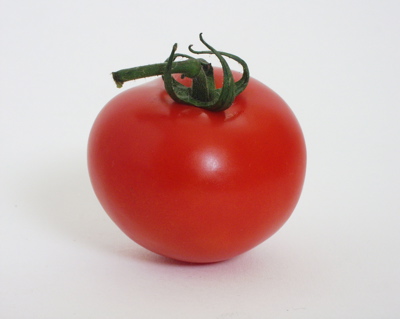
tomato_pd.jpgIt shouldn’t come as much surprise that I have tomatoes on the brain. After getting 10 pounds of tomatoes from the CSA this week, on top of the several pounds I left from last week’s 10 pound haul, I have tomatoes in lots of places. I’ve been making lots of things with tomatoes: tomato salad with mozzarella and basil, tomato sandwiches, roasted tomatoes with garlic…It seems only fitting that I should also make me a tomato list. So, this week’s Themed Things Thursday is all about tomatoes.

  1. Fried Green Tomatoes at the Whistle Stop Cafe, by Fannie Flagg. A novel featuring a restaurant that serves fried green tomatoes. (I expect they served other things, too. But the title doesn’t include the full menu.)
  2. Fried Green Tomatoes (1991) A movie based on the Fannie Flagg novel.
  3. The Tomato Collection. An album by Nina Simone. It actually seems to have nothing to do with tomatoes beyond the title, but I love Nina.
  4. The campfire song “Lord Jim”

    I know an old bloke and his name is Lord Jim,
    And he had a wife who threw tomatoes at him,
    Now tomatoes are juicy, don’t injure the skin,
    But these ones they did, they was inside a tin.

  5. Let’s call the whole thing off.” The song written by George and Ira Gershwin. Sometimes known as “the tomato song,” due to this bit:

    You like potato and I like potahto,
    You like tomato and I like tomahto;
    Potato, potahto, tomato, tomahto!
    Let’s call the whole thing off!

    Tomato, tomahto…or, as the Wikipedia tomato entry has, with somewhat dubious IPA:¹

    You like /təˈmeɪtoʊ/ and I like /təˈmɑːtəʊ/

  6. Don’t like tomatoes? Perhaps this website is for you: tomatoes are evil. You can purchase anti-tomato propaganda and play anti-tomato games.
  7. Attack of the Killer Tomatoes! (1978). The cult classic movie. A comedy sci-fi horror thriller romance. Oh, wait. Probably not the romance. Spawned (or sowed?) several tomatobased sequels, including one called Killer Tomatoes Eat France!² The second movie, or the first sequel, starred, of all people, George Clooney.
  8. Attack of the Killer Tomatoes. (1990) A short-lived cartoon TV show featuring the voice of John Astin. (John Astin was also in all 3 movie sequels.)
  9. I think the best way to end this list is to give you this: the theme song to Attack of the Killer Tomatoes!

——————————————————–

¹ I’d be inclined to use square bracket here, rather than slanty ones, for a start, as the slanty ones suggest a phonemic (rather than narrow phonetic) transcription., and the 2 variants of /o/ (əʊ and oʊ) are not phonemic. At the same time, the onset of that last syllabe is transcribed with a t, which seems unlikely in American English. I’d go for a flap. And I produce strong aspiration on the first /t/.
You know, you say /təˈmeɪtoʊ/, I say [tʰəˈmeɪɾəʊ].

²By the way, that exclamation point is part of the title. As someone who rations out my exclamation points, I feel compelled to insert this disclaimer.

have you read the manual?

New technology is often met with resistance and some confusion. Happily, there are usually people available to provide technical assistance. Apparently such help has been around a lot longer than I’d realized:

Lifted off the dusty shelves of the raincoaster library.

the week catches up with me

I am feeling totally zonked. Wiped out. I had a good day at work today, but it was a long, long day. Yesterday was a long day, full of running around to appointments. Sunday was a fun day, but a long day. And Saturday was a long day, and really no fun at all. I’m feeling the stress of the past week catching up with me this evening.

Last Tuesday night we heard the news that a good friend of John’s was…and it seems hard to even write this…hit by a truck. He’s alive, but in critical condition. It seems his car broke down on the highway last Monday night, and he was hit by a tractor-trailer while standing outside his car. The full details aren’t known, as he hasn’t been conscious since then.

We’ve been thinking about him and his family a lot this past week, and eagerly awaiting updates. There’s been some improvement. But there are still many unknowns about how things will turn out.

To make it all more stressful, his wife is 8 months pregnant. I can hardly imagine what she is going through, to have her life turned upside-down like this while being hugely pregnant and getting ready for a new baby. They also have a 4-year-old. At least she has family close by. I feel like I should help, but they are 2 hours away, and I’m not sure how I could help. I will try to think of a way to help, especially once the baby is born. But tonight I just feel stretched so thin.

We drove down to the hospital Saturday, with Phoebe. John and another close friend were able to see their friend, though officially only immediate family members were allowed into the ICU.

This is the sort of thing that makes you think. I’ve been looking at those big tractor-trailers on the highway, and I find their size to be so threateningly large, their mass to be so very unequivocally solid. I’ve been thinking about how fragile we are, in our little breakable bodies.

And I’ve been thinking about how we need to make plans and provisions for Phoebe, that we still haven’t dealt with. A will. Life insurance. We need to talk about things that are not easy to talk about. Make provisions for things we’d rather not think about.

It’s one of those times when I feel like I can’t possibly be old enough to be a responsible adult.

magical mystery fruit

Roll out for the mystery fruit. Step right this way.

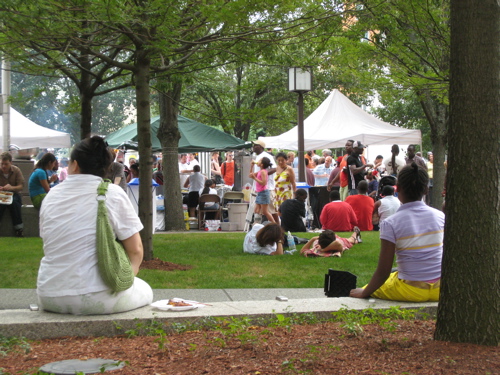
Yesterday, John, Phoebe and I took the train into town to attend the Cambridge Carnival International, a primarily Caribbean street festival in Cambridge, Massachusetts.

cambridge_carnival.jpg

We got there a bit on the early side, so things were pretty tame when we arrived. Things got quite a bit more crowded as the afternoon progressed, though. There were lots of international food vendors there, which was exciting. (The vegetarian options were somewhat limited though. We ended up getting some so-so Indian food that had probably been cooked the day before.) We mostly spent the time at the festival wandering back and forth, taking some pictures, listening to the music, and looking at people. There were lots of non-food vendors, too, mostly in stalls. I went wild and got a tattoo. Well, I went very moderately wild and got a temporary tatoo. (Anyone want to guess what image I chose?)

At some point, we wandered past a woman selling mangos and some other kind of fruit, sitting on a chair in the road median with a stack of boxes. There was a little ring of people around her, buying this green fruit. I couldn’t identify the fruit as we walked past. Later, I noticed people walking around eating this fruit, and saw some green rinds on the ground (scattered among the bits of sugar cane that people had gnawed on). Towards the end of our festivating, I walked past this fruit woman again. There was no crowd this time. I watched her crack one of the green fruits open in her fingers, and pop the fleshy fruit insides of it into her mouth. She then rolled it around in her mouth a bit. I was intrigued.

“How much are they?” I asked, avoiding trying to name them. I didn’t ask their name. In part to seem as if I knew what I was doing, in part to keep the mystery. I bought a baggie of them for 3 dollars.

I’ve eaten a couple of them, still without knowing what they are. They are sweet with a slight bitterness to them, that reminds me a bit of underripe bananas, and which left my tongue feeling slightly furry and numb. The fruit is almost all pit, explaining why the woman rolled it in her mouth. It seems you sort of suck on the pit, and chew the fruit off. They are about the size of a walnut, with a rind that comes off easily, and that resembles a lime peel.

mystery_fruit.jpg
These are photos of some fruit I bought yesterday. I have no idea what it is. It is definitely tropical. Probably Caribbean. Can anyone name that fruit?

In related news, today was farm day for me once more. Meaning I headed back to the farm for my week’s CSA share. Like last week, the share included 10 pounds of tomatoes. I have been working on last week’s tomato haul, but still have quite a few left. (By the way, my photo of last week was of only a portion of the tomatoes.)

Here are my remaining tomatoes of last week, probably about 4 pounds. (Note: the small person standing in the photo is not a tomato.):

tomatoes_and_phoebe.jpg

Below is this week’s full 10 pounds. (Not including last weeks remnants.) They include a lot more yellow and orange varieties. (Notice the large, orange brain-shaped one on the right?)

10lbs_tomatoes.jpg

I also got some husk tomatoes, which were an exciting discovery for me. They were pick-your-own, and I opted out of them last week due to Phoebe’s mood. But I went solo today, and decided to pick-my-own. We could gather a pint total of cherry tomatoes and husk tomatoes. The farm apprentice gave me the low down on the picking before I headed to the fields, including the details the husk tomatoes are ripe when the husks are brown, and the ones that have already fallen on the ground are often the best.

I decided to try the husk tomatoes first, as I was curious. (I’m always game to try a new fruit or veggie.) I tasted the first one I found, and wow! Them’s good eatin’! I decided to gather my whole pint of husk tomatoes. These are tiny little things, though they seem to grow in other sizes, too. Each is the size of a large blueberry, and is wrapped in a little balloon of husk. They taste very sweet, more like a berry or a currant than a tomato. (Tomatoes are berries, after all.) These may also be the same fruit that is known as a ground cherry, and are akin to tomatillos.

husk_tomatoes.jpg

These are the husk tomatoes I picked. I put in an averaged sized regular red tomato for scale. (Note that the plate in this photo is a smaller plate than the ones used in the big tomato photos above.)

pidgin post

When I was 14 years old, I lived in Hawaii for a few months. My mother was in a relationship with a man who lived in Honolulu, and in December of 1985, she decided we should all move there: my mother, my sister and me. (Perhaps was in part in response to the impending threat of another bitter Colorado winter.)

While I have moved many times in my life, this move was among the most dramatic.

My mother’s boyfriend, who we’ll call C, had a condo in Honolulu, right around Waikiki, in the shadow of Diamond Head. It was about as different a setting as you could get from the antique log house we’d been renting in Colorado. (Though that house too was in the shadow of a mountainous landmark, being in Manitou Springs, at the foot of Pike’s Peak.) We arrived there a couple of days before Christmas, leaving the biting cold and blizzards behind us for beaches and balmy weather. There was also much greenery, contrasting vividly with the white and grey we’d flown away from, and there were palm trees around town wrapped in red ribbon to resemble candy canes, an almost surreal reminder that the season had not changed. Aside from the transition in climate and surroundings, we went through a bit of culture shock, too. While Hawaii is a state, the 50th to join the union, back in 1959, it is also a place of multiple cultural heritages. European and mainstream American culture are blended with various Asian and Pacific island cultures, including a strong steak of indigenous Polynesian cultures. This is reflected in many of the customs and traditions practiced by those who call Hawaii home: food, clothing and music, for a start. And also language.

One of the first people we met in Honolulu was a young neighbor of C’s. I don’t remember how old he was, exactly. Maybe 13 or so. Close to my age, definitely younger than my sister’s advanced 16 years. I’m sad to say that I no longer remember his name (though I could probably unearth it), but I do vividly remember some of the conversations we had with him. He sort of took us under his wing, these 2 clueless haolie girls fresh off the mainland. While he spoke in English, with the local accent, he’d also sometimes demonstrate for us another type of speech. He referred to it as “pigeon.” At one point, I remember him warning us that if we ran into groups of local teens speaking pigeon, we should keep our distance. Such kids were often looking for trouble, our new friend told us.

It wasn’t till years later, at some point in my formal linguistics education, that I learned that what he’d really been saying was “pidgin,” not “pigeon.” A pidgin is a contact language, meaning a sort of blend of two or more languages, and used to facilitate communication between groups of speakers of different native languages. The pidgin in Hawaii developed from contact between speakers of English and Hawaiian, as well as settlers who were native speakers of Cantonese, Japanese, Portuguese and Filipino languages. The resulting mix sounds, to Mainlander ears, a bit like a foreign language with a few recognizable English words thrown in.

And what I learned even later was that what is colloquially known as Pidgin in Hawaii is no longer technically a pidgin, but a creole. A creole is also a type of contact language. However, a pidgin is generally an “initial” contact language. That is to say, it develops at an earlier stage in the contact between populations. Sometimes, a pidgin will develop into a creole. What this means is that both the language and the population have achieved the stability of having native speakers of that language. Not all pidgins turn into creoles, but it does seem that all creoles developed out of pidgins. (What is known in Hawaii as Pidgin is more formally known as Hawaiian Creole English, by the way. But that’s just a technical term, really, as far as I’m concerned. Those in the know, the locals, know that this language they speak is Pidgin.)

Pidgins, creoles and other contact languages are a fascinating and complex area of study in linguistics.¹ Sociolinguists, in particular, have been interested in their development and use in social context. There are many creoles spoken around the world, such as Haitian Creole (kreyòl ayisyen), which is “based” on French, or Cape Verdian Creole (Crioulo caboverdiano), which is “based” on Portuguese. I won’t get into all the details at this point, but I do feel I should make one point, and explain my “scare quotes.” Many people have assumed, when hearing a creole, that speakers are incompetent users of the (usually European) language from which it takes much of its vocabulary. Eg., that Kreyol is just “broken” or simplified, French. However, creoles are far more complex than this, and often the syntax² is based on an unrelated language, such as an African language. So knowing French will not enable you to produce a sentence in Haitian Creole, even though it may enable you to understand much of the vocabulary. This misunderstanding has historically led to discrimination against native speakers of creoles, especially in the area such as education and employment, based on the assumption that the speakers were merely poor speakers of, for example, French.

So there we have it. My pidgin post. Which is really, as it turns out, mostly about creoles. Sorry about the lack of respectable references. I meant to dig up my sociolinguistics textbook, but it’s managed to get itself buried in the recesses of our home. And seeing as it’s getting late, I should be getting to bed. But those of you who know this stuff better than I do, feel free to jump in and elaborate.

———————–
¹ Of course, I’m prone to call just about every aspect of language fascinating and complex. But pidgins and creoles are way cool!

² Syntax, in case you haven’t been subjected to it, is the backbone of the word order and grammatical rules of a language.

pigeon post

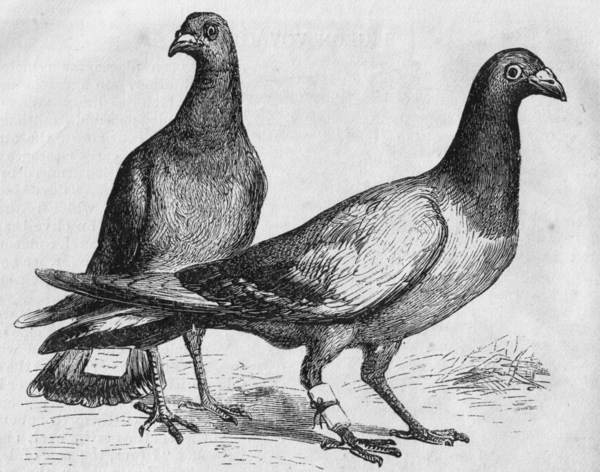
On our recent trip, we saw many exciting things in France and Germany: monuments, museums, landscapes, rivers, you name it. For Phoebe, however, the highlight of the trip was getting to see so many pigeons. She saw pigeons all over the place! (See her chase a pigeon in the short, short movie I posted earlier this week.)

Loved by some, hated by many, pigeons are a ubiquitous in cities the world all over. Some folks have been known to call them “rats with wings,” while others happily share their breadcrumbs with them. After its trip away, Themed Things Thursday flies home this week with a list of pigeons.

  • Don’t Let the Pigeon Drive the Bus, by Mo Willems. A picturebook about a mischievous pigeon who would like to drive a bus. (There’s a sequel, too, The Pigeon Finds a Hot Dog, in which the pigeon, and I hope I’m not giving too much away here, finds a hot dog.)
  • Wringer, by Jerry Spinelli. This Newbury Honor book is about a forbidden boy-pigeon friendship in a town that hosts an annual pigeon shoot.
  • pigeon_messengers_engraving.jpg

  • Ewan McGregor’s character in Little Voice (1998) kept pigeons as pets.
  • Valiant (2005) was a movie about a heroic World War II homing pigeon (voiced by Ewan McGregor…am I sensing a pattern here?).
  • Poisoning Pigeons in the Park, by Tom Lehrer. A song:

    When they see us coming,
    the birdies all try and hide
    but they still go for peanuts
    when coated with cyanide

  • Rapper Pigeon John is not really a pigeon, at least as far as I know.
  • Some may remember Sesame Street’s Bert dancing a pigeon-like dance to “doin’ the pigeon,” a clip of which is available on YouTube. (You can also see actual pigeons dancing, if you want to compare.)
  • There was an 80’s kids’ TV show called Pigeon Street. (The intro is also up on YouTube.)
  • dove.jpg

  • In spite of their bad reputation as a species, certain pigeons have received an especially elevated status for birds. Namely, bird of peace. In this context, the pigeon is referred to as a dove. A dove being a white pigeon.
  • Doves are featured in various myths and religious tales, such as the well-known story of Noah’s Ark. Land was found with the help of a dove, who flew back to the ark with an olive branch.
  • There is also a flock of pigeon-oriented idioms and terms such as:
    pigeon hole, stool pigeon, pigeon-toed, pigeon-chested, setting the cat among the pigeons, and pigeon blood ruby.
  • Brian Pigeon: There is even a blog out there written by a London pigeon. Check it out for a pigeon’s eye view of the world.

pigeons_row.jpg
Pigeons at Beaubourg.

photos from the Völklingen Ironworks

As you may know, I just got back from a 2 week trip to Europe, involving a week in Saarbrücken, Germany and a week in Paris (the one in France). On Wednesday two weeks ago we made a trip from Saarbrücken over to the town of Völklingen to visit the legendary ironworks there. The conference I was attending had a half day, giving me a bit of an opportunity for some site-seeing. John, Phoebe and I took the train over in the afternoon, leaving a bit later than we’d planned. The trains left twice an hour, making it a pretty stress-free trip, though. And then the actual train ride was only about 10 minutes, and then the ironworks was only about 5 minutes on foot from the Völklingen train station.

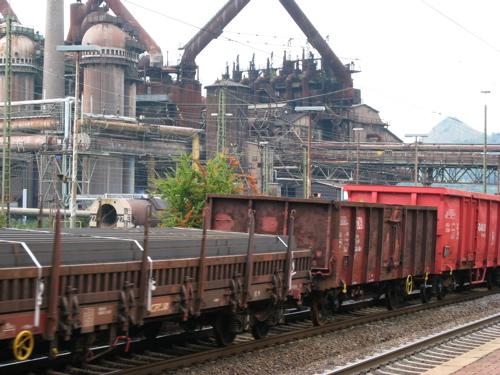
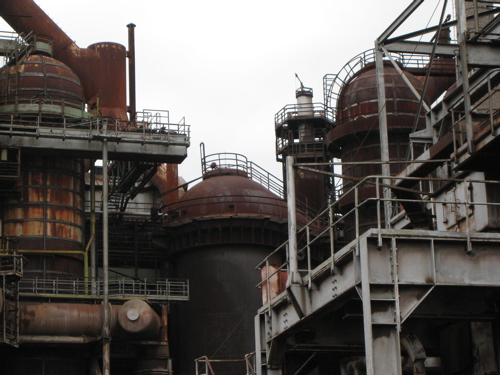
The Völklinger Hütte, or the Völklingen Ironworks, is an enormous relic of the boom of the industrial age. First built in 1873, and with many additions over the following decades, it was last operational in 1986. It was named a UNESCO World Cultural Heritage site in 1994, and was opened to the public in 2000.

With the listing of the Völklinger Hütte as the first industrial monument on the UNESCO World Cultural Heritage sites list a new phase begins in the history of the ironworks. It is the only surviving ironworks in the world from the heyday of iron and steel production and a unique testimony to an industrial epoch of the past.

It is really hard to grasp the enormity of the ironworks. It spreads over 100 acres, and the parts of the monument that are open to the public now contain over 5 kilometers of paths and walkways for visitors to explore.

The ironworks looms on the horizon like a surrealist matte painting from a science fiction movie, its dark, hulking presence and complex shape seeming improbable. With its domed towers and elaborate tangles of pipes and tubes, it has a nearly organic look. Up close, it becomes even more awe-inspiring. Now out of service for 2 decades, the domes and towers and tubes are all covered with a patina of rust, layers of paint from decades past peeling away, plants and even trees growing in crevices and on high platforms. I found myself awed by not only by the size and scope of the place, but also by its unexpected beauty. I was startled to find myself describing a place so forboding and monstrously large as beautiful.

Everywhere we looked was something interesting to see. The colors, the textures, the lines. The oversized machinery, enormous gears and tracks. The dangling chains, and exposed wiring. We spent a couple of hours there, but could have stayed many more. We only walked the lower paths and walkways, not having time to climb to the towers and high paths before the monument closed.

I’ve put together a selection of some photos I took on our visit, and I’ve posted a slideshow. Here’s a bit of a sampling of some of the photos:

img_0273.jpg  img_0334.jpg
img_0472.jpg  img_0474.jpg

We had some good food in Völklingen, too, by the way. There is a restaurant called Platform 11 3/4 in the old train station building, which is right next to the current train station building. The building was very cool, and they seem to have some sort of theater in it. (Possibly for puppet shows?) The staff was very friendly, and our waitress helped us navigate the menu for things we could eat. (They actually had vegetarian options marked out as “rabbit food,” or the German equivalent, which was handy.) The food was creative, and more importantly, quite good. I had vegetable ravioli served on a bed of lentils in a creamy basil sauce. John had some other pasta dish, which I’ve already forgotten the details of. We shared a salad with mixed field greens, cherries, nuts and warm goat cheese streudel.

We also had some good salads for lunch at a little ma & pa seafood restaurant we passed while straying into the town in search of food. The salads, which caught our eye in as we passed the restaurant’s glassed-in counter, had a nice selection of raw veggies, plus some potato salad (Kartoffelsalat!) and a bit of hard-boiled egg. The whole thing was topped with a light yogurt dressing. One of the vegetables was one that I wasn’t able to identify: it was a shredded, or thinly julienned, crispy white vegetable. I wondered if it might have been some sort of large radish or maybe turnip. It was definitely neither celeriac nor kohlrabi. The texture reminded me a bit of jicama. There were also some other sliced crunchy bits that reminded me a lot of bok choi, which I didn’t expect to find in a German salad.

Here’s a picture of my Salat:

salat.jpg

the finger and 10 pounds of tomatoes

Vacation‘s over, and I’m back to the grind. Which in my case involves the violin and vegetables.

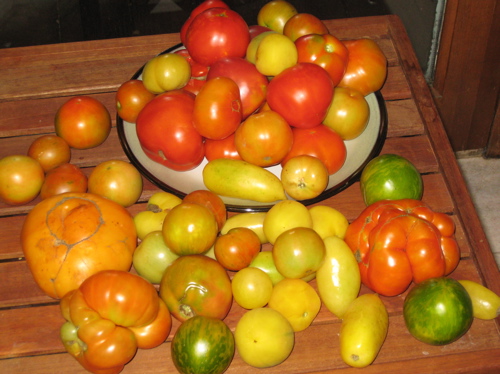
My CSA haul of this week featured 10 pounds of tomatoes. 10 freakin’ pounds. I’ve never had that many tomatoes before. There are quite a range of types, including some heirloom varieties, and I took a photo to document their pretty tomato-ness. (I didn’t arrange my tomatoes as artfully as jenny’s WTVG display, though.)

tomotoes.jpg

The most creative I have gotten with the tomatoes so far is to slice up a bunch of the little yellow ones on a plate, and pour some bottled salad dressing over them. (It was decent salad dressing, at least. Some sesame and lime stuff.) I even ate a tomato whole and plain, like an apple, while still at the farm. I’d forgotten to bring along a snack for Phoebe for the trip down to pick up the veggies, and her temper indicated hunger. I hoped we could snack on a nice fresh tomato, but while she was willing to taste it, she was not willing to ingest more than a bite. So I ate the whole tomato myself, sitting in the car, with a cranky toddler on my lap. So perhaps that was a more creative tomato experience than the slices on a plate.

The violin lesson yesterday was a mixed bag, too. I had not actually even opened my violin case since the previous lesson, 3 weeks before. Considering this, I played not too horribly. The first song came through moderately well. The second, on the other hand, led to a discussion of how my hand position needs adjusting and how I tend to overshoot the fourth finger position. I’m convinced that at least part of the problem is the way my little finger bends. I can’t move my damn pinkies smoothly. They sort of jerk and pop, and my muscle control is poor. I feel like I need to develop a workout routine for my pinky to build up its strength and dexterity. (I’m envisioning something set to the Rocky theme song.)

Phoebe’s park adventure

Phoebe had a grand time on her big trip to Europe. She particularly enjoyed those times when she got to stretch her legs and walk around, which didn’t happen often enough for her. I’ve put together a short movie (less than 2 minutes) of one of Phoebe’s Paris park romps, using some footage taken by my mother.