used

Last night I signed up for YouTube, and posted a video there for the first time ever. (Can you blame me?) When I went to sign up, and selected my user name, I got a message saying that the user name was already taken. My first thought was that I must have already signed up for YouTube, and just forgotten about it. So I tried my various passwords. No go. So maybe I used a different password that I’ve forgotten about. So I hit the button for “forgot password,” and got the message that an email with my password would be sent to my email address. So I waited. For my email. No email. NO EMAIL!

Do you realize what this means? Somebody out there signed up for a YouTube account with my name. MY NAME! Mine! For the first time ever, and I mean ever, I was faced with having to make a second choice. It was a bit of a shock. I ended up choosing alejna99. In part because I’m amused by the idea of having 99 alejnas signing up before me.

something beautiful

Phoebe took her first steps today. (Not counting a few inadvertent ones she’d taken over the past few weeks.) I caught a bit of her first toddling on camera. I’m happy to be able to share this beautiful Phoebe moment.

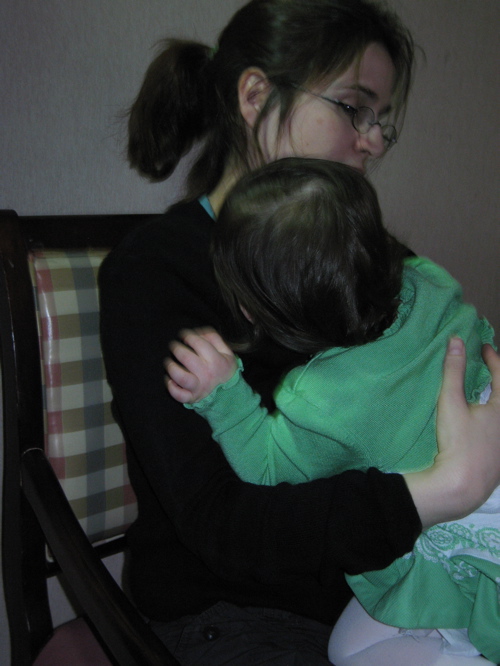
Phoebe’s a very good sleeper, and rarely wakes up in the night. But she woke up tonight a few hours after going to bed, just a little whle ago. I was actually glad. It was so wonderful to have the opportunity to hold her, comfort her, cuddle with her. I needed some comforting, too. It was hard for me to tear myself away from her, to let her go back to sleep…

teething bites

I repeat, teething bites. I know, I know. I’m far from the first one to realize this. But we just had a bit of a rough day. Phoebe has been working on 3 molars. At the same time. Plus she’s getting over an ear infection. The result: she was clingy today. Needy. And often cranky. Demanding to be picked up. Demanding to be put down. Then picked up. Often just to cry loudly in my ears. Long day. John and Phoebe did, thankfully, spend a good chunk of time together today. She seems a bit less needy with just him. But if I’m around, I must be holding her. Or entertaining her. Or both.

Anyhow, the day finally headed to a close. She was in a good mood for her bath. Which was great. But then, when I got her out of the tub and had her bundled in a towel, she bit me. Hard. On the arm. Left a mark. I’d like to think she didn’t realize it was me that she was biting, as I was wearing sleeves. But. I’ve realized how menacing those little sharp teeth can be.

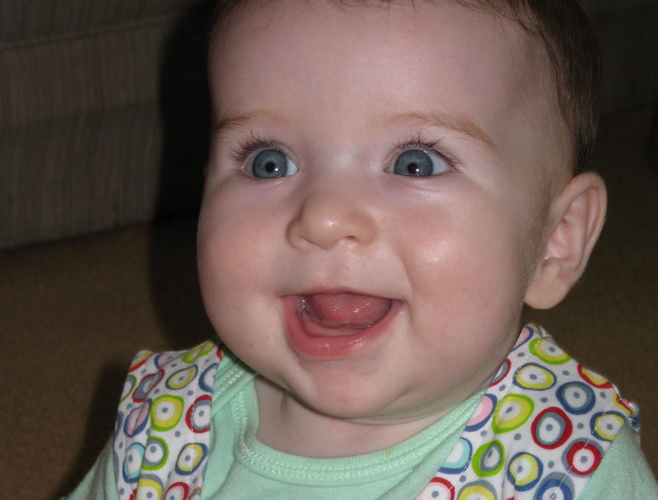
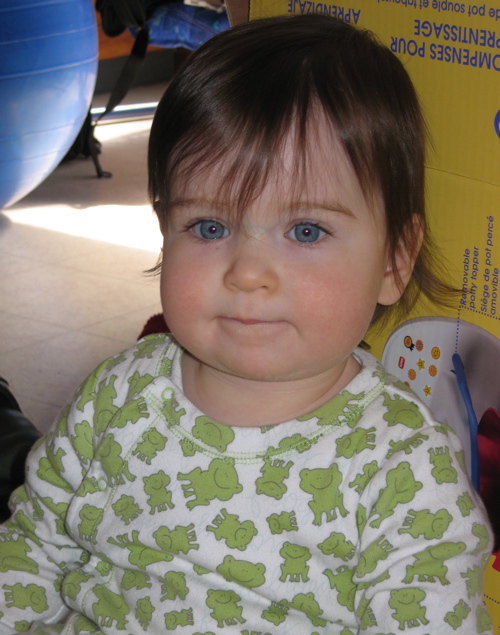
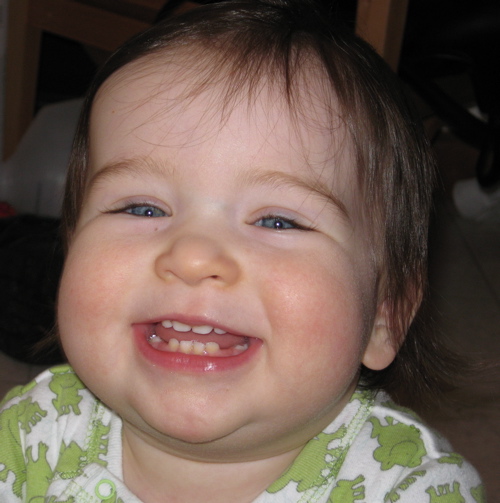
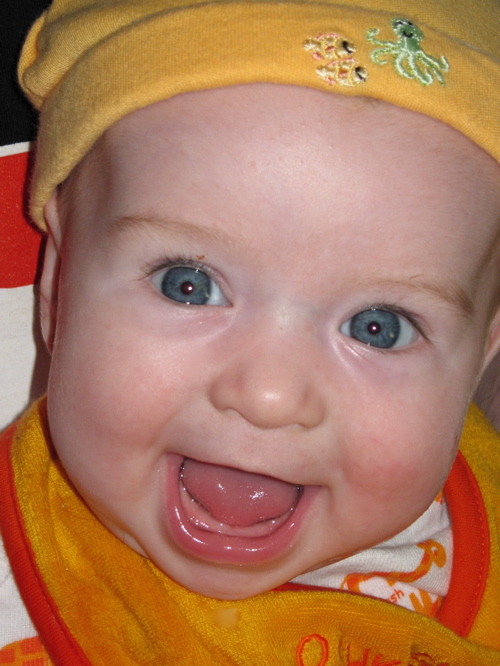
It makes me fondly remember the days of those big beautifully toothless grins. So very toothless.

img_1169.jpgimg_1696.jpgimg_1716.jpg

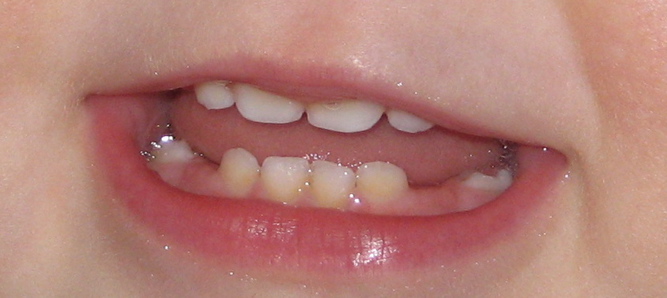
But now, she’s got teeth. Lots of sharp teeth. When the mouth is closed, she looks so docile. But then…

img_4641.jpg img_4644.jpg
I mean, just look at them!

img_4644_2.jpg

What next? What if she develops a taste for blood?

so blue

Feeling a bit blue, folks? Well I’ve got blue folks for you. A whole list of blue folks. Some serious, some silly. Blue-skinned, blue-furred or just blue in the face. Some people, some people-like creatures. One sort of blob. Plus one god.

A List of Blue Folks

  1. Smurfs. (By the way, I’m actually very disturbed by the Unicef Smurf commercial. Which is I guess the message they were going for.)

    smurf.jpggrouchy.jpg-ette.jpg

  2. Sesame Street offers Cookie Monster and Grover.
  3. tv_sesame_street_cookie_monster_interested.jpggrover.jpgbloo.png

  4. Then there’s the more contemporary Bloo from the cartoon Foster’s Home for Imaginary Friends.
  5. Blue Man Group. A group of men who are blue. Well, who paint themselves blue to perform some sort of performance. In the show Arrested Development, the character Tobias, a blue man who has aspirations to be a Blue Man, spends several episodes painted blue.
  6. bmg12_tn.jpgthe_tick.jpg

  7. The Tick. Mighty blue justice. A big blue superhero from the animated and live action TV shows.
  8. Various X-Men characters. The movies add one new blue mutant with each sequel. The first had Mystique, the second added Nightcrawler, and the third added Beast.

    m.jpgn.jpgb.jpg

  9. The Wee Free Men and other books by Terry Pratchett featuring the Nac Mac Feegle. Little blue people based loosely on the Picts of Scotland, who would paint their skin blue before battle. (See also Braveheart, which depicted blue face-painting that may or may not have been historically appropriate.)
  10. The Blue Fugates. An Appalachian family prone to methemoglobinemia, a medical condition causing the appearance of a bluish tinge to the skin. You can read more about them and other historical and mythical blue figures, like
  11. Blue Moovians. Ancient blue humanoids. Who knew?
  12. The Tuareg, a Berber ethnic group. Not actually blue, but

    The Tuareg are sometimes called the “Blue People” because the indigo pigment in the cloth of their traditional robes and turbans stained the wearer’s skin dark blue.

  13. The Hindu deity Krishna.* You can also learn more about why Krishna is colored blue.
  14. krishna.jpg

*(Note: I hesitated to include Krishna in my list, even though he is so very blue, seeing as he is an actual god and all. I don’t want to be disrespectful. However, upon remembering that he is often depicted as a playful god, I hope that his inclusion in my playful list will not offend. (cf. This line from a story in Shri Shyam Katha: “Then the playful Lord Krishna said. ‘First you promise me and then I will ask for a boon'” (Note: I must share that the preceding quotation made me giggle, as my most recent encounter of the word boon was about something else.)))

collecting tokens

The word token has many meanings, having synonyms such as symbol, memento, or representative:

    1. I give you this squid as a token of my affection.
    2. I’ll keep these pants forever as a token of my holiday escapades.
    3. I posted this photo of a duck in the dishwasher as a token of the many pictures I’ve taken of random things.

A token can also be a conventionalized object, such as a metal coin or plastic figure, used in place of money for some transactions or used in some sort of group activity, like a game.

    4. I’m not sure what to do with my old subway tokens now that they’ve started using Charlie Cards.
    5. My old Monopoly game was missing half its tokens.

In my world, though, the most frequent use of the word token is the meaning used in linguistics. (Interestingly, the about.com page, with all its various links and definitions from those various sources, doesn’t even mention linguistics.) In linguistics, a token is an instance of some form that is being studied, an item of a particular category or class. It is commonly discussed in terms of the type-token distinction, which has its roots in philosophical usage:

Type (metaphysics)

A type is a category of being. A human is a type of thing; a cloud is a type of thing (entity); and so on. A particular instance of a type is called a token of that thing; so Socrates was a token of a human being, but is not any longer since he is dead. Likewise, the capital A in this sentence is a token of the first letter of the Latin alphabet.

According to the Stanford Encyclopedia of Philosophy,

The distinction between a type and its tokens is an ontological one between a general sort of thing and its particular concrete instances (to put it in an intuitive and preliminary way).

In linguistics (and in related speech and language research) the term token is used to refer to any single instance of some phenomenon or category that’s under investigation, and type is used for some category of which a token is a member. The type-token distinction is often used when investigating words used in a written text. Imagine, if you will, a short text such as:

I like the word pants. I actually like saying the word pants. It’s one of those words that begs to be repeated. Pants. For example, in a discourse on pants, I would hypothesize that speakers would be less inclined to use pronouns to refer to pants than, say, other entities in the discourse. Even if the word pants had just been mentioned, I would still say “pants.”

The text in the block quote above has 63 words. However, it doesn’t have 63 unique words. It has fewer unique words, or word types. I counted 41 unique words, so 41 types. (Mind you, I’m counting things like “say” and “saying” as different words for these purposes, and ignoring punctuation and capitalization.) If we want to look at a particular word type, oh, let’s say maybe the word pants, we can count 7 instances of that word in the text. That’s 7 tokens of pants.

While token is commonly used for a written instance of a word in a text, it can also be used for a larger or smaller unit of speech or language. It could be a spoken production of a sentence, or a production of a single sound segment, like a consonant or a vowel. It could be a gesture. It all depends on what categories, or types, that you are looking at.

For example, let’s say I’m studying phonetic characteristics of a vowel in American English, such as [æ], the vowel in words like bad, pat and pants. I would probably want to collect a large number of instances of words spoken aloud that contain that vowel. If I get a recording of someone reading a list of 5 words with [æ], and I have them read that list 3 times, I end up with 15 tokens of [æ] by that speaker. I could also talk about having 15 tokens of words containing [æ], or even 15 tokens of utterances containing [æ]. If I have 4 speakers all reading that same list, 3 times each, I end up with 60 tokens of [æ].

Here’s an example of the use of the word tokens from a phonetics paper* I grabbed off the web (found by googling “tokens of p”, in case you’re wondering):

This includes all /k/ and /p/ tokens produced, not only those in potentially fricatable environments.

(And yes, I do get off on this stuff.)

The article repeatedly mentions tokens of /p/ and tokens of /k/, and how many tokens of each fit some criteria, or follow some pattern.

Now let’s say we wanted to study the use of the word tokens in that text. (So in this case, our type is tokens.) Using a basic text search, I counted 28 instances of the word tokens. That means that the text contains 28 tokens of tokens.

Much of what I do as part of my research, especially for my various jobs, involves collecting, categorizing and otherwise analyzing tokens. I love this part, collecting and working with the data. It’s the thrill of the hunt. Followed by the thrill of the puzzle. Followed by the thrill of the data organization. (What I must learn to love is the thrill of the write…)

———————————-

*Loakes, D. and McDougall, K. (2004) “Frication of /k/ and /p/ in Australian English: Inter – and Intra-Speaker Variation” in Proceedings of the 10th Australian International Conference on Speech Science & Technology, pp 171-176.

Nimberpoop, R. (1954) “What’s your deal with the word pants? A study in bizarre philological obsessions.” Sense, Nonsense and Polysemy Quarterly, 3, pp. 4-97.

calling it off

Dear Dell,

This may be difficult for you to take, but I need to convince you that there is nothing between us. There will never be anything between us. I am in a deep, serious long-term relationship with another. I have never been interested in you, not even as a friend. I know that sounds harsh. But I need you understand that this must stop. You need to stop sending me pictures of yourself, and other details about you. It’s creeping me out.

I never even open what you send me, just toss it right in the recycling bag. Over and over again. But recently I realized that I’m just ignoring the problem. The real problem is you. You need to leave me alone.

So I made that call. I thought it would be simple, straightforward, if a little awkward. I’ve had to end other relationships like this not too long ago. And those others took things in stride, agreed right away to stop sending me things, even though it made them sad. But you. I had trouble even reaching a live human body. I got tossed around voice menus. In desperation, I had to pretend to want something from you that I really didn’t want. A fiction to try to get through to you. I felt dirty, teasing you like that. I selected the menu options for “purchase a desktop computer,” just so I could speak to a live person. “I’d like to get off your mailing list,” I said.

What followed was more run-around. The person I spoke to said I could make this request on your website, but she could still help. She tried to find the page. She put me on hold. She passed me off. I held some more, and was eventually disconnected. Meanwhile, I went to your website. Hunted for this page that the voice on the phone alluded to, but couldn’t find. There were links leading nowhere, and everywhere, more creepy pictures of you. Finally, I found the form I needed, deeply, deeply hidden, only revealed through keyword searches. You really have made it hard for people to break things off with you. But I’m strong, persistent. I’m tired of you and your kind harassing people who want nothing to do with you, and creating so much waste.

So I am writing you now to gloat over my victory, to make sure that you understand that you must leave me alone now. You can keep your damn catalog.

Sincerely,

alejna

p.s. To spite you, I will share with the world at large how to be removed from the Dell mailing list: here is the form.

p.p.s. You should know that LL Bean and Crate & Barrel took things much better than you, and let me call their customer service number and talk to someone. Who then removed me from the mailing list, no questions asked. It took maybe a minute for each. And those were folks I’d actually had brief flings with, catalogs we’d once ordered from.

p.p.p.s. You’re not the only offender, and I realize that. I’m working on finding ways to get you all to stop.

p.p.p.p.s Here’s a paper on this topic that might be of interest: in pdf or the html version. I heartily recommend the pdf, as it has some useful diagrams that don’t come through in the html version.

them’s good eatin’

The fabulous folks of one plus two and Under the Mad Hat have served up the latest feast of Just Posts, a tantalizing buffet of posts addressing issues of social justice. I highly recommend you sample a few. To start nibbling, just click on the pretty button with the dove:

justpostmar2007

Bon appetit!

morning bowl of flakes

Last week, I told you about a book I have in my collection written by none other than J. H. Kellogg, a book of “plain facts” about sex which offers inadvertent amusement on nearly every page. Last week, I offered up some choice bits I’d found. And as a game, I asked for people to give me numbers so that we could look for something entertaining from those pages. We had 5 participants, who each requested 1 or 2 numbers each. Here are the results:

maverick roark requested pages 3 and 12. Page 3 is the title page, which I’ve typed out in entirety.

Plain Facts for Old and Young by J. H. Kellogg, M. D.
Member American Public Health Association, American Society for the Advancement of Science, American Society of Microscopy, Member Mich. State Board of Health, Medical Superintendent of the Battle Creek Sanitrium, Author of Numerous Works of Health, Etc.
Published by I. F. Segner, Burlington, Iowa, 1882.

Just so we know he’s qualified to say that sex should be avoided.

Page 12 gets you this bit from the table of contents:

The Social Evil.
Unchastity of the ancients–Causes of the “social evil” –Libidinous blood–Gluttony–Precocious sexuality–Man’s lewdness–Fashion…

NotSoSage requested a bit from page 323. This one is from the chapter called “Solitary Vice”:

The entrance of a single corrupt boy into a school which may have been previously pure–though such schools must be extrememy rare–will speedily corrupt almost the entire membership. The evil infection spreads more rapidly than the contagion of smallpox or yellow fever, and it is scarcely less fatal.

Mind you, we’re not actually talking about an STD or some such here, we’re talking about the spread of the “solitary vice” itself.

ericalee requested pages 46 and 72. These are from the chapter “Sex in Living Forms”, which actually does seem to contain some fairly scientific information. Page 46 is mostly about plants:

Nothing is more interesting in the natural world than the wonderful beauty, diversity, and perfect adaptaility to various conditions and functions, which we see in the sexual parts of plants.

He does get a bit excited about plant sex…

Page 72 covers male anatomy:

As the production of seminal fluid is more or less constant in man and some animals, while its discharge is intermittent, the vesiculae seminales serve as reservoirs for the fluid, preserving it until required, or allowing it to undergo absorption.

Hmm…I didn’t really find anything amusing on this page. Perhaps someone with more knowledge of anatomy would, though.

bs requested page 208, which is in the chapter “Incontinence”:

No continent man need be deterred by this apocryphal fear of atrophy of the testes, from living a chaste life. It is a device of the unchaste–a lame excuse for their own incontinence, unfounded on any physical law.

I hadn’t realized how old the expression “a lame excuse” was…

jwbates requested 69, which is also from the “Sex in Living Forms” chapter:

We have sufficient evidence of this in the fact that among barbarian women, who are generally less perverted physically than civilized women, childbirth is regarded with very little apprehension, since it occasions little pain or inconvenience.

Yes, well, you know how barbarians are…it’s amazing they notice at all when they’ve just given birth.

Okay, them’s the numbers you requested. Thank you for playing. Come play again with me soon. (Because as we learn from Kellogg, you wouldn’t want to play with yourself.) If you throw some more numbers (between 1 and 512) at me, I’ll offer up some more nuggets next week. We’ve barely scratched the surface!

removing all doubt?

Tonight in my class we discussed, among other things, an article on the use of silence in Western Apache culture.* In this culture, people often remain silent in circumstances when people from mainstream American culture would be inclined to talk. Such situations include reunions of children returning from boarding schools with their parents, meetings of young couples who are courting, and meetings between strangers.

It may seem strange to think of people refraining to speak in these cases, but if you think about it, many cultures have a tendency to “fill the void” with idle chit chat. Talk about the the weather, or about near-meaningless nothings:

    A: So how’ve you been?
    B: Oh, fine. You?
    A: Not too bad.
    B: Good, good.
    A: So, um…uh…nice weather we’re having.
    B: Uh…yup. It’s warm out.
    A: Warmer than expected.
    B: Blah, blah, blah, blah, warm.
    A: Blah, blah, blah pants.
    B: Blah blah minotaur.

I couldn’t help but remember, or half remember, this saying:

    “It is better to remain silent and be thought a fool than to speak and remove all doubt.”

Problem was, I couldn’t entirely remember the wording of it, or who said it. Apparently there’s a reason for this:

Searches on “better to keep your mouth closed” and “better to remain silent” (using the quotation marks in both cases) turned up numerous web pages, all offering different versions of the phrase. Some sources quoted the saying as “It’s far better…”, some substituted the words “stupid,” “ignorant,” or “simpleton” for the word “fool,” and still others twisted the saying into an almost unrecognizable form.

A page titled Mark Twain and the Mutating Quote attributed at least four variations of the same phrase to the eminently quotable Twain, explaining that it was a case of “split personality” that accounted for the variations, rather than a rash of misquotes.

Other pages suggested a number of other authors for the saying, including: Abraham Lincoln, George Eliot, Groucho Marx, Albert Einstein, and a mysterious figure named Silvan Engel.

Googling even came up with attributions to Confucius. Plus I’ve found stuff ending in “leave no doubt,” and even more variations.

So, to quote the wise/illustrious/immortal/venerable/witty and/or possibly fictitious Confucius/Twain/Lincoln/Eliot/
Marx/Einstein/Engel:

    “It’s (far)? better to ((remain|keep|stay) (silent|quiet)|(keep your mouth shut)) and be (thought|considered) a (fool|idiot|total dork) than to (speak|open your mouth|blather on) and (remove all|leave no room for) doubt.”

Ah, right. I’ll shut up now.

———————-
*Basso, K.H. 1972. “To give up on words: Silence in Apache culture.” In P.P. Giglioli, Ed. Language and Social Context. pp. 67-86.