
Okay, since you asked. Do you want me to tell you, or do you want to guess at it more? Here’s the bigger picture, with spectrogram. It’s of a short phrase I used to produce various intonational contours. (This one looks to be H* L-L% in ToBI terms.)
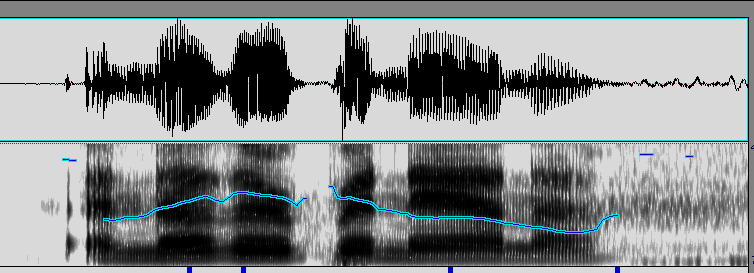
In case you want some hints:
1) There are two words. (In English.)
2) All consonants are voiced, at least phonologically.
3) The noise at the end of the file is either just background noise, or breath.
4) The filename of the picture gives a hint to one of the words.
 collecting tokens
Grr, I’m no good at reading spectrograms, I’m a syntactician!
But I can deduce that in the first word, the last two vowels are about the same, given the first two formants. So if ‘banana’ is one of the two words, it isn’t the first, since (Im assuming) the two vowels are slightly different in your dialect(whereas they are identical in mine).
The consonant between the two vowels is quite short, and since it is (at least phonologically) voiced, it is probably a plosive. The first though, is longer, and there’s still some F-0 action going on, so it isn’t likely to be a stop (unless you use those European stops). I’m guessing it’s a nasal. As for the quality of the vowels, well, I’m hopeless at analysing formants, but to take a stab in the dark, they look like mid-closed vowels, and since the back-mid vowel (I’m assuming again) in your dialect is a little bit diphthongised, I’ll tend towards front; /e/.
Am I at all close? I have no idea and I give up.
Hey, Jangari-
I’m sorry. I left you hanging for days!
You made some good calls. “Banana” is indeed the second word. The first intervocalic consonant is a nasal, as you have deduced. The second is actually a fricative, so an obstruent, but not a plosive.
You noticed that the last two vowels are about the same, given the first two formants. Which I thought was a cool observation, because, yes, those 2 formants do look the same. But…there is some 3rd formant action going on in the last vowel of the first word. It’s unfortunately somewhat obscured by the pitch track. And good call on the mid-vowels. However, it’s neither closed nor front. (My /e/, by the way, is pretty strongly diphthongized. Is yours not?)
Okay. The answer (unless you want more hints) is the name of this blog I started, where I intended to post a bunch of utterances with different intonational contours. (Many of which have been produced with the same text.) I never quite got around to it, though. I hope to some day…
You /e/ is strongly diphthongised eh? I don’t think mine is.
So the two vowels there would be the ‘o’ and the ‘er’ in ‘another’. I assume you have an r-ful accent, which would probably change the second vowel, that might be that 3rd formant action that you speak of.
I was close, they’re mid-to-open vowels, and I just took a stab at front. They’re probably closer to long schwas or that upside-down /v/ (which to me is identical to short /a/).
Incidentally, all 6 vowels in ‘another banana’ are basically identical for me, maybe with slight differences resulting from tone and stress.
You know, I realized (while working with some spectrograms later today) that my /e/ is not necessarily strongly diphthongized in contexts before a consonant. I think I’ve been taught about the “off-glide,” but it may happen more in open syllable, word-final contexts.
Yes, I’m r-ful. So that’s the 3rd formant action. And the middle-syllable is the long schwa/upside down v. So “another” get’s schwa, long schwa, r-colored schwa for me. I get 5 out of 6 of my vowels as some sort of schwa, with a definite /æ/ for the middle vowel of “banana.”
Any interest in recording me an “another banana”? It would be fun to compare. (I also don’t know a thing about Australian English intonation.)
Maybe when I have a good enough internet connection to be able to send it; I’m on dial-up at the moment, and not even a very good speed of dial-up.
But what sort of intonation do you mean? Decontextualised utterance like ‘another banana’ could take on a wide range of intonation contours.
Jangari-
“But what sort of intonation do you mean? Decontextualised utterance like ‘another banana’ could take on a wide range of intonation contours.”
That’s exactly what I used it for. At some point I had a game where I would have a dialog with a partner, whose only response could be “another banana.” I’m pretty sure I’ve elicited, or produced, at least 40 intonationally distinct “another banana”s. Probably more than that. (Where pitch accent type, pitch accent location, number of pitch accents, phrase accent and boundary tones have varied.) My goal was to have examples of it with all possible phonologically distinct (according to the the theory I work in, ToBI) contours for American English .
But I don’t know how much, in terms of pitch accent types and boundary tones, Amesrican and Australian English share. I’m actually assuming that they share most of the elements, but I would also expect some differences. So you could produce it any way you’d like, and I’d be interested.
All possible phonologically distinct contours?! That would be a mammoth task.
I’ll see what I can do. Maybe I can put something through praat and email you an image, it might be the simplest way. Emailing a sound file from my 32 kbps dial-up would take days.