early intervention: starting to get into it (part 3)

Last week I started writing about our experiences with Phoebe and Early Intervention for a language delay. Part 1 was about the original assessment, and part 2 was about starting to work with a speech pathologist. (If you are interested, you may also want to see what I wrote before the original assessment back in November.)

——–

Some time in January, our speech pathologist told us of an opening in a parent-toddler group that we could attend on Mondays. I wasn’t sure what to expect from the play group. I hadn’t had a whole lot of interaction with groups of parents and toddlers.

The group leader, N., was a very friendly young woman who welcomed us warmly. The other parents were generally quite friendly as well, and all were supportive of all the kids in the group. There were about 8 kids in the group (each accompanied by a parent or other family member), with the number fluctuating a bit week by week. The first week we were there, Phoebe was the only girl at the group. Apparently boys are flagged for Early Intervention services much more frequently than girls. However, our group did have quite a few girls re-appear and join the group over time, as well. (In fact, at the last group we attended, there were more girls than boys. However, this was considered remarkable.) All kids were under 3, as services only cover kids up to 3. The youngest child was 18 months when we started, though I later learned that he was a “community child,” meaning a child not receiving EI services, and attending the group as a “model.” Most children were closer to 2. (Phoebe was almost 2 when she started.)

While I know groups vary quite a bit, here’s an overview of what went on during the group.

The group met for 2 hours, from 9 to 11 in the morning. Things started off with some unstructured time where kids could ease into things, and play with various toys set up in stations around the room. This gave adults a bit of time to chat (and thankfully, time to run late). The group leader, N, would also move around the room and chat with each child, and also with the adults to get progress updates. Other activities then followed, in a more-or-less fixed order: clean-up from the free play, snack time, playground time (indoor or outdoor, depending on weather), craft time, “circle time” (with songs) and then the good-bye. Each activity had it’s own routine and sometimes associated songs.

Because the group was geared towards working on expressive language and communication skills, the routines typically involved getting the kids to participate and communicate. For example, for the snack, there was always a choice of 2 snack items, and the child was encouraged to express their choice. “Do you want crackers or raisins?” N might ask, showing both options. And depending on the individual’s abilities and level, different answers would be encouraged. For most of the kids, a single word or sign was encouraged. (Some of the kids weren’t speaking, though all in the group were hearing.) Sometimes a “please” would be encouraged. For some kids, such as those just entering the group, pointing to the desired snack was enough. For more advanced speakers, a whole-sentence request was elicited: “I want crackers.” I remember being impressed by one little boy, who was almost 3 and had been attending the group and getting EI services for at least a year, because he could sometimes be prompted to ask: “Can I have crackers, please?”

Our own goal for Phoebe was to get Phoebe to make requests using single words. Even after she started making such requests with us, she was still very reluctant to speak in front of others. She would sometimes manage only to point, or only to whisper her choice in a single word. What was nice was that every attempt was greeted with encouragement and praise, and there was little pressure. If a child wasn’t up to making a request, a choice would be made for them and they would still get encouragement.

I swear that Phoebe loved every bit of the play group time. She was probably fondest of circle time, where we’d all sit in a circle and sing songs. Each child would get a turn, in the order of our seating arrangement, to pick between two toys representing songs: a spider, a fish, a boat, a bus, etc. Most of the songs (or at least the tunes) were familiar to me (and some to Phoebe), and a subset of the same group of songs would be chosen each week. All the songs had some sort of movement or gestures, so that kids could participate with their hands and feet. (Mostly the kids did not sing along, but the adults all did.)

Phoebe behaved quite wonderfully during the group, staying in her seat, following instructions, and observing everything going on around her. I think it helped that she had already been attending daycare, which also had a bit more structure than our time together at home. (I think Phoebe is also rather on the mellow side, as toddlers go.) The kids in the group varied in how well they could focus. A few kids would have trouble sitting still, especially by the end of the 2 hours. But for the most part, all the kids seemed tuned in for at least most of the group time.

While I was worried that I would find the whole thing painfully hokey, seeing Phoebe so engaged was really gratifying. And while she continued to be quiet during the group time itself, she started to show a lot of signs early on that she was really taking in the lessons of the group.

—–

Okay, I’m still not done. Next time, I’ll write more about Phoebe’s progress. And maybe about the one-on-one sessions. If anyone out there has questions about particular aspects of the EI services we received, please feel free to leave a comment or email me. (See the “contact alejna” page in the sidebar.)

early intervention: getting started (part 2)

Last night I posted a bit about Phoebe’s initial assessment for Early Intervention services. This is part 2. (If you are interested, you might also want to look back at what I wrote back at the end of November, and how we ended up getting the assessment.)

——-

As I mentioned, because of the time of year, it was several weeks after the assessment before our services got started.

In early January, we heard from the person who would be taking on our case. (I’m actually not sure what her specific qualifications were. And actually, I never thought to ask. But we’ll call her a speech pathologist.) She set up an appointment to come to our house for a first meeting to talk to us about goals, and to write up our ISP (Individual Service Plan).

At that time, our main concern was that, while she used quite a large number of different words to label things at her own discretion, and would occasionally produce longer utterances of her observations, Phoebe didn’t often use language to communicate her needs and wants. What was most difficult was that she would typically only ask for things by pointing, or sometimes just by becoming unhappy, and we would have the job of trying to figure out what was wanted. Most of the time, we were able to do this, largely through playing what was a lot like a game of 20 questions. Are you hungry? Do you want milk? Do you want the toy? Are you hurting? Those times when we didn’t come up with the right question, Phoebe would get frustrated. She would sometimes start making that sort of grunting/groaning toddler noise, and occasionally break down crying. Mind you, these times were few and far between, but we wanted to get past them. We knew, for example, that she could say the word (and in some cases the sign) for many of things that she wanted. But somehow, she was never willing to say them as a request.

This was the main goal written on her ISP: for Phoebe to make simple requests, using single words.

We also worked at that first meeting on getting a schedule for services. The speech pathologist would meet with Phoebe once a week, either at our home or at Phoebe’s daycare. Phoebe could also attend a weekly group at one of the program offices (either a parent-child group, or a “drop off” group). Since I wanted to be involved in the process, we got signed up for a parent-child group. I also wanted to be around for the one-on-one meetings, rather than have them take place at daycare. As it turned out, because of my tight schedule, we ended up scheduling our one-on-one meetings right after the play group, at the program building, rather than having a separate meeting at our home on a different day.

We did have one more home visit from the speech pathologist before starting the regular schedule. She came over with a bag of toys, and sat down to play with Phoebe. Because that was just what it seemed like. As they played, the speech pathologist used very short, simple sentences and repeated single words often. I was very impressed with how engaged Phoebe was right from the start.

The speech pathologist also left us with some suggestions for encouraging Phoebe to make requests. The main suggestion was to frequently give Phoebe a choice of two things. For example, when offering a crayon, we should ask “Do you want green or blue?” When she’d point to one or the other, we should use the single word, repeating it clearly a couple of times. I was a bit skeptical about how much difference this could make, but having seen how engaged Phoebe was during the meeting, I decided to work this into our daily routine.

It may well have been a total coincidence of timing, but we had a breakthrough shortly after. I wrote a post about it on my old “Phoebe blog” (which I used mostly to post updates for family and friends) on January 19th. Since that site seems to be broken just now, I’ll copy the whole thing here:

We’ve been working on trying to get Phoebe to express her wants to us more clearly. Phoebe uses a lot of words, but usually just to name things. She’s quite good at responding to questions, like “what does a dog say?” (“woof”) or “what color is this?” (“gee!”) or “do you want milk?” (“yup.”)

She has started asking for things that are just out of her reach. She will, for example, point to where we keep her beads and say “bee?” There has also been at least one time when she has wanted us to get her Bunny out of her crib, and she’s pointed towards her room and said her version of “Bunny.” However, she has been reluctant about making requests for things that she can’t see.

Today, though, we had an exciting moment. We were in the car heading home from a meeting in Boston, and having a snack of graham crackers. I asked Phoebe if she wanted some water. To which she replied. “No. Milk, yeah!”

(Unfortunately, we didn’t actually have any milk in the car with us. But we were at least able to acknowledge her request by saying that we would get milk later.)

—–

Okay, I’ll have to continue this again later. (It’s late at night once more.) Next time, I’ll write about going to the play group.

early intervention: getting in (part 1)

Yesterday, Phoebe and I made our last appearance at the play group we’ve been attending since January. I’m sad that we won’t be going back. Phoebe loved it.

It actually wasn’t just your average play group, though. It was part of Early Intervention services that Phoebe was receiving for a speech delay. As of last Monday, it was official that Phoebe would no longer qualify: she no longer has a delay.

I’ve wanted to write about our experiences for a while, in part because I think it’s good to have stories out there for people who may be concerned about what it means to be qualify for Early Intervention services. I’ve also found the process quite interesting, as a linguist. Plus it’s been something big going on in my life as a parent, too.

It turns out I have quite a bit to say, so this post will be just the start. (Also, I have to get to bed. It’s after 1:00 am now.)

———————–
Way back at the end of November, I wrote about how we were going to have an assessment to see about a possible language delay for Phoebe. The pediatrician was concerned that Phoebe wasn’t speaking often. I resisted, being sure that Phoebe was just taking her time. And then decided that, while I knew more about language development than your average mother (and probably more than the pediatrician, even), I wasn’t qualified to make an assessment.

I told people back then that I was about 85% sure that Phoebe wouldn’t need services. A funny number that.

As it turned out, Phoebe did qualify for services.

The initial assessment was actually quite a lot of fun. A team of specialists came over to our house: a case manager, a developmental specialist, and a language specialist. They ran a bunch of tests, which actually involved playing a bunch of games. Phoebe had a fun time. She was cooperative and remarkably at ease for having strangers around asking her questions. While we’d worried that she would clam up, she spoke quite a bit for what was her norm at the time.

As the core of the assesment process, they gave an approximate age level, in months, for a vareity of developmental areas: fine motor skills, gross motor skills, self care, cognitive abilities, receptive language and expressive language, and probably a couple of others that aren’t coming to mind just now. Phoebe was 21 months at the time of the assessment, and she tested right around age level for a few things, and several months above age level for a few more. Her receptive language skills were remarkably high, testing at 27 months. 6 months above age level! (And they don’t necessarily push the tests to the limits, once they establish that there is no delay.)

But for expressive language, measuring what she would actually say, she was scored at around 16 months. Almost a full year behind her receptive language score. Also, it meant that her expressive skills were below her age level. A 5 month delay, in fact, which qualified her for Early Intervention services.

While we had some doubts, we decided that if this was something that could benefit Phoebe, we should take advantage. We had heard that such services were generally very positive, and that even if they did not help, they were very unlikely to actually harm or hinder. We would be having weekly one-on-one visits with a specialist, and could also attend a weekly toddler group.

Things got going slowly due to the time of year. The offices were closed for a couple of weeks at the end of December, people went on vacation, and January arrived before we started services.

—–
To be continued…

decoding real estate listings: a helpful glossary

If you’ve ever spent any time house-hunting, you’ve probably noticed that real estate listings have a certain lingo of their own. Often, this involves descriptions of properties that have been somewhat embellished to make even flaws quirky characteristics sound like selling points. Some of these euphemisms have become standardized, such as the “handyman’s special,” a term for a home that is falling apart in every imaginable way in minor need of repairs.

In order to help you read between the lines in an MLS listing, I offer to you this helpful example and glossary.

Example: a typical MLS listing

Charming and cozy 2 bedroom house. Enjoy summer breezes in this lovingly decorated perfect starter home, with sunny, low-maintenance yard. Modern kitchen, 1 and a half baths, partially finished basement. Homey, and ready to move in!
Location features:
• easy access to freeway
• excellent cell phone reception
• close to amenities
• friendly, mature neighborhood

Glossary of Terms:
charming: run-down
cozy: cramped
summer breezes: house is drafty, may have windows missing or holes in roof
lovingly decorated: all the carpets are magenta, and there is loud wallpaper in every room
perfect starter home: you’ll want to move out as soon as you can afford better
sunny: no trees or shade of any kind
low-maintenance yard: lawn is paved over
modern kitchen: kitchen done in the Modern style, circa 1960
1 and a half baths: the second bathroom has partially-installed fixtures, or there may be a toilet in the basement
partially finished basement: basement features water-stained shag carpet
homey: house has funky smells, possible from cat urine
Ready to move in!: home has been abandoned
easy access to freeway: next to an on-ramp
excellent cell phone reception: under a cell phone tower
close to amenities: across from a liquor and/or convenience store
friendly, mature neighborhood: may be near a strip club or adult bookstore

I hope that this information will be helpful to you in your house-hunting endeavors. If you have more terms to add to the glossary, I welcome your contributions!

——————————-
This week’s Monday Mission, which I’ve chosen to accept in a roundabout way, was to write a post in the style of a real estate listing. For more listings, stop by Painted Maypole.

Thanks to maja for teaching me “low-maintenance yard” and “easy freeway access,” terms that she may have actually seen in use.

Well, golly!

I’m seriously amused. There is a quiz out there called “The Blog Cuss-O-Meter,” which I saw at casa az last night (and at raincoaster a few days ago when I was too busy to give it a spin). I thought to myself “screw it, I hardly ever swear on my blog,” but I took the quiz anyhow. Here is the result I got:

The Blog-O-Cuss Meter - Do you cuss a lot in your blog or website?

(The site further gives this bit of info: “This is 791% MORE than other websites who took this test.”)

This surprised me more than a little, especially given that others who took this were surprised at how low a score they got. In spite of having decided, and stated, that I reserve the right to swear on my blog, I tend to shy away from using certain words in my writing that more easily leave my lips when I am, for example, driving. Hell, I wrote a whole post last week where I played with “crap” as a theme, but I somehow avoided using the word shit.

For example, I’d just like to point out that the word fuck appears to appear in only 4 posts in the history of this blog, which means just over 1% of the posts. (And one of those uses is on an image of a little candy heart. Doesn’t that make it sugar-coated?)

But I do use a lot of mild taboo words. My guess is that somehow, the ass in kick-ass, as in my tag “kick-ass women” is responsible. (Yes, I’m saying my ass is responsible.) It’s in my sidebar, so may count as being in basically all of my pages somehow. Otherwise, what do they consider?

Seriously, this makes me want to do an experiment. Anyone want to try adding some shit or something to their sidebar to see if they can inflate their score?

(Oh, and by the way, I’m back home. The conference and trip were really great. The presentations went well. I saw lots of people I wanted to see. And now I’m really fucking freakin’ damn quite palpably tired and need to get ready for the next conference, now less than 3 weeks away.)

the well of idioms may be about to run dry

I’m afraid I may have upset the apple cart with yesterday’s scandalously wasteful overuse of idioms. (I mean, I packed in the idioms like sardines, all higgledy-piggledy as if they grew on trees.) Because as some of you know, this country is suffering from the ravages of an idiom crisis:

Idiom Shortage Leaves Nation All Sewed Up In Horse Pies

WASHINGTON—A crippling idiom shortage that has left millions of Americans struggling to express themselves spread like tugboat hens throughout the U.S. mainland Tuesday in an unparalleled lingual crisis that now has the entire country six winks short of an icicle.

To do my part to conserve, I’ll resolve to work on recycling old careworn and threadbare clichés, and coining my own beet-juggling idioms. For more details, please tumble your aardvark over to the full story at The Onion.

dot dot dot

exclamation_point1.jpgThere are times when the world conspires to make me ponder a topic for a list. This week the world apparently wants me to reflect on punctuation.

I’m quite fond of punctuation, really. Not so much the prescriptive uses of it. I like the informal uses of it that reflect the prosody of spoken language. You can break up a sentence or phrase with periods to show the strong emphasis of making each word its own intonational phrase. (What. The. Hell?) There’s the use of parentheses or commas for, you know, parenthenticals. (And I’m quite partial to parentheticals.) Or you can use ellipses to signal that you’re trailling off…

So I offer you a ThThTh list with an abundance of punctuation marks.

First, I offer to you the Evidence of Punctuation Conspiracy:

Further punctuation-related things include:

  • The “Blog” of “Unnecessary” Quotation Marks. This blog is a “great” place to see of all sorts of abuses of quotation marks.
  • Apostrophe Abuse. Its the cats pajama’s in terms of misused apostrophe’s.
  • The Ominous Comma. A blog. While not actually about punctuation, it gets points for having such a cool punctuation-related name.
  • Eats, Shoots and Leaves: The Zero Tolerance Approach to Punctuation by Lynne Truss. A book on punctuation that is said to be entertaining. (Yes, I should have read it. I have it. But haven’t read it. It will probably tell me to stop with the sentence fragments. Or some such. Screw that.)
    • There’s a punctuation “game” based on the book. (I use “scare quotes” here to suggest that there is not a lot of “fun” or “playing” involved.)
    • More fun is the panda joke that is the inspiration for the book title (offered up by Geoffrey Pullum of The Language Log) .
  • I love you period,” a song by Dan Baird

    I love you period
    Do you love me question mark
    Please, please exclamation point
    I want to hold you in parentheses

  • Let’s not forget the colons and semi-colons of the island nation of San Serriffe:

    The native people of San Serriffe are the Flong. However, the dominant group are of European stock, the descendants of colonists, known as colons. There is also a large mixed-race group, known as semi-colons.

  • Finally, I offer a bit of cartoon swearing. As in using punctuation marks in place of swear words, usually in a cartoon. (This allows me to end the post with a bang. Or 2.)(Sorry, a little punctuation mark humor.)(No, I’m not sorry. I’m dorky like that.)

          &*%#@$!!

murmurs

Phoebe’s last doctor’s appointment was a while ago now. Her 18 month appointment. (She’s now 21 months old.)

For those of you who haven’t taken a baby on a well visit to the doctor, they tend to follow a predictable pattern, at least in our experience. You go into a room strip the baby down. A nurse weighs the baby, and measures the baby’s length and head circumference. Then you wait a bit and the pediatrician comes in. She looks over the measurements, and pokes and prods the baby. Looks in ears and mouth, listens to lungs and heart. Asks questions about development. How much milk does she drink? Does she still drink from a bottle? Eating solid foods? Using a spoon? Is she babbling? Yodling? Falling asleep on her own? Crawling? Walking? Dancing?

We answer the questions, and it being us, we joke around a bit with the doctor. Happily, she has a sense of humor and understands when we are joking. The visit goes pretty uneventfully, typically. We learn that Phoebe is big and tall for her age. We rattle off some of her accomplishments. Things are all smooth sailing till the doctor leaves and the nurse comes in to give the shots. And then it’s over till next time.

But this last time there were a couple of things that caught me by surprise. One was that the doctor heard a heart murmur. And the other was that she thought that Phoebe’s speech was lagging.

After the visit, we got the referral for the cardiologist to check on the murmur. We weren’t too worried, as the doctor didn’t think it was likely to be a troublesome murmur. But of course we followed through. We wouldn’t take risks with Phoebe’s heart. We sought the expert opinion. And the cardiologist confirmed that the murmur is completely benign.

The speech part of the story is ongoing.

Phoebe is a quiet child, for the most part. She takes after her parents. She started saying a few words at around 12 months old, and over the following months added quite a lot of words. But the thing is, she would use a word for a day or two, and then move on to the next word. We wouldn’t hear the word again in most cases. Turtle was a favorite word for quite a while, and then yellow, and then uh-oh. And there would be all sorts of other words she’d use only once or twice, often carefully articulating. Shoe. Puzzle. Rubberband. She spent a whole day working on getting the production of hat just right, getting the /h/, and the vowel and fully released /t/ out there in a careful sequence.

So when the doctor asked for a list of words that Phoebe used regularly and consistently, we didn’t really have much of a list to offer. That wasn’t what Phoebe was doing. We could remember maybe 2 or 3 words. Ball. Uh-oh. No. There were a couple of signs and gestures, too.

What’s funny is that I have studied language development in classes, and have read a textbook or two, and attended lots of conference talks on the subject. But up to that visit, I hadn’t really given much thought to whether Phoebe’s development was on schedule. I had noticed that Phoebe was not doing the things the textbooks had described, but I figured that intro textbooks tend to overgeneralize, and that individual babies have different patterns. Actually, I still think this is the case. Phoebe was using language productively, and showing remarkable comprehension of even quite complex sentences and structures. It hadn’t occurred to me to worry. So when the doctor mentioned that she thought Phoebe was behind in her speech, and that she recommended that we get an evaluation for early intervention, I was quite startled. My first first reaction was that this wasn’t necessary. But I agreed that we would take the information and consider it before the next well visit, which wouldn’t be till Phoebe turns two.

The doctor said that at 18 months, a child should be using at least 5 or 6 words consistently. I thought our list wasn’t that far off, especially as we drove home from that visit. I remembered a few more words here and there. I realized that had I been more fully prepared, I could have presented a list of 6 or so words. And perhaps the doctor would have just taken the list as adequate to meet the criteria of her checklist.

John was a late talker. His mother doesn’t remember the details of when he started talking, but remembers that she had a sign up over his bed saying that Einstein didn’t talk till he was 4 years old, or some such. John’s family says that once he started talking, he was using complete sentences. So it doesn’t seem too surprising that Phoebe is taking after her father. She has been a cautious child, much like John was, I’m told.

But the truth is, I’ve had murmurs of doubt. I know that children do vary a lot in their paths through language development. I’ve seen that other kids were much more verbal at Phoebe’s age, and even younger. A baby who lives next door to John’s parents was producing about 60 words consistently by the time she was 14 months. A friend’s daughter was saying all kinds of words when I’d seen her when she was 16 months, making requests, chattering away. I don’t necessarily think Phoebe needs to be as verbal as those other kids, but I sometimes wonder.

She does a lot of pointing. We do a lot of 20 questions, trying to figure out what she wants. We communicate quite a lot, and things go quite smoothly most of the time. She makes observations. She names objects. She responds to questions. She’s produced a few two-word combinations. There are times when she says fairly long things which we can mostly decipher, though other times when we have no idea. She has lately even gotten better at producing words on request, as in answering “what’s that?” or “what does a dog say?” And she’ll say “please,” now, on request. Which is so freakin’ cute I can’t even tell you.

She’ll say “more” if she wants something, and point, but beyond that it’s as if she hasn’t fully figured out that she can use words to make requests. She’s been getting better at this, though. But still, every once in a while, she gets frustrated. I can’t tell what she’s pointing at. Or guess what she wants to do.

I sometimes read about the verbal progress of kids Phoebe’s age, or younger, and I feel little pangs. I know she’ll be talking soon enough. But I do sometimes get impatient to reach that next stage. And I would really love it if she called me something. She knows I’m Mommy, but she never calls me that. She doesn’t call for me. For a while she called me Ada, which I realized came from “other.” (Maybe I’ll share the story some time.) She has said Daddy for a while, but there was a stretch when she’d use it to mean “good-bye.” She’s now started to say “bye,” but may have stopped saying Daddy.

Anyhow, the upshot is that we are having the early intervention evaluation. I realized that even though I know quite a bit about language development, I am not an expert, and I certainly don’t have a clinical background. I didn’t feel like the suggestion that we see a cardiologist was somehow a criticism of us or our parenting abilities, so it shouldn’t be any different for this. I still have this nagging feeling that they’ll tell us we’re doing something wrong, or that they’ll tell us we’re overreacting. And while I have decided that I am 85% sure that they will think that Phoebe is on track, I have realized that I don’t want to withhold from Phoebe anything that might be beneficial to her, such as early intervention services. Certainly not out of some sense of pride.

So some people are coming over to our house bright and early tomorrow morning. (Or this morning, if you want to get technical, since it’s after midnight.) Which means I should be cleaning, and not writing this. Because I can’t quite get over the feeling that they will be evaluating us, and not just Phoebe’s language.

how to talk like a pirate

jolly_roger.jpgWell, it’s finally arrrived. Today, September 19th, is Talk Like a Pirate Day. You’ve gotten yourself a pirate name, and brushed up on your pirate job skills. But are you still unclear on how best to talk like a pirate? Have no fearrrr.

There arrre many avenues to explore in learrrning how to talk like a pirate. An important resource is the “how to” page of the official Talk Like a Pirate Day website. There you can learrrn the basics (the 5 “A”s), more advanced pirate terminology (don’t confuse your hornpipe with your bunghole), and even advance all the way up to pick-up lines like this one:

How’d you like to scrape the barnacles off of me rudder?

In case you don’t have time for such intensive language study, you may find one of several translators handy, like this one or this other one. This one acts as more of a phrase book, and allows you to produce such eloquent discourses as this:

Ahoy, me proud beauty! Be that th’ market? I’ve a fierce fire in m belly t’ have a bit of a lie-down’

Of course, it’s also important to work on your arrr, long considered to be one of the hallmarrrks of pirate speech. (If you’d like to learn the history of this phenomenon, The Language Log discussed this a couple of yearrrs ago.)

Here’s what you do to say “arr”:

  1. Step one: Say “ah”. (Your vowel may vary by dialect; [ɒ], [a] and [ɑ] are probably all legitimate.) You’ll probably want to put in a glottal stop at the start [ʔ].
  2. Step two: Quickly lower your third formant to produce the [ɹ] sound. This can be accomplished by curling the tongue back (retroflex “r”) or by bunching your tongue up (bunched-tongue “r”)

Now, if you want to say “arrr” like a pirate, the instructions above are just a starting point. To produce the piratical “arrr” tha we’ve come to expect. (Cf. Geoffrey Rush saying “arrr” in Pirates of the Caribbean), you really need to growl it. And for me, at least, this seems to possibly involve some pharyngeal frication, and possibly also some additional voice quality modifications. I’m not sure what I’m doing (not really just creakiness or breathiness), but it sure as hell isn’t modal phonation. A really effective arrr will also be quite loud: push the air strongly through those vocal folds, dammit. On top of all of this, you’ve got to really drag it out, especially the [ɹ] part. (Keep that 3rd formant down.) Arrrrr!!!!!

In an experimental study, subjects (N=2) produced both “normal” and piratical arrrs. Piratical arrrs were between 2 and 3 times the duration of “normal” arrrrs. See figures 1 and 2, below.

Figure 1: Arrrr! vs. ar, speaker A (male)
j_arrrr.jpg

Figure 2: Arrrr! vs. ar, speaker B (female)
a_arrrr.jpg

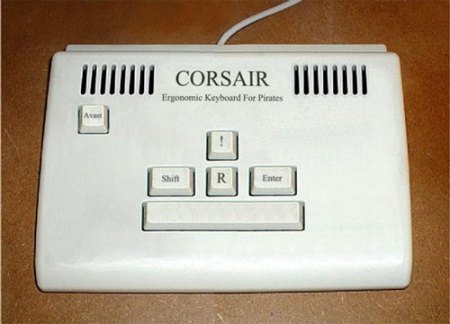
And in case you don’t have occasion to speak out loud today, you might try some pirate-style typing.
piratekeyboard1.jpg

RRRRRRRRRRRRRR!!!!!!!