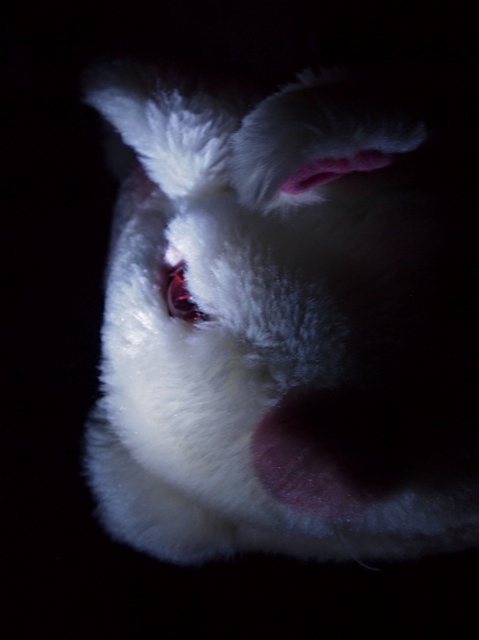
Ce matin, un lapin…

This morning, as I went about my business, which included doing tasks which I shamelessly attributed to an imaginary rabbit, a song popped into my head that I remembered from when I was little. “Ce matin, un lapin…”

I don’t know when the last time I thought of this song was, but there is a good chance it’s been many a year. For one thing, I don’t think I ever googled it before, so that may be an indication.

Back in 1980, I moved to France (along with my mother and sister). My sister and I went to an international school outside of Paris. We weren’t exposed to a huge amount of contemporary popular French culture, as we didn’t have a TV, and went to a school with primarily non-French students. However, at some point in the year, I went on a trip with my class into the French Alps. I don’t remember how long of a trip it was (2 weeks, maybe?), but there was a bit more cultural immersion, staying in a dorm run by French employees. There was certainly more music played than was typical of our regular school. I’m pretty sure this was when I would have heard the song, because those are the memories it triggered.

It probably shouldn’t surprise me that I remembered the lyrics a little wrong, or perhaps that I’d misheard them in the first place. (I was 9, and not a native speaker of French, and I don’t remember how often I would have heard the recorded version of the song, and how often I would have heard it sung by other kids.)

I’d thought it went:
Ce matin, un lapin. Ou tu es un chasseur. Ou tu es un lapin qui avait un fusil.
(“This morning, a rabbit, or you are a hunter. Or you are a rabbit who had a gun.”)

I think 9-year-old me interpreted the song to mean something rather philosophical, and somewhat twisted, along the lines of: “Today, will you be the rabbit, or the hunter? Or will you be a rabbit with a gun?” The tenses don’t really make sense for my interpretation, though.

It turns out the song was much more literal:

Ce matin un lapin a tué un chasseur.
C’était un lapin qui avait un fusil.

“This morning a rabbit killed a hunter. It was a rabbit who had a gun.”

Yes, a perky little kids’ song about a homicidal rabbit.

Happy Easter!

a dweam within a dweam

I admit that I have some mixed feelings on marriage. Having seen some marriages that were less than ideal, I grew up thinking that I probably wouldn’t get married. Marriage wasn’t really a goal of mine. I’m a firm believer that a person can be happy and whole without being married.

When I first met John, I certainly didn’t entertain ideas of marrying him. It wasn’t love at first sight. In fact, we were each dating other people when we met. (If you must know, I was dating his roommate.)

But I think I can pinpoint the moment I fell for John. It was over a year after I first met him, and some time after both of our earlier relationships had ended. The moment I fell for John was was, remarkably, right after I fell on my butt.

It was the winter break of my Junior year of college, late December. I had just returned to the US from a semester abroad in Brazil. I went over to my by-that-point-ex-boyfriend’s house to catch up. John was still one of his housemates, and hearing that he was home, I went up to his room say hello. His door was open, and I poked my head in to say hi. Then I glanced at the papers he had taped up on his door, a long vertical banner of dot-matrix printouts. (Did I mention this was 1991?) First was a set of Dan Quayle quotes. Below that was a bunch of quotes taken from insurance claims. I started reading. I snickered. I laughed some more. I read some more. I bent down to read the pages lower down on the door, eventually squatting to read those at knee-level. I read: “I saw a slow-moving, sad-faced old gentleman as he bounced off the hood of my car.” I tried to read it out loud, but was laughing so hard I couldn’t. I laughed so hard I lost my balance, squatting there on my heels. I fell right onto my butt.

You might think that this would be somewhat of an embarrassing turn of events for a reunion with an acquaintance. And perhaps it would have been, except that John, seeing me laughing so hard at things that he had found funny enough to print out and hang on his door, was laughing along with me. And while he may well have been laughing at me for falling on my ass in his doorway, I didn’t mind. I was laughing too hard. And when our eyes met, both of us laughing at the quotes and my clumsiness, I’m pretty sure that was the moment that I knew I had found someone I wanted to know better.

We didn’t get married that night. But we did start seeing more of each other. Then we moved in together. Got engaged. Bought a house. We made some attempts to plan a wedding, but were foiled by various scheduling conflicts with key family members.

We ended up getting married by a Justice of the Peace eight years into our relationship, and shortly before I planned to quit my job. (Die-hard romantic that I was, I wanted to have health insurance.) We’d had a long engagement, and what with living together and owning a house together, even, I felt that we were largely as committed as we needed to be. What with my luke-warm views on the institution of marriage, I didn’t see how being married would change our relationship. I remember commenting to an acquaintance, a married woman a few years older than me, something to that effect. She replied: “Marriage does change things. It gets better.”

I have to say that she was right. It was a subtle shift, but having our commitment be officially recognized made things a bit more settled, and a bit more comfortable. And when we had our party (several years later), the wedding ceremony to celebrate our marriage surrounded by our friends and family, it got even better.

Sometimes, when you are lucky enough to find someone who shares your sense of humor and your worldview, someone you love passionately and who loves you right back, someone who lets you feel at home with yourself, that conventionalized connection marriage gives you makes you feel just a little bit more together and a little bit more at home. It’s a declaration to the world that you know who’s going to be there to help you up when you fall on your butt.

This post is dedicated to Flutter, a remarkably strong, strikingly beautiful woman with a great sense of humor, to share in her joy at getting married. Flutter, I wish you and Clay many happy years full of love, health, comfort and humor. May you laugh your asses off together with abandon. (Emily has invited those who know Flutter to join in on the celebration. To see more of the well-wishing, go see her post “Mawigge is what brings us together today.”)

This post is also dedicated to John, love of my life, who has been there for me, on more occasions than I can count, when I have fallen on my butt (either literally or figuratively) over these past 20+ years.

14 juillet, 1989

The summer of 1989, I was living outside Paris with my mother and stepfather. I had just finished my last year of high school, and my best friend from California came to visit. Her visit overlapped with the 14th of July, known in France as “le quatorze juillet” (or “The 14th of July.”) Also known as Bastille Day, the anniversary of the start of the French revolution. This was to be the bicentennial celebration. There was lots of excitement about the the holiday, and my friend and I made plans to be in Paris for the big day itself.

We got to stay in a studio apartment that belonged to a friend of mine from high school. She was away, and knowing what a long train ride I lived from Paris, had offered the apartment to me for my friend’s visit. It was in the 8ème arrondissement, within walking distance to the Place de L’Étoile and the Champs-Élysées.

The night of the 14th was a beautiful one, and rather cool. I don’t remember what my friend and I did during the day, but by evening, we made our way back towards the Champs-Élysées to watch the big parade that everyone was talking about.

The metro and the streets were packed. Moving from the metro stop, it felt like I was being swept up in a wave of people. We were jammed together so tightly, with people pressing from all directions, I had the sense at times that if I stopped walking, I would be carried along by the crowds. (More likely I would have been trampled.) I find it remarkable that my friend and I didn’t get separated.

As we reached the expansive width of the Champs-Elysees, the crowd thinned enough for us to breathe easier and walk at our chosen pace. We strolled a bit and looked for a place to sit among the crowds on the sidewalks.

I remember very little about the actual parade. I couldn’t tell you who was in it, or even how long it was. I remember my friend’s confusion about why the people along the sidewalks would periodically shout “Ozzy! Ozzy!” (They were really shouting “assis! assis!” to get people closer to the street to sit down and stop blocking the view of those sitting further back on the sidewalk. It could be that part of why I remember so little about the parade was that I could actually see very little of it.)

I do remember that there were big tanker trucks from which people sprayed massive quantities of confetti over the street and spectators.

When the parade ended, after some amount of time, my friend and I got up and walked up the Avenue towards the Arc de Triomphe.

Feeling a bit bruised (possibly literally) from our arrival, we hung back a bit, and didn’t hurry. As we got further up the avenue, the amount of confetti on the ground increased. It had piled and drifted into heaps of little white paper dots. There were still plenty of people around, and the mood was festive. People started to scoop up handfuls of confetti from the street and throw them like snowballs. My friend and I joined in, laughing and tossing confetti at each other. Occasionally, some stranger would lob a heap of confetti our way. At one point, a group of teenage boys came up behind me and dumped a whole shopping bag of confetti over me, leaving me with a purple bag over my head. My friend, rather than coming to my assistance, laughed at me. Understandably.

We continued tossing confetti at each for a while, gradually still working our way up the avenue. At one point, I bent down to scoop another handful, and as I stood up, laughing, met the eyes of a fireman who must have been working crowd control. As soon as I met the fireman’s eye, he sprayed me with a fire extinguisher full on in the face, and turned to spray my friend as well. Perhaps he felt threatened by my hands full of confetti, or perhaps I looked particularly maniacal with my hair full of confetti and my gleeful laughing. (Of course, everyone looked rather wild at that point.) Perhaps it was just his way of joining in the fun. But, man, getting a face full (and a mouth full, since I’d been laughing) of fire extinguisher spray was pretty nasty.

With that acrid taste in our mouths, we continued on up towards the Arc de Triomphe, much more subdued (and rather baffled) after our run-in. By the time we reached the Place de l’Étoile, where traffic was still stopped from the parade, we were feeling pretty tired and dragging our feet a bit. There were still lots of people around, mostly also appearing to be heading away from the scene.

Suddenly, as we walked in front of the Arc, fireworks started directly overhead. Really, I should say capital-F-Fireworks. It was the most spectacular display I’d ever seen, and I’d never been so close to such large-scale fireworks. At times, it seemed as if the sparks would actually fall all the way down to us. (But they didn’t.) The fireworks lit up the smoke-filled air like daytime, and the beauty and awesomeness of the display was almost enough to wash the bitter aftertaste of the fire extinguisher from our mouths.

What’s more, it felt like we had stumbled across a completely unexpected treasure. We hadn’t known that there were fireworks scheduled at that location or time, nor apparently did the various others walking across the Place de L’Étoile that night. We all stopped together in wonder. Had we been in more of a hurry, we would have already been tucked away in the depths of the apartment building, perhaps hearing the muffled booms as we brushed our teeth. Instead, we found ourselves with front-row seats to a once-in-a-lifetime show.

gathering moss

The first time I ever moved was when I was three years old. My family lived in a rental house in Sausalito, California. It was a tiny house built into the hillside overlooking the San Francisco Bay, with 30-odd steps leading up to the house from the sidewalk. One of my earliest memories was of moving day. The movers put down big pieces of plywood over those steps so that they could slide the boxes down to the street level.

That move sent me and my things in two directions, as my parents were separating. My mother rented an apartment a few towns away, and my father rented a house in a neighboring town. My sister and I would go back and forth. A couple of years later, my mother left the apartment for a rental house in another town, and my father rented the same apartment vacated by my mother.

When I was six, my mother, my sister and I moved our things in with my new stepfather, into a big newly built house. My father died that same year, and my mother and stepfather cleared out the apartment that had been one of my two homes for three years. I remember trying to save all I could get away with.

When I was nine years old, my mother, my sister and I moved to France to start anew. We packed up what we could fit in a few suitcases and a big trunk, and headed to Paris. We travelled a bit, stayed in hotels here and there, and finally settled in an apartment in a Paris suburb, near the school my sister and I would attend.

We stayed there a year before returning to the US. We moved in with my Grandmother in her house in a small, rural town in the mountains of Colorado. The following year, we moved to another Colorado town, where we rented a log cabin-style house.

We stayed there for just over 3 years, which up to that point was the longest time I’d spent in any one residence. Part way into my freshman year of high school, we moved to Honolulu, Hawaii. We got rid of lots of things, put some into storage, and moved over with little more than a few suitcases. A few months later, it was back to the mainland, where we settled once more in California. A couple of years later, my mother married a Frenchman and moved back to France. It was the spring of my junior year of high school, and I moved in with a friend’s family for a couple of months to finish the school year. That summer, I moved to France with a few suitcases, though I recall I had my mother’s full sterling flatware set in my carry-on bag.

The next year, I headed back to the US for college. Over the 4-ish years of college, I lived in 2 dorms and 4 apartments. I also had a semester studying abroad in Brazil. If I’d had a car at that point, I could easily have fit all my belongings into it.

In addition to the homes I lived for stretches of months or years, there were more temporary places. Hotels or friends’ homes for a few days here, a few weeks there, filling in the gaps between moves.

How can I count the places I’ve lived? 5 US states and 2 other countries? (Do I count differently the times I moved back to a place after moving away? That happened twice. Unless you count coming back from Brazil, then it was 3 times.) Was it 15 towns, or do I count those other transitional towns? (There were at least 2.) Was it 9 schools during K through 12, or do I not count changes in the same district? (That happened once.) There have been 8 different houses and at least 11 different apartments. (And that one apartment where I lived twice.) Or do I just count the number of times I packed up all my belongings? (Because I doubt I can figure that one out.)

When I was 24, John and I moved up to Massachusetts. When we moved out of that apartment, four years later, it was the longest time I had ever been in one place. Amazingly, that was 10 years ago, as of last month. In May of 1999, we bought our house. That was the last time I moved.

I’ve been in Massachusetts for 14 years now, in New England for nearly 20 years. I never imagined myself staying in one place for so long. (And I never imagined how much stuff I could accumulate.)

the curse of the sock store

Quite a few years ago, long before we had kids, we’d occasionally go on a weekend getaway to stay in a bed and breakfast somewhere in New England. During one such trip, we stopped by a town known for its shopping. I seem to recall that we were heading to a game store. We saw quite a few other specialty stores, though I don’t remember what they were for the most part. What I do remember was seeing a sock store.

John and I had never heard of such a thing before, and we had a laugh about the idea. I mean, really, a whole store devoted to socks? Who really cares that much about socks? How could a store stay in business that really sold just socks?

However, we are nothing if not curious. So we decided to stifle our laughter as best we could and pop into the sock store to see for ourselves. As you might imagine, what we saw were a lot of socks. Seeing as we both had feet, and both used socks, we thought we might as well pick some up. I found a set of 3 pairs of socks in a sale bin, and John got some other socks. We made our little purchase and went our way, continuing to laugh at the supreme silliness of a sock store. We mocked the sock store.

However, it would appear that the socks must not be mocked.

For it turned out that those socks we had bought, the ones we picked up on a whim, they were really good socks. Once we tried them, all of our other socks became instantly inferior. They fell down. They weren’t as comfortable. The sock store socks became the favorite socks, sock favorites to a couple of people who wouldn’t even have believed that one could have favorite socks.

What’s more, suddenly we needed more socks.

We found ourselves seeking out socks, not just buying them willy nilly. Before you knew it, our sock stock had multiplied in size, as did our need to find better and better socks. We lamented that there was no sock store nearby. Our desire for socks could not be sated.

The only reasonable explanation is that we fell victim to the curse of the sock store. Having mocked it, we are now forever doomed to want more socks.

Coventry Carol

When I was growing up, I got to spend quite a few Christmases at my grandmother’s house in Colorado. Each year, she would bring out the collection of Christmas records, and play them on her great big stereo, the kind that’s about the size of a buffet table. It had a phonograph inside that could take a stack of records. I used to enjoy watching the mechanisms in action when it would change records; the arm with the needle would lift and move back slowly, and a single record would be dropped from its position in the stack above the turntable before the arm would reposition itself and lower the needle once more.

I didn’t know any of the identities of the albums in the Christmas stack, but I know at least some of these were recordings of chorale ensembles that included my grandfather. (He was a baritone, I believe.) I loved the songs from those albums, which included traditional carols as well as more “modern” holiday songs. I knew most of the songs from other places, whether it was “Silent Night” or “The Little Drummer Boy.” But there were two favorite songs that I never heard anywhere other than on my grandmother’s phonograph: “I Wonder as I Wander” and “Coventry Carol.”

“Coventry Carol” was always a particular favorite. I have always been a sucker for a melancholy tune in a minor key, even though I couldn’t have told you what that was when I was 7 or 8. For that matter, I didn’t know what it was called. It just sounded so pretty to me, so lullaby-like, with its “by by lu-lee lu-lay” and “little tiny child.”

It wasn’t until a few years ago that I rediscovered this song, having used the magic of the internet to track down the song title. A couple of versions made their way onto my Christmas playlists, shuffling in with the cheery holiday tunes and more somber traditional carols. It’s still one of my favorites.

I recently looked up the lyrics to the song, having never really listened to them.

Lullay, Thou little tiny Child,
By, by, lully, lullay.
Lullay, Thou little tiny Child.
By, by, lully, lullay.

I had always assumed, as I think most people hearing the song at Christmastime do, that the “little tiny Child” was the baby Jesus. Really, though, the song is from a 16th century pageant from Coventry, England, about the Slaughter of the Innocents, in which King Herod is said to have ordered the murder of young male children in Bethlehem:

In The Pageant of the Shearmen and Tailors, this gentle lullaby was sung by the women of Bethlehem to their babies, urging them to “Be still, be still, my little child,” just before the unwilling soldiers of King Herod came to slaughter their infants in Herod’s attempt to eliminate a competitor, the newborn King of the Jews. In the liturgical calendar, those children are commemorated on December 28, the Feast of the Holy Innocents.

It’s hard for me to express how this story affects me now that I am a mother, and especially with a new baby. I sometimes get choked up singing some of the lines, when I pay attention to the words, as I imagine mothers grieving the loss of their small children.

Herod the King, in his raging,
Charged he hath this day;
His men of might, in his own sight,
All children young, to slay.

Many believe that the Slaughter of Innocents was fictitious. Whether or not that story is true, it is sadly true that there have been far too many times, both in ancient and recent history, when young children have fallen victim to the senseless tides of war and politics. Thousands of innocents die each year from violence or from hunger or from preventable poverty-related illness¹. And countless mothers and fathers forever mourn their loss:

Then woe is me, poor child, for thee,
And ever mourn and say;
For thy parting, nor say nor sing,
By, by, lully, lullay.²

So now I see the Coventry Carol, the beautiful lullaby of a Christmas song from my childhood, as a song of mourning and remembrance. I see it also as a reminder that there is much work still to be done to protect the lives of the innocents.

—-

¹ According to Unicef, “25,000 children die every day from preventable causes.”

² Typically, the lyrics show the words “Thee” and “Child” capitalized, as if referencing a deity. However, I choose to leave them here in lower case, as I feel the words better represent the common children about whom the song was written. Full lyrics can be found at sites such as this one.

Note: I drafted this post about a week ago, in conjunction with my contribution of a song to the 2008 Blogger Christmahanukwanzaakah Online Holiday Concert, at Citizen of the Month. It seemed a bit gloomy to post in conjunction with Neil’s festive event, so I decided to hold off. Today, December 28th, is the Feast of the Holy Innocents, which seems a fitting date to beat you over the head with my gloominess.

Incidentally, I saw another post about Coventry Carol just yesterday, “The Children of Coventry’s Carol” at The Task at Hand, a thoughtful and beautifully reflective essay.

pink applesauce

My grandmother wasn’t a big fan of cooking. She wasn’t a bad cook, but just didn’t like to spend a lot of time in the kitchen. She made food that was, for the most part, pretty uncomplicated. When possible, she would use shortcuts.

For example, when making apple sauce, she wouldn’t peel the apples first. She would just steam them right in their skins, and then mash them in some sort of a ricer. I remember her using some tart apples that grew in her back yard, with skin that ranged from green to light red. The resulting apple sauce would have a bit of a pink tinge to it.

I made apple sauce a few weeks ago with some of the apples that we picked the weekend before. And like my grandmother, I didn’t bother to peel them first. I just quartered up about a dozen of them, and cut the cores out. Then I steamed them in a big pot. When the apples were soft, their flesh just separated right from the skins. I pulled off the skins, and plopped the apples into a food processor. The deep red skins of the Empire apples tinted the resulting sauce to a rich rose color. There was also quite a lot of juice that pooled in the pan, and since I’d used only a bit of water to steam, the juice was not only pink, but really tasty.

Pink apple sauce (and juice) and an Empire apple.
The rosy apple juice byproduct of steaming unpeeled apples for apple sauce.
The rosy apple juice byproduct of steaming unpeeled apples for apple sauce. (This photo shows the color a bit better, though the light's not as pretty.)

feeding the Monster

When my sister and I were growing up, we used to spend quite a few summers visiting our grandmother in Colorado. Part of our visit would always include at least one big camping trip in the Monster.

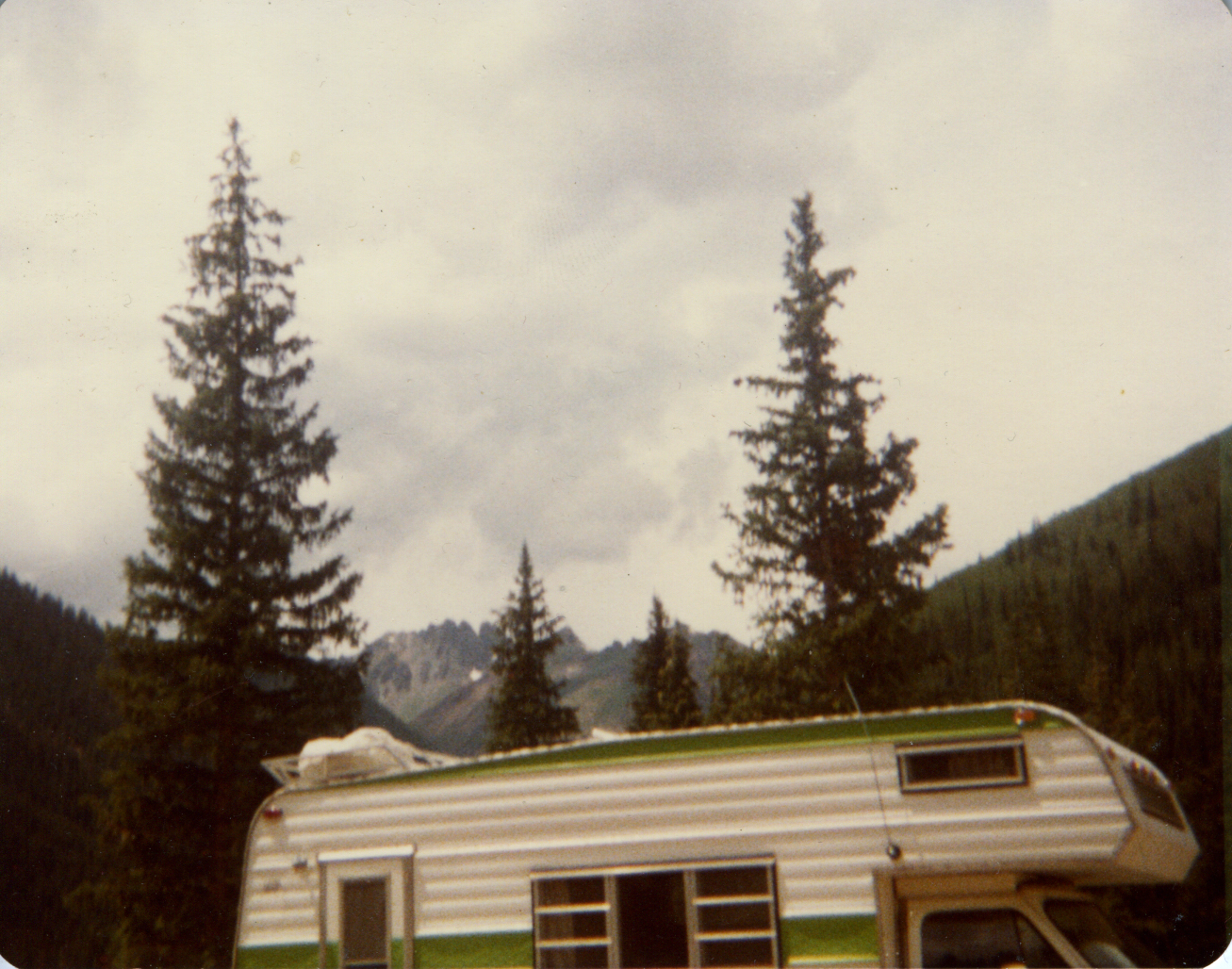
The Monster was a 1972 “motor home,” white with green stripes. My grandparents had been campers for many decades before buying the Monster, and had done their previous camping in sleeping bags and tents. When the big RVs started making their appearance, they would roll into campgrounds growling, rumbling and shaking the ground, sounding like monsters to those sleeping on the ground. So when my grandparents got one of their own, they named it the Monster.

The Monster was a big creature, though not large as RVs go. It had a big truck/van engine, and the sort of body with a bed over the cab. The back of the body was a combined kitchen-living-sleeping space, with a gas stove and oven, sink, small refrigerator, cabinets, and a hint of counter space on the driver side, and a table that converted to a bed on the passenger side. The cabinets over the table/bed could also be used as a sleeping bunk, though no one ever did this that I saw. There was also a small bathroom at the back, not much bigger than a shower stall. It had a toilet, sink and very small curtained shower area, which was always used only for storing buckets and other plumbing-related items. (For that matter, we didn’t often use any of Monster’s plumbing, as my grandmother liked to minimize the need to empty the Monster’s bladder, as it were.) There was green shag carpeting on the floor, and green and brown floral print on the bench cushions.

I loved those camping trips with my Grandmother. We had regular haunts that we’d visit in the Southwest. Mesa Verde. Arches. We’d often make a stop at the Four Corners Monument. We pretty much went to the Great Sand Dunes every summer that we visited. On longer trips, we’d explore new parks and monuments, as well as one or more of our regulars. My grandmother was nothing if not adventurous.

Our camping trips were full of ritual and tradition as well as adventure. We even had a regular camping site we’d return to time after time at the Sand Dunes. On the rare occasions that site was occupied on our arrival, we’d choose another inferior spot, and hope that the interlopers would vacate the next day so we could move back to our rightful spot.

Some of the rituals were pragmatic, such as the checklist we’d go over when leaving home, and when leaving each campsite. Stove Off? Check. Camp chairs loaded? Check. Louvered windows completely closed? Check. Things had to be locked down and stowed away before we headed off over the roads, which typically included steep mountain passes and rutted gravel roads.

One of our camping trip traditions was to collect aluminum beverage cans. Because the monster was a large beast, he guzzled gas. I expect he got about 10 miles to the gallon, probably less. The cans we collected would go towards feeding the Monster.

Back in the 70s and early 80s, littering was rampant, and recycling for environmental reasons was rare. People would redeem their cans and bottles for money, or just chuck them. In the Southwest, there was a lot of chucking. Some in the trash, and a whole lot on the side of the roads. We quite routinely would pull over on the side of the road if the glint of cans sparkled in the bright summer sunlight. We’d lug around big canvas bags, and wander around scavenging for cans. I can’t say that we did a whole lot of landscape beautification, as we’d leave other non-redeemable trash on the ground. But a fair amount of the roadside litter was cans. It would often feel a bit like being on a treasure hunt, or an Easter egg hunt. It was exciting to find a spot with lots of cans, disappointing when the glint turned out to be from a tin can or from some other non-redeemable packaging.

In campgrounds and picnic areas, we’d peer into the community trash barrels, looking for the glint of can. We didn’t really dig through the trash, that I recall. We’d typically just go for the surface fruits. In later years, when recycling bins started to make their appearance, we’d consider those cans off-limit. But cans on the ground or in the trash were fair game.

In the evening, or at times when we weren’t on the road, we would flatten the cans to compact them for easier storage. I have memories of my grandmother stepping on the cans in her sturdy brown leather boots. I still remember the feel of the aluminum can wrapping around my sneakered foot, stepping once in the middle before tamping down the top and bottom of the can.

After a trip, my grandmother would lug in the great bulging canvas bags to some sort of redemption center in the nearby city. I’m not sure how much money we tended to get from a typical trip, as she’d get only a penny or two per can. But we collected enough cans to cover a substantial percentage of Monster’s gas needs.

The only photo I managed to find showing the Monster, taken with my 110 camera in about 1979. You can see the big canvas can bags strapped to the back of the roof.

Marvin: a short tale of a small rat

One the first pets I had as a child was a pet rat. (The first ever pets were some goldfish.) I was quite young when we got him, perhaps 5, so I may have some of the details muddled in my brain. But this is Marvin’s story as I remember it.

Marvin was a rat that had been a class pet in my sister’s first grade or second grade class. When Marvin needed a home, we got to keep him.

An important thing to know about this circumstance is that Marvin was our pet at our father’s house. Certainly not at our mother’s house. You see, our parents separated when I was three years old, and we spent the next few years living part-time with each of our parents. My sister and I were always together, but some of the time we lived with our daddy, and some of the time with our mother.

Marvin was a white rat with brown spots. He was small as rats go, definitely a domesticated variety of rat, and not your big scary urban rat. He had a pink tail, with a thin fuzz of white fur. He was quite cute and gentle, with very soft fur and dainty pink paws. He got to live on a coffee table in our living room, a circular sort of a tray of a table with a shallow rim, perhaps 10 or 12 inches off the ground. He wasn’t enclosed at all, as for some reason, he hadn’t figured out how to climb off this table. (There was at least one incident when he escaped from his table. He managed to stain the same couch cushion that my sister and I had damaged, with a small burn mark, while testing the Christmas tree lights a few months before. So that cushion ended up with a burn on one side, and a rat poop stain on the other. Which side to offer up for company?)

I was fond of Marvin in my way, and enjoyed occasionally picking him up and petting him. Mostly I observed him going about his business on his disc-shaped island. But I never actually talked to him. At some point, a TV crew came to follow our father around for a morning to observe him in his role as daddy and caregiver to two small children, an unusual role for a man in the 1970s. (There’s more of a story here, which I hope to share at some point.) I remember one of the crew prompting me to talk to Marvin, to get some footage. I was a bit baffled by this request. Talk to him? But he was a rat! He wouldn’t understand. I’d no sooner talk to my toys.

When my father died later that year, we had to give up Marvin as a pet. My mother had a zero tolerance policy for rodents, and wasn’t going to have a rat living under her roof. (Remarkably, she later allowed my sister to bring home a tarantula for a weekend, when that was her class pet. But that was only for one weekend.)

From what I understand, some friends of my father’s either took Marvin or found a home for him. At least that’s what I was told. I never saw nor heard news of him again. I thought about him from time to time over the years, sometime wondered if he really was given a home. I guess I didn’t want to know the answer if it wasn’t the case.