Apple announces the iCup

icup.jpg Eagerly anticipated by sixth-graders everywhere, who have been predicting (and getting each other to spell) the product for decades, Apple announced that it will soon be releasing the iCup. Like the iPhone, the iCup is a hand-held device that syncs up with your computer.

iCup Features

  • wireless beverage access
  • intuitive tip-and-sip interface
  • equipped with touch-sensitive LID technology
  • cross-platform compatibility: will sit on desktops, tables or other flat surfaces
  • handles-free design allows iCup to be held either in left or right hand
  • choice of 2 storage capacities: 16 oz, or the luxury 24 oz model
  • holds beverages, your choice of hot or cold, or some temperature in between
  • powered by cutting-edge gravity-based storage methods
  • stylish aluminum casing coordinates with Apple’s professional line of computers
  • In related news, the 79th Carnival of Satire is now available for your reading entertainment, and features my recent iPhone review (in which I come down hard on the iPhone’s chunky, clunky design).

    black is the new black

    While other colors may go in and out of fashion, black clothing never goes out of style. This Themed Thing Thursday is decked out in black from top to bottom.

    This list is wearing black

  • Macy’s employees may know a thing or two about fashion, but not all of them appreciate the new company policy that store employees must dress in black.
  • Dressed in Black,” Depeche Mode

    Shes dressed in black again
    And I’m falling down again
    Down to the floor again
    I’m begging for more again
    But oh what can you do
    When shes dressed in black

  • LBD: Little Black Dress: A black article of clothing so well-known, it has it’s own acronym. The concept of the little black dress is said to date back to the 1920s, with a design by Coco Chanel.
  • Men in Black (1997): a movie about a secret agency that deals with extra-terrestrials on Earth, and in which agents (who are sometimes actually women) wear black suits.
  • The Man in Black: A song by Johnny Cash, and also one of his nicknames due to his trademark wearing of black:

    I wear the black for the poor and the beaten down,
    Livin’ in the hopeless, hungry side of town,
    I wear it for the prisoner who has long paid for his crime,
    But is there because he’s a victim of the times.

  • The Man in Black from The Princess Bride. Princess Buttercup and her kidnappers (Vizzini and Fezzik) are pursued by a mysterious man dressed all in blask, including a black mask.
  • Black is frequently the color of choice for those who wish to wear a mask to disguise themselves: eg. Black Mask with Jet Li, Zorro‘s mask, or the Lone Ranger‘s.
  • black hat. In old Westerns, the bad guys could often be identified by the black hats they wore. (Whereas the good guys tended to wear white hats.) The term black hat has been co-opted by those in computing, as a reflection of “bad guy” attitudes about compromising the security of computer systems.
  • In many cultures, especially European cultures, wearing black is associated with mourning. It is considered the color to wear for funerals. (Have you ever noticed that in movies and TV shows, funeral attendees almost exclusively wear black? But at real funerals I’ve been to, people wear a wider range of colors, though still somber ones.) Traditional widow‘s garb is black, and women in mourning were expected to wear black for an entire year after the death of a husband or relative in British (and American) upper-crust societies. (In Gone With the Wind, it was considered scandalous when recently widowed Scarlett wants to wear colorful clothing.)
  • grim_reaper.gif

  • Depictions of witches often show the witch dressed in black, especially the signature black pointy hat made famous by the Wicked Witch in the Wizard of Oz, and vampires are also frequently depicted dressed in black, especially in a black cape. The Grim Reaper, a personification of death, wears a black cloak.
  • Goth subculture: black is the most commonly worn color by those who consider themselves goth. Black is often worn in other subcultures, such as punk.
  • Ninjas are often depicted wearing all black, likely because of it’s shadowy quality. I’m not sure the same could be said for Catholic priests and nuns, whose formal garb is also often black.
  • black belts: both the item of black cloth worn around the waist that signifies an expert rank in martial arts, or the person who sports that belt.
  • Tuxedos are traditionally made of black cloth, and are often accompanied by a black bow tie, after which the term black tie, an event where formal dress is expected, is named.
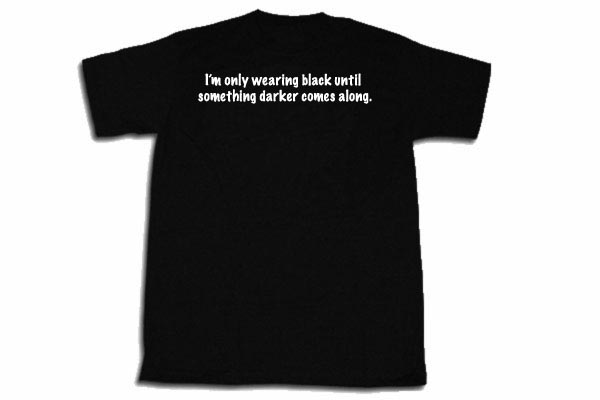
  • only_wearing_black.jpg

    finding pants in unexpected places

    From the pantheons of pants I bring to you the the ultimate excercise in pants procrastination¹. Upon my recent realization that the word procrastination contains the letters of the word pants, my mind has suffered an onslaught of other words which contain pants. You see, pants are that pervasive. So I offer to you the following bit of complete nonsense, just for the sake of using all these pants-containing words.

    I recently read an article about a distinguished pantologist, who is being recognized for her life’s work.

    She is best known for her prediction of an alignment of planets, for which she used computations based on her observations of a species of bee that pollenates resupinate plants. She also recently received international attention for her study on the mating habits of the spantangus, large percentages of which were highly unexpected by the scientific community. She has hundreds of publications in dozens of fields, on topics ranging from pantheism and theories of pantisocracy, to histories of Pakistan and Palestine, to the cultivation of eggplants. She holds patents for many inventions, including a method for stapling using only dental floss, and various contraptions, such as one for plasticizing antipasto displays for restaurant windows, or another for separating vast quantities of egg whites from the yolks. It is hard to say which of her many achievements is most representative of her work.

    She is a passionately creative spirit as well, and one of her favorite leisure pastimes is spattering colorful paints on paper, and pasting on patterns of pastina. She is also a talented pianist, and tapdances whenever she has the opportunity.

    The pantologist attributes much of her early explorations into vast areas of knowledge to the eccentricities of her parents, with whom she has a strong relationship, and whose intellectual partnership was an inspiration to her. Her father was once a pantomimist, known for a routine of silent stamping of feet (clad in his signature pantoffles) and for his impersonations of 17th century philosophers and contemporaneous politicians. He left the entertainment industry after a complaints from a reviewer suggesting that his acts catered only to the whims of his sycophants. He then became quite reclusive, and dedicated his efforts to designing closets and pantries for small apartments. Her mother once had aspirations to become a paleontologist before becoming a veterinarian, with a specialization in elephants (which are known to be disproportionately challenging patients). Upon retiring, her parents devoted their time to running the family’s plantations, which primarily grow plantains and peanuts.

    The distinguished pantologist’s record is not untarnished, however. There were some phantoms of rumors of misappropriation of funds, as well as some speculation about the ethics of some of her experimentations. There was the well-publicized scandal of 1983, during which she received some criticism for a study on the benefits of regular naptimes, in which participants were misled about the compensation they would receive. Her interpretations of data have also sometimes been called into question, and her explanations have not always been transparent. Her fan base, however, anticipates that these minor problems will soon be forgotten, and that she will be remembered for her accomplishments.

    An award ceremony, an event with all the trappings for which elaborate preparations were made, was held last week. The article contained a brief transcript of the highlights of the award presentation, during which the distinguished pantologist surprised the audience with a spontaneous anecdote about an embarrassing incident from her youth involving the mispronunciation of the word cephalopod. The article was also accompanied by a few images, some with rather cryptic captions.

    Okay, there it is. Anyone want to count how many words in this post contain the letters p-a-n-t-s? (I actually haven’t counted yet myself. I have work to do, you know.)
    —————-
    ¹ An expression for which I now have (thanks to azahar, and the anagram generator to which she referred me) a veritable abundance of anagrams:

    How about A Catnap Torsion Sprint? Or A Transact Pinion Sport? Or maybe A Tsarina Popcorn Stint?

    the eggplant strikes back: the vegesaga continues

    This is week 8 of my CSA adventure.

      2 pounds of beets
      1 pound of carrots (donated from another farm, as the carrot crop failed at the farm I go to)
      1 pound of cucumbers
      a bunch of onions
      a pint of pick-your-own peas (though I just picked a half pint, as it was raining, and the pickin’s were looking slim)
      1 small japanese eggplant (I traded in my bunch of onions for a second eggplant.)
      1 small summer squash or pepper (I chose an eight ball zucchini)
      1 bunch or chard or kale
      1 sprig of thyme or marjoram
      1 bunch of basil
      1 ping pong ball-sized tomato

    I’m feeling a bit down on this veggie business just now. I sent out an email to a bunch of local friends inviting them to come in small groups, and giving a choice of a dozen or so dates. It turns out that many of them want to come and/or are only available on August 2nd, and no one is available this week. It will be fun to have the bunch of folks, though I hadn’t intended to throw a party 2 days before our big trip. However, I actually won’t have enough vegetables to feed them all. I can save the beets and carrots from this week, but most of the vegetables don’t really last from one week to the next. And the point was to feed people farm-fresh vegetables, not ones that were a week or more old.

    So I had a thought. Since I’ll be going away for 2 weeks, I thought perhaps I could see if I could pick up 2 shares worth next week. I know that lots of people go away during the summer, and there always seem to be a lot of vegetables at the end of the night when I arrive at the tail end of the pick-up. So, I asked the farmer. I didn’t know what she’d say, and knew that “no” was definitely a possible answer. I was prepared for the “no” answer.

    What I wasn’t prepared for was how irritated I would be by that answer.

    Her first answer was, “no, it’s not possible, because of the way the vegetables grow.” When I mentioned that other people might also be going away at various times over the summer and might want to switch a week, she said, “Oh, I see. But it would be too hard for me to keep track.” What I find irritating is that I could think of several ways off the top of my head that it would be feasible for people to arrange these things without it taking up much of her time. She writes in her emailed newsletters that she wants to encourage a sense of community, but all communication between members of this “community” is filtered through her. If there were even some sort of bulletin board, or virtual bulletin board, I could post a request that someone swap a week’s pick-up with me, and then some other member and I could communicate directly. But the answer was “no, I can’t keep track.” (Well, when I explained about the horde of people coming for dinner next week, she did say I could email her and that she’d consider if she learned of someone planning to forfeit their share for the week. But it doesn’t seem too likely this will work out, and I will feel like I’ve put her out.)

    And then I’ve realized that part of my irritation was not just about her answer. It’s her farm, her business, so her decision. She needs to decide what works for her. But the trouble is, there have been a number of things that haven’t worked for me as well as I’d hoped.

    One main issue is that I hadn’t realized how little of the share would actually be food that Phoebe will eat. (We’ve tried, but she’s become pickier.) There have been greens and onions and kohlrabi, radishes and herbs, garlic and bok choi. And then there was all the lettuce. (Do all the other members really not find 5 heads of lettuce a week to be excessive?) Phoebe won’t eat lettuce, and I can’t even freeze it for later. Here I’ve been collecting more vegetables each week than I’ve ever used before, and then we’ve had to buy additional vegetables for Phoebe. It seems so wrong to be buying frozen broccoli and peas when I have a fridge full of farm-fresh vegetables.

    And I’m irritated that I’m trying to be all supportive of this CSA business, and spread the word, and encourage people to consider trying it out. And right now I don’t feel so gung ho. It’s been a fair amount of work, both to go get the vegetables (I even had to rearrange my schedule to be able to make it to one of the two weekly pick-up dates) and to prepare them.

    I know that there’s a lot of variation in how the farms and CSA shares operate. My advisor at school is also participating in one, and the deal he gets sounds more appealing. He doesn’t go to a farm, but to a pick-up location that is in or near Boston. What he’s gotten in his weekly shares also sounds more appealing. So maybe I just need to find a different CSA next time around.

    So, like all relationships, we’ve had a few bumps. I’m sure that we’ll make up again in a few weeks. I have enjoyed the veggies we’ve gotten so far, and we’re eating more healthily than usual, possibly more healthy than ever. But for now, I think I’ll sit and pout and give the CSA the cold shoulder.

    psychic baby (qu’est-ce que c’est?)

    You know how when you’re expecting a phone call, or waiting for someone to show up at the door, it’s hard to settle down and concentrate? Well, that’s how I usually feel when Phoebe’s having a nap.

    Even though she usually naps for about an hour and a half, the time zips by. I get her settled, putter around for a few minutes, and usually open up my laptop. To, well…putter. Before I know it, 45 minutes have elapsed. And I think about getting to work. Knowing that I probably have only about 45 minutes.

    Today, we were down at John’s parents. (We’d gone down for the weekend to get in a visit before our big trip.) The plan was to head out to the rehab center to visit John’s dad after Phoebe’s nap, and then to go directly home. So, once Phoebe was napping, my puttering included some packing and getting organized. I read some stuff online, answered a couple emails, and did some other puttering and even some work-related stuff.

    It looked like Phoebe was going to have a longer than usual nap. She was upstairs, and the baby monitor was with us downstairs.

    I’d started reading the new Harry Potter last night, and managed to read about 15 pages before I fell asleep. In this unexpected quiet time, the book beckoned. John was sitting reading his copy of the book. (Yes, we did buy two copies yesterday.) I commented to him that I felt like whenever I settle down to do something focused, Phoebe always wakes up. “I feel like if I sit down to read, she’ll wake up.”

    After some more deliberation, and couple more minutes of quiet from the baby monitor, I decided to pick up the book. I sat down. I said to John: “Do you want to time this?”

    I started to open the book.

    “Waaaaaahhhhhh!!” said the baby monitor.

    I slammed the book shut. And there was silence.

    Tell me, how did she know?

    Harry Potter and the 25,000% return on investment

    Tonight marks the historic release of Harry Potter and the Deathly Hallows, which, in case you have just awoken from a coma, is the the seventh book in the phenomenally popular children’s fantasy book series by J. K. Rowling. Like millions of others around the world, I’m looking forward to adding this book to my collection of the first six books of the series.

    I’ve been a book lover for as long as I can remember. I was a voracious reader through all my school years, up through high school. But having moved around a lot, I didn’t actually own a lot of books until college. I really started collecting books shortly after I got out of college.

    Back in 1998, I worked in a large bookstore. John and I were doing our Christmas shopping. Back in my bookstore days, everyone in both of our families got books for gifts. Or at least something we could buy at the bookstore. For one thing, the 30% employee discount was great. For another thing, just seeing all those books all the time gave ideas for gifts.

    At one point during our shopping trip, we were looking for a gift for John’s 8-year-old nephew. He was a really smart kid, but he wasn’t really a reader. I think he was reading Goosebumps at the time, but that was about it. John and I both love books, and we thought maybe we could find something fun that would be a bit higher quality. We asked the children’s department supervisor about any new books, maybe a fantasy, since it was a genre we both liked. She mentioned one that she had heard was good. Harry Potter and the Sorceror’s Stone, by some new British author. There were a couple of copies of the new hardcover in the store, not enough to even put on display anywhere. As a matter of habit, as a collector, I checked to make sure they were first printings. They were. We grabbed both copies: one for the nephew, and one for us. (It looked like a fun read, and like a good addition to my growing collection of children’s fantasy books.) We wandered around a bit more, and reconsidered the book as a gift for the nephew. It was a pretty big, thick book for a kid who didn’t really read. We put one back, opting instead for a Klutz Lego book, but kept the other copy for ourselves. (Because whenever we went shopping for books for other people, we always found things for us.)

    The list price of the book was $16.95. I bought my copy during the annual “employee appreciation days,” which were a few days in early Decemeber when employees got a 40% discount, instead of the usual 30%. So I paid a little over $10.00 for the book, plus 5% Massachusetts sales tax.

    The book jacket got wrapped in Brodart, and then John and I both read the book. (Probably John read it first, since he reads a lot faster than I do.) We both enjoyed it, and enjoyed talking about it. The book then joined the ranks of all the other books, on one of the crowded shelves, in our little apartment that was jam-packed with books.

    Within a few weeks, customers started coming into the bookstore asking for a book they’d heard about on the radio, or read about. Some had the title and author. Many couldn’t quite remember either. I remember one woman asking for a book that was about rabbits, but who wore glasses. (The Beatrix Potter association was strong in some people’s minds.) Within a few months, the popularity was booming. The book made it onto the New York Times best-seller list, something unprecedented for a children’s novel. By the time the second book was released in the US, in 1999, everyone knew Harry Potter’s name in the bookstore. In every bookstore, probably.

    I was working in another bookstore the summer of 1999, as assistant manager of a smaller store of the same gigantic chain. The bigger store where I’d worked before, which often got big name authors in for signings, was scheduled to have J. K. Rowling in for a signing. Being a book collector, I also appreciated having autographed books when possible. So I planned to attend. I made sure to work an opening shift that day, so I could make it out to the bigger store for the evening signing. As the day went on, I got hints that the event was going to be bigger than I’d realized. I heard about large numbers of people already queuing up for the signing. I coudn’t leave work early, and started to worry about getting a place in line. I actually called the big store to ask if they needed additional staffing, thinking both that they would need the help, and that it could get me in the store without the line. But they said they were all staffed up to the gills.

    After work, I drove out to the big store with friend from work. When we got to the store, there were people lined up all the way around the side of the building. I’d been to many, many other book signings before, but hadn’t imagined anything like this.

    I had brought both of my books with me: my prized first printing of the first book, as well as the recently released second book, of which I also had a first (though much less prized) printing. We’d been told that Rowling would only be signing one book per person, though. So I left one book in the car, carefully wrapping the other in a plastic bag.

    There were literally hundreds of people in line ahead of us. I don’t remember if people were lining up inside the store as well, or if all had to line up outside. From where we waited, we couldn’t actually see the front of the building, let alone the front door. It was a fun wait, with the excited crowds and the anticipation of seeing the already legendary author. The weather was beautiful (whatever month it was), and I had a friend to pass the time with. The signing was probably scheduled for 7 or 8, so there was a lot of time standing around before the line even moved. I remember that it was dark by the time we got to get in the building. Police were guarding the doors, to make sure only those standing in line could get in. Once we were in the building, we could see that the line was still very long, snaking though a few aisles of the warehouse-sized store. We got in, but not many people behind us did. It seemed they were only letting in about 600 people. Rowling had agreed only to sign for a limited amount of time.

    Relieved and more excited, as the line scooched forward, I got my book out the plastic bag, looking at it for the first time since I’d gotten in line. There was my copy of Chamber of Secrets.

    I’d grabbed the wrong book.

    Suddenly, the line seemed to be moving all too quickly. I’d parked at the back of the building. My precious first printing of Sorcerer’s Stone was out in the car. Police stood at the door of the building, making sure that no one else was getting in.

    This is where my job paid off. I got the attention of a manager who knew me, since I’d worked there a few months earlier. I told her what happened. She grabbed her manager’s keys and nametag lanyard from around her neck, put it over my head and said: “Run.”

    It had been a long day at work, I’d been standing in line for 3 hours in my work clothes and shoes, and I am not, I repeat not, a runner. But I can tell you that I ran. Ran to the back of the store, let out by the police, ran around the building, out to my car and and back to the front door. The police barred my entrance, but “my” nametag and keys to the building convinced them to let me pass. And yes, this time I had the right book.

    By the time I got back, my friend was almost at the front of the line where J. K. Rowling herself was, sitting at table and signing book after book at a breakneck pace. I joined my friend in line, feeling both victorious, and like a total dork. But within minutes, I was in front of Rowling herself, holding my book open to the pre-determined page, where she would sign her name. (Just her name. No date, no personalization. Fine by me.) I may have said something to her, of the generic type, like “I really love your books.” I remember that she looked up at me, and smiled a half smile. Her eyes looked tired. And then it was over. I was now the proud owner of a signed first printing of the first American edition of Harry Potter and the Sorcerer’s Stone.

    As it turned out, when Rowling finished signing the books for the customer’s standing in line, she was finished signing. She didn’t sign any books for the employees working in the store, including a friend of mine who was still working at the big store, and who also had a first printing of Sorcerer’s Stone. While I can understand that she was tired, and had just signed her name an unbelievable 600 times in less than 2 hours, it did seem pretty shabby to me to refuse to sign another 20 or so books for the people who worked in the store. But that is how the cookie crumbled.

    My friend with the first of the first book sold hers, the unsigned, first printing of Sorcerer’s, for $1000 on ebay shortly after that.

    I’ve kept mine, and the value has continued to go up.

    Had the big store taken me up on my offer to work the event, I would have lost out. Had I not had my “connections” at the store, though, I would have ended up getting my second book signed, which would have been worth a few hundred dollars. But as it turned out, a ten dollar purchase, a few hours in line, and quick sprint around a large building have landed me with a book that I’ve seen selling for between $2500 and $5000 dollars. My copy’s been read, so may not be in pristine condition, though I would say it’s “near fine.” So it would probably go for the lower end.

    Still, not such a bad return.

    berry me deep

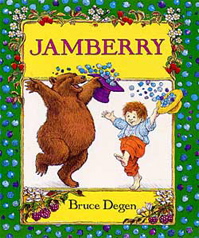
    jamberry.jpgOur blueberry-picking excursion of the weekend has me thinking about berries. Mmmmmm, berries.

    I love berries. And so do lots of other people. Berries show up in muffins, pies and other baked goods. Also in lots of books and folktales, and few songs. Plus a few other places you wouldn’t expect to find berries. Which is how berries ended up in my list of themed things.

  • Jamberry, by Bruce Degen
    A book of a bear, a boy, and many, many berries. Blueberries, strawberries, raspberries and blackberries. And silly rhymes.

    Quickberry, quackberry
    Pick me a blackberrry

  • Blueberries for Sal, by Robert McCloskey
    A picturebook of berry-picking and bears, and mistaken identity.
  • Blueberry. The name of my stuffed bear I got from my mother for my fourth birthday. I still have him.
  • Violet, the gum-chewer of Charlie and the Chocolate Factory (the book by Roald Dahl, and the movies based on it) turns into a giant blueberry.
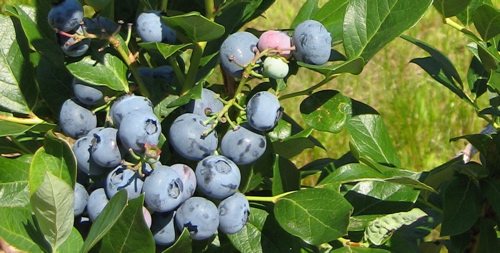
  • blueberry_crop.jpg

  • Firefly & Buffy. Maybe Joss Whedon has a thing for strawberries. In Firefly, strawberries are a luxury item and valued commodity. A box of strawberries is what Book uses to convince Kaylee to take him on as a passenger in the pilot episode. In the Buffy Season 6 episode “Wrecked,” the creepy Rack tells Willow “you taste like strawberries.” (I also feel like there was a scene in the bronze at some point where some random dancing person gets briefly turned into a giant strawberry. Am I imagining this?)
  • strawberrywatercolor.jpg

  • Strawberry Shortcake. The doll. The cartoons. The empire. I still remember the commercials for the doll from when I was little. I can still hear the song, with it’s mockable swellness:

    Strawberry Shortcake
    My she’s looking swell!
    Cute little doll
    With a strawberry smell.

  • The Little Mouse, the Red Ripe Strawberry and the Big Hungry Bear, by Don Wood Another picture book. About a mouse. And a strawberry. Also some mention of a bear.
  • The Grey Lady and the Strawberry Snatcher, by Molly Bang. I don’t actually know this berry-oriented book, though it won a Caldecott Honor medal. I liked the author’s story of struggling to get it published.
  • The Strawberry Legend. A Cherokee Legend where a woman forgets her anger and remembers her love as she eats some berries. (There’s at least one book version, too.)
  • The Blackberry Bush, a folktale in the book Stories to Tell to Children by Sara Cone Bryant.
  • Blackberry . One of the rabbits from Watership Down, by Douglas Adams.
  • BlackBerry. An electronic device. John had one for a couple of years. He would sometimes throw it when he got email because it would irritate him so much with its onslaught of interruptions.
  • Blowing a raspberry. Okay, it has nothing to do with berries. It’s when you make a sort of continous spitting noise by sticking your tongue between your lips and blowing, or by blowing through loosely closed lips. I have no idea why it’s called a raspberry.
  • Knott’s Berry Farm. Not actually a farm, and not so much berry-ish. It’s a large amusement park. But the founder did sell berries.
  • Frankenberry. A cereal. Berry-flavored. Also a cartoon character from the cereal box and commercials. Has a bit of a cult following. (There also seem to be some other meanings to Frankenberry, as seen on Urban Dictionary, but they seem pretty lame to me.)
  • Finally, here are a few berry songs that I picked for you:
    • Raspberry Beret, Prince (Okay, not really about raspberries)
    • Blueberry Hill, Louis Armstrong (Not really about blueberries)
    • Strawberry Fields Forever, the Beatles (…nothing is real…)
    • blueberries_2.pngraspberry_sm.pngblackberries_orig.pngstrawberries.png

  • and they were like, “yeah, whatever, it’s the quotative like”

    So here I was, sitting here with my laptop when I should’ve gone to bed. And having just finished a task of actual work, I continued to poke around on my laptop, looking around what other folks have written. And then (dude!), what catches my eye but a post on the quotative like.

    As you may know, I’m all over the quotative like. So I couldn’t help but to check it out. And what’s more, I learned that there’s even a recent New York Times Magazine column on the topic. And I was like, “Woohoo! Quotative like is hitting the mainstream!”

    The article’s a quick read, and generally fairly accepting of the quotative usage of like. However, I don’t entirely agree with the author’s categorization of the quotative like as a function word:

    O.K., the new like is hot and it’s useful, but is it legit? Aren’t some rules of grammar or usage being broken here?

    Linguists and lexicographers say no. It’s natural, they say, for words to take on new roles. In this case, a “content word” (one that means something) has become a “function word” (one that has a grammatical function but little actual meaning). Academics call the process “grammaticalization.” It’s one of the ways language changes.

    I would tend to categorize the quotative “like” as a content word, not a function word. But it’s a bit tricky. But it does make me ponder the origins of the usage. I wonder if it arose from the hedge-like interjection form of “like.” You know, the one that, like, people toss in that doesn’t, like, add a lot of meaning? I can imagine an origin based on a usage like (such as) “…and then he said, like, ‘no way.'” or “I thought, like, ‘his use of that discourse marker was infelicitous in that context.'” If my hunch is right, then this would be a case of a word becoming more contentful…

    breaking the spell of procrastination

    I’ve lateley spent some time thinking about procrastination. And not just about procrastination, but about procrastination. The word, that is. Perhaps because I’ve been spending a lot of time procrastinating. Inspired by Sage‘s Word Wise Wednesday tradition, I thought I’d share a bit that I’ve learned about the etymology of procrastination. Remarkably, the meaning of the word has not drifted far, at least according to the Online Etymology Dictionary:

    procrastination
    1548, from L. procrastinationem “a putting off,” noun of action from procrastinare “put off till tomorrow,” from pro- “forward” + crastinus “belonging to tomorrow,” from cras “tomorrow,” of unknown origin. Procrastinate is recorded from 1588.

    It’s terribly unmysterious.

    I was quite interested to note, however, the description of the word as a “noun of action.” In my experience, it often seems to be more of a noun of inaction. And what’s more, observe that one can spell the word inaction from a selection of the letters of the word procrastination. Coincidence? I think not.

    Because let’s face it, without inaction, procrastination just wouldn’t be the same.¹

    You may also be interested to learn that, in addition to inaction, the following words (and many, many more) can be made by using letters of procrastination:

    pasta, carrot, onion, poi, toast, pots, coin, top
    trap, scrap, ration, nation, station, Patton, stint, coot
    tint, print, caption, croon, tiara, stair, star, icon, coop
    scoop, poo, poots, crap, strip, carrion

    and, you may be happy to learn

    stop

    And do you want to know what got me a-ponderin’ about procrastination, and the words one can spell from its letters? I realized that one can spell…pants.

    Pants!

    And of course, realizing that made me want to come up with a full-blown anagram for procrastination with pants. It’s been tricky, but here are my candidates.

    Croatian roi pants²

    coir pants ration³

    I think my best attempt is this one:

    Rio pants action: R

    ————————-
    ¹ Actually, without inaction, procrastination would end up something like prorast. And where would that get us?

    ² Using the a French word roi, meaning “king.” Or alternately “Croation iro pants,” using a Japanse word, iro, meaning “color.”

    ³ Where coir is a fiber that might be a bit rough for pants.