Well, golly!

I’m seriously amused. There is a quiz out there called “The Blog Cuss-O-Meter,” which I saw at casa az last night (and at raincoaster a few days ago when I was too busy to give it a spin). I thought to myself “screw it, I hardly ever swear on my blog,” but I took the quiz anyhow. Here is the result I got:

The Blog-O-Cuss Meter - Do you cuss a lot in your blog or website?

(The site further gives this bit of info: “This is 791% MORE than other websites who took this test.”)

This surprised me more than a little, especially given that others who took this were surprised at how low a score they got. In spite of having decided, and stated, that I reserve the right to swear on my blog, I tend to shy away from using certain words in my writing that more easily leave my lips when I am, for example, driving. Hell, I wrote a whole post last week where I played with “crap” as a theme, but I somehow avoided using the word shit.

For example, I’d just like to point out that the word fuck appears to appear in only 4 posts in the history of this blog, which means just over 1% of the posts. (And one of those uses is on an image of a little candy heart. Doesn’t that make it sugar-coated?)

But I do use a lot of mild taboo words. My guess is that somehow, the ass in kick-ass, as in my tag “kick-ass women” is responsible. (Yes, I’m saying my ass is responsible.) It’s in my sidebar, so may count as being in basically all of my pages somehow. Otherwise, what do they consider?

Seriously, this makes me want to do an experiment. Anyone want to try adding some shit or something to their sidebar to see if they can inflate their score?

(Oh, and by the way, I’m back home. The conference and trip were really great. The presentations went well. I saw lots of people I wanted to see. And now I’m really fucking freakin’ damn quite palpably tired and need to get ready for the next conference, now less than 3 weeks away.)
going bananas

With work keeping me crazy busy, and life in general pulling me in all sorts of directions, it’s no wonder I feel I’m going a bit bananas. And what with yesterday’s big banana-related news, it’s no wonder I’ve got bananas on the brain. Seeing as I don’t have a whole lot of time tonight, this ThThTh list may be on the short side. So please feel encouraged throw in your own bananas.banana_bunch_1.png

A small bunch of bananas

  • banana split. An ice cream sundae characterized by a banana that has been split in half lengthways.
  • The Tattooed Banana: a blog devoted to “the emerging appreciation of banana art.”
  • Banana Yoshimoto. A Japanese author. Not actually a banana. Her first novel was Kitchen.
  • Bananarama. An 80s musical group. They weren’t bananas either. Actually, the members were all female.
  • Yes, we have no bananas.” A song that was a hit in the 20s. (…we have no bananas today…)
  • The Banana Boat Song.” A song made famous by Harry Belafonte. Here’s a clip from the movie Beetlejuice with the song:
  • top banana. An expression meaning “head honcho” or “big cheese.” Has origins in burlesque performances.
  • slipping on a banana peel. A common slapstick-type sight gag. (cf. this batch of cartoons.) For further insights into the phenomenon, check out this insightful post, which also led me to this fabulous banana-peel-slipping-related dialog from the 1966 Batman movie:

    Batman: [reading a riddle] What has yellow skin and writes?
    Robin: A ball-point banana!
    Batman: [reads the second riddle] What people are always in a hurry?
    Robin: Rushing people… Russians!
    Batman: So this means…
    Robin: Someone Russian is going to slip on a banana and break their neck!
    Batman: Precisely, Robin!

  • Banana in the tailpipe: a prank involving shoving a banana up the tailpipe of a car, causing the engine to stop. Made famous by a scene with Eddie Murphy in the movie Beverly Hills Cop (1984).
  • This may come as a shock to you, but I find the word banana itself to be funny. (Yes, much like the word pants.) I might even go as far as saying that I find banana to be an inherently funny word. This may be part of why bananas are featured in a lot of jokes. Some of them remarkably silly. I found a page of banana jokes that someone posted on a joke blog, and lookie what I found there:

    Knock knock
    Who’s There?
    Banana
    Banana who?
    Banana Pants.

  • banana_peeled1.png

    throwing together a themed list (even though it’s not Thursday)

    125_125_banner_a.jpgI came across¹, a site that I think is pretty fun. It’s got a bit of a running vocabulary quiz. At the same time, the site is set up such that for each word you get right, 10 grains of rice get donated through the United Nations. (The rice is paid for by advertisers.)

    It’s kinda cool to see the running totals they have posted, too. The site only started on October 7th of this year. Yesterday, 198,342,51 grains of rice were donated, whereas 6,645,520 were donated 1 month ago.

    Anyhow, that’s getting to be a decent amount of rice. And it’s inspired me to throw together a bit of a list of rice things. Even though it’s not Thursday. It’s a short list, anyhow.

    A Few Grains of Rice

    1. One Grain Of Rice: A Mathematical Folktale A picture book by Demi.

      It’s the story of Rani, a clever girl who outsmarts a very selfish raja and saves her village. When offered a reward for a good deed, she asks only for one grain of rice, doubled each day for 30 days. Remember your math? That’s lots of rice: enough to feed a village for a good long time–and to teach a greedy raja a lesson.

    2. On a Bed of Rice: An Asian American Erotic Feast, edited by Geraldine Kudaka. An erotic anthology. I like the name, what with the mixed meanings of food and sex. And if there are two things I like (aside from pants), they’re food and sex. (I also just found myself thinking that a somewhat similar phrase would make for an interesting book title, too. “On a Bed of Noodles.” Perhaps it could be an erotic humor anthology.)
    3. “Rice, rice baby,” by Weird Al. I think you can guess which song it parodies.
    4. 米国 beikoku, a Japanese term for the US, which means “rice country”

    ——

    Aside from the bit about donating rice, I find it fun to test my word knowledge and learn new words. So far, my favorite new word that I’ve learned is, without doubt, omphaloskepsis. It means navel-gazing. And then I thought to myself, “now that would be a fine blog name.” Indeed, it is.

    Other words I have encountered which make me happy include the following:

      eructate=belch
      anserine=gooselike
      bumbershoot = umbrella
      edentulous=toothless
      demulcent = soothing

    Anyone want to go play for a bit and bring me back some tasty word morsels?

    —–

    ¹ I came across links to this site at least 3 times, though I can only track down one, which wasn’t even the first place I saw it. Anyone else reading this post about it?

    I do doodle. Do you?

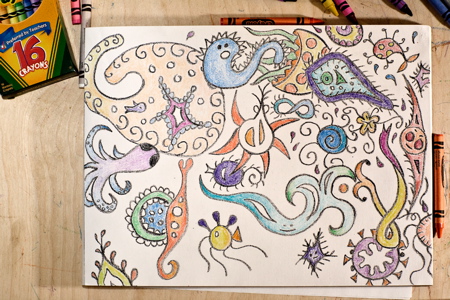
    I doodled today. I do like to doodle. (I also like to say the word doodle. Also noodle. I may well have to doodle a noodle just so I can talk about it.) Anyhow, here is what I did doodle.

    doodle.jpg
    My doodle, as photographed by John.

    Today we went into Boston (John, Phoebe and me) to go to a computational linguistics meeting. We (that is John and I, not Phoebe) were part of the group’s foundation almost 6 years ago, and were very active in the group for several years. But for that past few months, the group has been largely hibernating. (Not the people so much. They’ve been largely awake. But busy.) We’ve decided to reanimate the group, though. Which is great. I did, however, volunteer to do actual work for said group, before my mind had a chance to catch up with my mouth. And as such, I have given myself even more metaphorical bagel over which to spread my figurative cream cheese.

    After the meeting, John wanted to go to a camera shop in Cambridge. This seemed fair, especially since all during the meeting, John had been pretty tied up with Phoebe. (Don’t worry, not literally tied up. We used duct tape, not rope. No, no, no, I mean John was busy keeping Phoebe occupied.) We’d brought a few toys, but they didn’t hold interest her for long. John and Phoebe went wandering for a bit, and came back with, among other items, a new box of crayons and a pad of drawing paper.

    By the time the meeting finished, over an hour past Phoebe’s usual naptime, Phoebe was both wired and tired. Within a few minutes of being back in the car, though, she was out. (As in asleep. But still in the car.) So when we stopped at the camera store, I decided to just hang out in the car with Phoebe so she could nap. I figured I had my laptop to keep me busy, anyhow, and I could even do some work. However, my laptop ran out of battery within a few minutes. And I found myself with no reading material other than a sort of sad little board book we’d gotten from the pediatrician’s office.

    So I decided to take advantage of the crayons.

    Here’s what I doodled while waiting in the car. (I did a bit of the coloring after we were moving, but discovered that I get carsick when drawing in the car. Not something I’d known. I can’t read in the car, but I didn’t realize doodling would be a problem.)

    img_2514.jpg

    I added a bit more to it while John was giving Phoebe a bath.
    img_2520.jpg

    Then I finished it up once Phoebe was in bed.

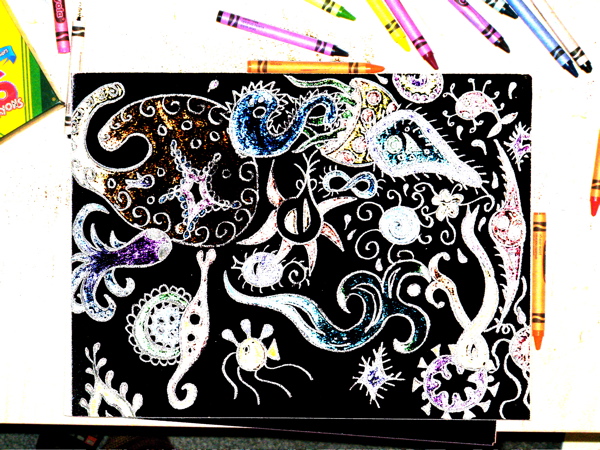
    I also fiddled a bit with the levels in iPhoto, since I had trouble getting the color right in the picture. (These 4 photos are ones I took, by the way.) And I stumbled across this weird effect: when I boosted the saturation and the contrast, there was a point in the levels adjustment where the white paper appeared black, and the opaque crayon bits came out white. Nifty, huh?
    img_2524.jpgimg_2524_2.jpg

    squawk

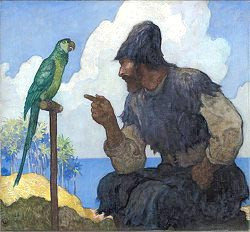
    pirateparrot.jpgHere it is, the day after International Talk Like a Pirate Day, and I’ve still got pirates on the brain. But rather than bringing you a list of pirates for this week’s Themed Things Thursday, I’ll bring you a list of the frequent pirate’s companion: the parrot.

    A Flock of Parrots

    1. Parrots are frequently to be seen on the shoulders of pirates¹, specifically of fictional pirates. Captain Flint was a pirate’s parrot in Treasure Island, the pirate novel by Robert Louis Stevenson. More recently, we’ve seen the pirate in the Pirates of the Caribbean movies.
    2. Parrots, especially African Grey Parrots, are well known as birds who can imitate human speech.
    3. This is no doubt the source of the use of the word parrot as a verb (transitive), meaning repeat without really understanding. As in “They parroted my parrot jokes, but none of them laughed.”
    4. You can find a variety of parrot jokes out there. (These even a site with pirate and parrot jokes.) This is probably my favorite parrot joke.
    5. Polly want a cracker? The stereotypical parrot sentence, whether said to a parrot, or by a parrot. Possibly popularized in Robert Lewis Stevenson’s Treasure Island.
    6. Poll or Polly has been a common parrot name for centuries, with an early documented use from 1611.
    7. Also in the nursery rhyme:

      Little Poll Parrot
      Sat in his garret
      Eating toast and tea;
      A little brown mouse
      Jumped into the house,
      And stole it all away.

    8. Then there’s the song “Polly,” by Nirvana

      Polly wants a cracker
      I think I should get off her first
      I think she wants some water
      To put out the blow torch

    9. Or Paulie (1998), a movie about a parrot.
    10. Parrots have been featured in various folktales from around the world, like 2 Buddhist folktales from India “The Brave Little Parrot.” (who puts out a forest fire²) and “The Steadfast Parrot” (who is faithful to a tree) and an
      Italian folktale (involving a prince who has himself turned into a parrot).
    11. Other moderately famous parrots include Waldo the Parrot, from Twin Peaks (who seems to have been present, and biting, the night of Laura Palmer’s death) and Parrot, the parrot with biting sarcasm from the Terry Pratchett novel Faust Eric
    12. Parrot Heads are the nickname given to fans of the musician Jimmy Buffett
    13. And to round things off, I bring you Python’s parrot. The ex-parrot. He is decidedly not pining for the fjords.

    ————————–

    ¹ Or about the arms and head, especially of those posing as pirates.

    ² Kind of like a friend of mine did recently, except he used a plastic bag to put out the fire.

    how to talk like a pirate

    jolly_roger.jpgWell, it’s finally arrrived. Today, September 19th, is Talk Like a Pirate Day. You’ve gotten yourself a pirate name, and brushed up on your pirate job skills. But are you still unclear on how best to talk like a pirate? Have no fearrrr.

    There arrre many avenues to explore in learrrning how to talk like a pirate. An important resource is the “how to” page of the official Talk Like a Pirate Day website. There you can learrrn the basics (the 5 “A”s), more advanced pirate terminology (don’t confuse your hornpipe with your bunghole), and even advance all the way up to pick-up lines like this one:

    How’d you like to scrape the barnacles off of me rudder?

    In case you don’t have time for such intensive language study, you may find one of several translators handy, like this one or this other one. This one acts as more of a phrase book, and allows you to produce such eloquent discourses as this:

    Ahoy, me proud beauty! Be that th’ market? I’ve a fierce fire in m belly t’ have a bit of a lie-down’

    Of course, it’s also important to work on your arrr, long considered to be one of the hallmarrrks of pirate speech. (If you’d like to learn the history of this phenomenon, The Language Log discussed this a couple of yearrrs ago.)

    Here’s what you do to say “arr”:

    1. Step one: Say “ah”. (Your vowel may vary by dialect; [ɒ], [a] and [ɑ] are probably all legitimate.) You’ll probably want to put in a glottal stop at the start [ʔ].
    2. Step two: Quickly lower your third formant to produce the [ɹ] sound. This can be accomplished by curling the tongue back (retroflex “r”) or by bunching your tongue up (bunched-tongue “r”)

    Now, if you want to say “arrr” like a pirate, the instructions above are just a starting point. To produce the piratical “arrr” tha we’ve come to expect. (Cf. Geoffrey Rush saying “arrr” in Pirates of the Caribbean), you really need to growl it. And for me, at least, this seems to possibly involve some pharyngeal frication, and possibly also some additional voice quality modifications. I’m not sure what I’m doing (not really just creakiness or breathiness), but it sure as hell isn’t modal phonation. A really effective arrr will also be quite loud: push the air strongly through those vocal folds, dammit. On top of all of this, you’ve got to really drag it out, especially the [ɹ] part. (Keep that 3rd formant down.) Arrrrr!!!!!

    In an experimental study, subjects (N=2) produced both “normal” and piratical arrrs. Piratical arrrs were between 2 and 3 times the duration of “normal” arrrrs. See figures 1 and 2, below.

    Figure 1: Arrrr! vs. ar, speaker A (male)
    j_arrrr.jpg

    Figure 2: Arrrr! vs. ar, speaker B (female)
    a_arrrr.jpg

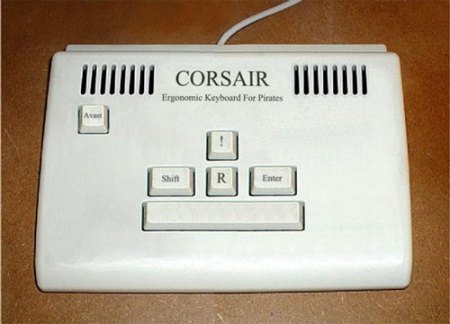
    And in case you don’t have occasion to speak out loud today, you might try some pirate-style typing.
    piratekeyboard1.jpg

    RRRRRRRRRRRRRR!!!!!!!

    You want the pants? You can’t handle the pants.

    Well, maybe you can handle the pants. In fact, I’ve promised pants. And I’ve given pants. And I think that you deserve more pants.

    In the great tradition of the pants game, I offer to you the following great movie pants movie moments:

    • “Go ahead, make my pants.” — Harry Callahan (Clint Eastwood), Sudden Impact (1983)
    • “You can’t handle the pants!” — Col. Nathan Jessep (Jack Nicholson), A Few Good Men (1992)
    • “May the Pants be with you.” — Han Solo (Harrison Ford), Star Wars (1977)
    • “Fasten your pants. It’s going to be a bumpy night.” — Margo Channing (Bette Davis), All About Eve (1950)
    • “The stuff that pants are made of.” — Sam Spade (Humphrey Bogart), The Maltese Falcon (1941)
    • “Show me the pants!” — Rod Tidwell (Cuba Gooding Jr.) and Jerry Maguire (Tom Cruise), Jerry Maguire (1996)
    • “I have always depended on the pants of strangers.” — Blanche Dubois (Vivien Leigh), A Streetcar Named Desire (1951)
    • “Round up the usual pants.” — Capt. Louis Renault (Claude Rains), Casablanca (1942)
    • “Pants? We ain’t got no pants! We don’t need no pants! I don’t have to show you any stinking pants!” — “Gold Hat” (Alfonso Bedoya), The Treasure of the Sierra Madre (1948)
    • “Oh, Jerry, don’t let’s ask for the moon. We have the pants.” — Charlotte Vale (Bette Davis), Now, Voyager (1942)
    • “Keep your friends close, but your pants closer.” — Michael Corleone (Al Pacino), The Godfather: Part II (1974)
    • “Get your stinking pants off me, you damned dirty ape.” — George Taylor (Charlton Heston), Planet of the Apes (1968)
    • “We’ll always have pants.” — Rick Blaine (Humphrey Bogart), Casablanca (1942)

    pigeon post

    On our recent trip, we saw many exciting things in France and Germany: monuments, museums, landscapes, rivers, you name it. For Phoebe, however, the highlight of the trip was getting to see so many pigeons. She saw pigeons all over the place! (See her chase a pigeon in the short, short movie I posted earlier this week.)

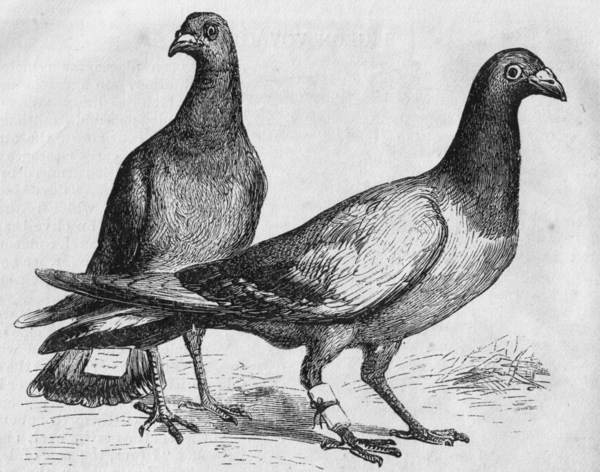
    Loved by some, hated by many, pigeons are a ubiquitous in cities the world all over. Some folks have been known to call them “rats with wings,” while others happily share their breadcrumbs with them. After its trip away, Themed Things Thursday flies home this week with a list of pigeons.

    • Don’t Let the Pigeon Drive the Bus, by Mo Willems. A picturebook about a mischievous pigeon who would like to drive a bus. (There’s a sequel, too, The Pigeon Finds a Hot Dog, in which the pigeon, and I hope I’m not giving too much away here, finds a hot dog.)
    • Wringer, by Jerry Spinelli. This Newbury Honor book is about a forbidden boy-pigeon friendship in a town that hosts an annual pigeon shoot.
    • pigeon_messengers_engraving.jpg

    • Ewan McGregor’s character in Little Voice (1998) kept pigeons as pets.
    • Valiant (2005) was a movie about a heroic World War II homing pigeon (voiced by Ewan McGregor…am I sensing a pattern here?).
    • Poisoning Pigeons in the Park, by Tom Lehrer. A song:

      When they see us coming,
      the birdies all try and hide
      but they still go for peanuts
      when coated with cyanide

    • Rapper Pigeon John is not really a pigeon, at least as far as I know.
    • Some may remember Sesame Street’s Bert dancing a pigeon-like dance to “doin’ the pigeon,” a clip of which is available on YouTube. (You can also see actual pigeons dancing, if you want to compare.)
    • There was an 80’s kids’ TV show called Pigeon Street. (The intro is also up on YouTube.)
    • dove.jpg

    • In spite of their bad reputation as a species, certain pigeons have received an especially elevated status for birds. Namely, bird of peace. In this context, the pigeon is referred to as a dove. A dove being a white pigeon.
    • Doves are featured in various myths and religious tales, such as the well-known story of Noah’s Ark. Land was found with the help of a dove, who flew back to the ark with an olive branch.
    • There is also a flock of pigeon-oriented idioms and terms such as:
      pigeon hole, stool pigeon, pigeon-toed, pigeon-chested, setting the cat among the pigeons, and pigeon blood ruby.
    • Brian Pigeon: There is even a blog out there written by a London pigeon. Check it out for a pigeon’s eye view of the world.

    pigeons_row.jpg
    Pigeons at Beaubourg.

    finding pants in unexpected places

    From the pantheons of pants I bring to you the the ultimate excercise in pants procrastination¹. Upon my recent realization that the word procrastination contains the letters of the word pants, my mind has suffered an onslaught of other words which contain pants. You see, pants are that pervasive. So I offer to you the following bit of complete nonsense, just for the sake of using all these pants-containing words.

    I recently read an article about a distinguished pantologist, who is being recognized for her life’s work.

    She is best known for her prediction of an alignment of planets, for which she used computations based on her observations of a species of bee that pollenates resupinate plants. She also recently received international attention for her study on the mating habits of the spantangus, large percentages of which were highly unexpected by the scientific community. She has hundreds of publications in dozens of fields, on topics ranging from pantheism and theories of pantisocracy, to histories of Pakistan and Palestine, to the cultivation of eggplants. She holds patents for many inventions, including a method for stapling using only dental floss, and various contraptions, such as one for plasticizing antipasto displays for restaurant windows, or another for separating vast quantities of egg whites from the yolks. It is hard to say which of her many achievements is most representative of her work.

    She is a passionately creative spirit as well, and one of her favorite leisure pastimes is spattering colorful paints on paper, and pasting on patterns of pastina. She is also a talented pianist, and tapdances whenever she has the opportunity.

    The pantologist attributes much of her early explorations into vast areas of knowledge to the eccentricities of her parents, with whom she has a strong relationship, and whose intellectual partnership was an inspiration to her. Her father was once a pantomimist, known for a routine of silent stamping of feet (clad in his signature pantoffles) and for his impersonations of 17th century philosophers and contemporaneous politicians. He left the entertainment industry after a complaints from a reviewer suggesting that his acts catered only to the whims of his sycophants. He then became quite reclusive, and dedicated his efforts to designing closets and pantries for small apartments. Her mother once had aspirations to become a paleontologist before becoming a veterinarian, with a specialization in elephants (which are known to be disproportionately challenging patients). Upon retiring, her parents devoted their time to running the family’s plantations, which primarily grow plantains and peanuts.

    The distinguished pantologist’s record is not untarnished, however. There were some phantoms of rumors of misappropriation of funds, as well as some speculation about the ethics of some of her experimentations. There was the well-publicized scandal of 1983, during which she received some criticism for a study on the benefits of regular naptimes, in which participants were misled about the compensation they would receive. Her interpretations of data have also sometimes been called into question, and her explanations have not always been transparent. Her fan base, however, anticipates that these minor problems will soon be forgotten, and that she will be remembered for her accomplishments.

    An award ceremony, an event with all the trappings for which elaborate preparations were made, was held last week. The article contained a brief transcript of the highlights of the award presentation, during which the distinguished pantologist surprised the audience with a spontaneous anecdote about an embarrassing incident from her youth involving the mispronunciation of the word cephalopod. The article was also accompanied by a few images, some with rather cryptic captions.

    Okay, there it is. Anyone want to count how many words in this post contain the letters p-a-n-t-s? (I actually haven’t counted yet myself. I have work to do, you know.)
    —————-
    ¹ An expression for which I now have (thanks to azahar, and the anagram generator to which she referred me) a veritable abundance of anagrams:

    How about A Catnap Torsion Sprint? Or A Transact Pinion Sport? Or maybe A Tsarina Popcorn Stint?