many thanks for all the pants

As I have quickly risen to the highest echelons of the pants-writing set, it is my responsibility to divulge breakthroughs in my ongoing pants research whenever possible. So I would be remiss if I did not share with you (with her permission) the following excerpt from an email sent by my lovely friend Elizabeth, without whom I could not have reached these great pants heights. (You see, it is Elizabeth who first introduced me to the inherent funniness of the word pants.)

Oh, and this morning I was innocently washing my hair when I noticed that my shampoo bottle had a trivia question on it: Who do people say they talk to the most? And then it said the answer was on the conditioner bottle. I grabbed the conditioner bottle and the answer was….PANTS. I kid you not. As it turns out, I bought the green shampoo and the purple conditioner and even though they’re the same brand, they’re not the same type, so they have different questions and answers. So I’ve spent most of this morning trying to figure out what the answer to the question is (I would guess spouse/partner, Evan thinks it’s themselves) and what the question could possibly be that’s answered by the word pants. It’s all I can do not to drive to CVS and check out the green conditioner and purple shampoo. I think it’s cruel that hair product manufacturers would do this. I mean, don’t most people take showers in the morning, when they’re not at their sharpest mentally?

Anyway, thought you’d appreciate the random appearance of pants in my life.

–Elizabeth

In the interests of pants research, I aks for your help. Please consider some possible questions which might be answered with “pants”, and share them with the greater pants community.

May the pants be with you.

um…uh…what do you mean?

I’m experiencing some internal conflicts. Namely, there is often a gap between how I want to be spending my time, and how I should be spending my time. One thing I want to be doing is writing for fun. One thing I should be doing is writing for work and school. So sometimes I try to reconcile these by writing for fun and work. So in the interest of reconciliation, I bring you…the filled pause.

As part of my work and study, I do a lot of transcriptions (of various types: orthographic, phonetic and prosodic) of actual speech. (And by speech, I mean people speaking. Not speeches.) One of the common features of spoken language (in contrast to written language), is the occurence of what are commonly called filled pauses. In English, the two most common/frequent of these are uh and um (or er and um in British English). These are generally considered to be non-linguistic speech elements, i.e. sounds that we make in the course of speaking that are not really part of the language. However, I just read a really cool article that makes the argument that um and uh should actually be considered words, in particular interjections:

We will argue that uh and um are, indeed, English words. By words, we mean linguistic units that have conventional phonological shapes and meanings and are governed by the rules of syntax and prosody. We will also argue that uh and um must be planned for, formulated, and produced as parts of utterances just as any other word is.

They suggest that the meanings of uh and um lie in their usage, as with other interjections. Whereas nouns, verbs and adjectives will be defined by way of a paraphrase or with synonyms, interjections typically have a description of how or when it is used. Take a word like ouch. Its most common usage is an interjection, and dictionary.com gives its definition like this:

ouch 1 /aʊtʃ/
(used as an exclamation expressing sudden pain or dismay.)

Notice how the definition is in parentheses. Compare this to your typical noun or verb, like, say, ouch (Okay, this is a totally new word for me, too, and nearly as surprising to me as the alternate definition of mother….):

ouch 2 /aʊtʃ/
noun
1. a clasp, buckle, or brooch, esp. one worn for ornament.
2. the setting of a precious stone.
–verb (used with object)
3. to adorn with or as if with ouches.

So the authors of this article (Clark and Fox Tree, 2002), suggest that uh and um are words with meanings that can be defined in terms of their usage: to signal that the speaker is expecting a delay in speaking. Further, they go on to elaborate that uh is used when the speaker expects a shorter delay before resuming their speech than for those cases when um is used. They found evidence to support this in several spontaneous speech corpora. They also discuss various implicatures (in the Gricean sense) associated with using uh and um, including many which have been explored in the literature. For example, a speaker may use a filled pause (or filler) to implicate difficulties in speaking (um…it’s the…doohickey…uh…um), or a desire to hold the floor lest someone else tries to get in a word edgewise (um…hello, still speaking here).

Anyhow, I found their arguments to be quite compelling. And considering um as a word squares quite nicely with my own recent awareness of written uses of um. I’ve found myself using um occasionally in emails, or in blogging, or blog comments. I use it to signal discomfort, or perhaps even embarrassment. For example, considering the following totally hypothetical comment exchange in response to an entry I’ve written about a childhood memory or finding a duck in the dishwasher:

comment from “Bob12497”:
Great post, and great layout! I agree with everything you say. I explore similar topics on my website.

comment from me:
Hi, Bob12497-
Um…thanks.

Or consider the following hypothetical email:

Hi, Bob-
It was great seeing you at the meeting this morning. As you could probably tell, I was very enthusiastic about our upcoming goals and my commitment to participation in these new projects. Um…could you remind me what the new projects are about?

Anyhow…um…I should probably get to some cleaning. The squirrels have started complaining about the clutter.

References:
Clark, H. H., & Fox Tree, J. E. (2002). Using uh and um in spontaneous speaking. Cognition, volume 84, 73-111.

Snodgrass, G. & McSnorfle, Q.R.S. (2007). “Managing your duck in the dishwasher.” Unusual Duck Sightings Weekly, volume 23, pp. 23-99.

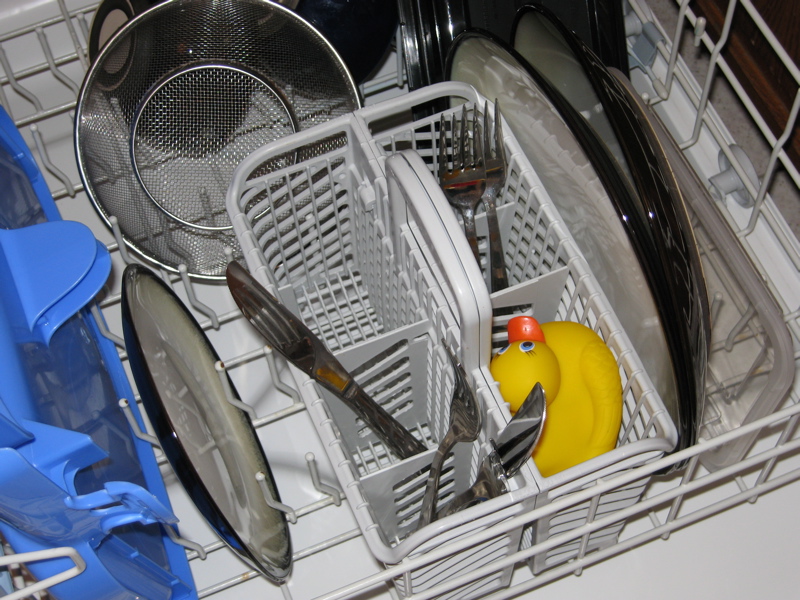
There’s a duck in the dishwasher.

These are words I spoke soon after arriving home last night. “There’s a duck in the dishwasher.” And as is a common curse with those working in linguistics, I (sometimes) actually listen to the words that come out of my mouth. “There’s an unlikely sentence,” I said to John. And googling “duck in the dishwasher” in fact brings up only one (two if you count the archive of the same) hit, with the following line: “…and so before I clean the duck (in the dishwasher) I first have to squeeze the water out.”

So I bring to you this duck in the dishwasher. My own duck in the dishwasher. (Thus increasing the frequency of the sequence of words “duck in the dishwasher” on the web.) And I hope to start a collection of highly improbable-sounding, but spontaneously and appropriately contextually-oriented, sentences. So if you have any to share with me, please do so. (Before you duck in the dishwasher.) (Did I mention I need to nap? Haven’t done that yet.)

duck.jpg

And by the way, this post is largely an excuse to set up my Technorati Profile.

the power of pants

Fooled ya! This post isn’t really about pants at all. Well, I guess it’s about “pants,” the tag.

WordPress has this feature by which you can check out other posts from WordPress blogs with the same tag. And for each tag, it will also show you a list of “related tags,” in case you want to follow up with other posts on similar topics. For example, for the tag “politics,” you currently get the following list of tags:
news, blogroll, life, culture, personal, religion, iraq, music, media and books

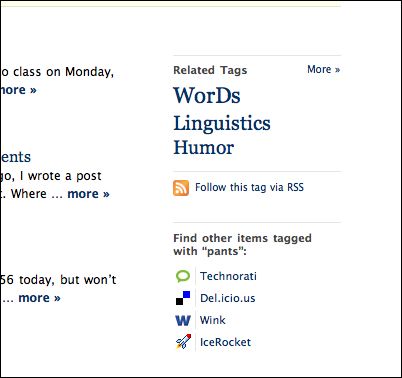
Recently, I decided to add the tag “pants” to my recent posts on pants. I am pleased to inform you that right now, at least, if you click on the “pants” tag, you get to see the following “related tags:”

  1. words
  2. linguistics
  3. humor

pants_tags.jpg

Those are actually the only related tags WordPress lists right now. (You’d expect to see “trousers” or “slacks”, perhaps “shirts” or even “fashion”…)

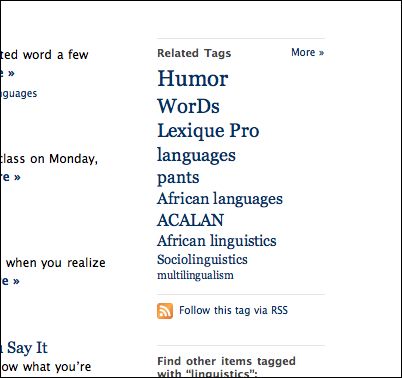
What I find even funnier, is that I see that the list of related tags for “linguistics“, which has related tags such as “languages”, “sociolinguistics,” and other terms you might expect, also includes “pants”. My friends, that is the power of pants.

linguistics_tag.jpg

By the way, this suggests to me that perhaps looking at blog tags would not be the most reliable means of investigating, say, semantic networks. (Though it could lead to lots of entertainment.)

return of the promised pants

I’m so embarrassed. I ran off to class on Monday, with my pants only half-way up. I mean, my pants post. I promised you some pants, and then I left you hanging. So, here I am again. Back with the pants.

Before I begin with the in-depth pants analysis, let’s pull our pants back up:

a. Listen to the pants. The file pair_of_pants.wav (and the streamed mp3 version of the same) contains two productions of the word pants, one “normal,” and one “funny.” (Before I tell you which is which, I’ll let you try the pants on yourself for size. I mean, judgements.)

Streamed version of pair_of_pants.mp3:

pair_of_pants.wav soundfile (can be downloaded):

b. pants methods. To recap:

The two productions of pants were spoken by a female native speaker of American English who was wearing pajama pants at the time of the recording. Each of the two versions of pants is of a similar length (roughly .7 seconds from the onset of the [p] burst), and produced in citation form with a similar f0 contour (H* L-L% in ToBI terms).

c. The funny pants. In my head at least, the second pants version is way funnier than the first. Especially when used in a sentence, such as “you’re not wearing pants:”

not_wearing_pants.mp3

d. Look at the pants. Let’s return to our citation form examples.

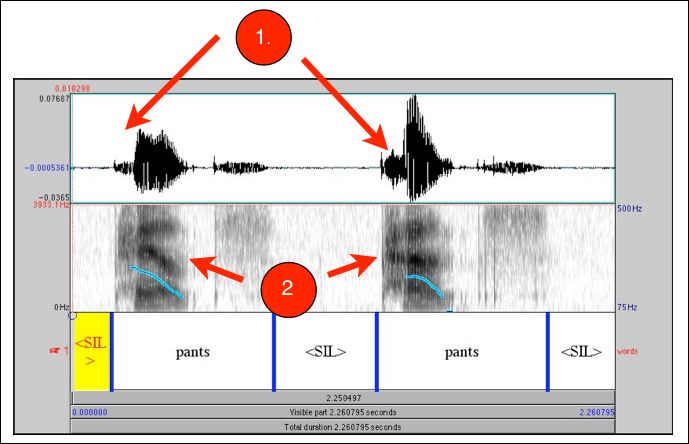
Figure 1: pair_of_pants.wav with accompanying Praat TextGrid, and some arrows and stuff
Note: The display shows waveform (top panel) and spectrogram with overlayed f0 track in blue (middle panel). The third panel, the TextGrid, shows orthographic transcription.
pair_of_pants_marked.jpg

e. Pants analysis. A couple of acoustic differences between the two versions are quite striking: 1) differences in aspiration and 2) differences in the second formant.

  1. differences in aspiration. Check out the much higher amplitude aspiration noise in the second version (on the right). The arrows marked with “1” point to this in the waveform. Further, you can hear the aspiration ([h]-ness) continuing through the vowel, which is produced with a much breathier voice than the first version.
  2. differences in the second formant. (Note: if you’re not used to reading spectrograms, the first 3 formants show up as more-or-less horizontal dark smudgy lines. The first formant is on the bottom. The second formant, marked with the red arrows marked with “2”, is the middle dark smudgy line.) In the “normal” pants version, the second formant falls rather steeply throughout the vowel (indicating that the vowel is diphthongized). In the “funny” pants version, the second formant stays pretty much horizontal.

f. Pants conclusions. Pants is a funny word. I like to say the word pants.

Here are the pants I promised you.

Way back when, long, long ago, I wrote a post about pants. The pants post. Actually, the “Pants!” post. Where I talked about the word pants, how I like saying “pants”, how pants is a funny word. And I, therein, made a promise to do some acoustic pants analysis:

When discussing pants, it’s also important to pronounce pants properly. I produce pants with very strong aspiration on the [p]. There seems to be a bit of difference in the vowel, too. I’ll plan to make some recordings so that I can do a bit of pants analysis.

It’s taken me a bit of time to get back to you with the promised pants. I hadn’t figured out a great way to incorporate soundfiles into my posts. And for a post on the particulars of pants production, one really neads to have an accompanying pants soundfile. Thanks to a new WordPress feature, I am now easily able to embed soundfiles. Even pants soundfiles. Especially pants soundfiles. I now promise you to include more pants soundfiles than ever before. This blog can become known as the one with pants.

So, here are the pants I promised you. The image below shows a screenshot of the soundfile pair_of_pants.wav displayed in praat, which I have additionally marked up a bit with arrows and such. The file pair_of_pants.wav contains two productions of the word pants, one “normal,” and one “funny.” (Before I tell you which is which, have a listen, and you be the judge. Listen to the pants yourself.)

Streamed version of pair_of_pants.mp3:

pair_of_pants.wav soundfile (can be downloaded):
pair_of_pants.wav

Figure 1: pair_of_pants.wav with accompanying Praat TextGrid, and some arrows and stuff
pair_of_pants_marked.jpg

The two productions of pants were spoken by a female native speaker of American English who was wearing pajama pants at the time of the recording. Each of the two versions of pants is of a similar length (roughly .7 seconds from the onset of the [p] burst), and produced in citation form with a similar f0 contour (H* L-L% in ToBI terms).

Okay, I have to run off to class now, without finishing my pants analysis. I hate to leave you hanging with my pants half done, but there it is. More indepth pants analysis is coming soon…

New Year’s resolutions for 2006

It’s been quite a few years since I’ve made a list of New Year’s resolutions. And here it is, the beginning of another new year, and it seems like a wonderful opportunity to set some goals. Having a new baby can lead to difficulties in getting many things done, so I’ve decided to set some goals that I know can be achieved. Namely, some that I’ve already reached.

A New Mother’s Retroactive Resolutions for 2006

  1. Personal appearance: Lose 10 pounds
    Physical appearance is important to so many people, and I think weight loss often tops people’s New Year’s resolution lists. I can honestly boast that I lost at least 10 pounds in a single night! While the process wasn’t exactly painless, it sure was quicker than dieting.
  2. Health and fitness: Exercise more
    Another common goal is to improve one’s fitness levels. And I did indeed “exercise more” in 2006. The trick to this one is to take advantage of the inherent ambiguity of the term more. Since it is necessarily a relative or comparative term (i.e. something can be/have/do/etc. more XXX than some other thing), I choose to leave out the specifics of the comparison. For example, if I wanted to say “I plan to exercise more than I have been exercising” my resolution would have failed. However, if I consider my resolution to mean something like “I plan to exercise more than various people who are a) comatose b) dead or c) of a more extreme couch potato nature than even myself,” I have achieved this goal in spades.
  3. Fine arts: Write a song
    Let’s not leave out creative and artistic growth. I actually wrote several original compositions, complete with lyrics. My greatest hits include “The Diaper Song” (We’re changing the diaper, and we’ll put a new diaper on…put a new, put a new, put a new, put a new diaper on.) and “The Bouncy Song” (I have a little girl, her name is Phoebe Lenore, and she likes to bouncy bouncy…bouncy bouncy bouncy bouncy bouncy Phoebe…)
  4. Feeding the mind: Read some books
    It’s always important to strive for intellectual breadth and depth. I’m happy to say that I’ve read quite a few books this year. Many of them quite thick ones. Well, with thick pages, at least. And I’ve even gone as far as to nearly memorize several of them, including: Goodnight Moon (Brown), Bear Snores On (Wilson), The Foot Book (Seuss), Quiet Loud (Patricelli) and The Going to Bed Book (Boynton).
  5. Home improvements: redecorate the house
    Let’s not forget the home. I can quite honestly say that there have been many changes to the appearance of our home. Not a single room looks the same. The new look is definitely more colorful than ever! The new palette includes a shift from earthy tones (mostly muted browns and grays, typically represented by wood and stone) to an array of chartreuse, tangerine, fuchsia, cerulean and lemon yellow. Mostly represented in plastic and some plush.
  6. Productivity and daily routine: Wake up earlier in the morning
    Who doesn’t want to feel more productive? I used to frequently waste the day away by sleeping until 8:00 a.m., or even snoozing in past 10:00 on weekends. I now always wake up before 7:00 a.m. There are even many days when I wake up before dawn: by 6:00, or 5:00, and sometimes even 4:00! And I don’t even need to set the alarm clock.
  7. Etiquette: write and mail thank you notes in a timely manner
    This one is for real, actually. Though the interpretation of “timely manner” may be subject to my own somewhat lax standards. I determined that I should finish writing thank you notes for the presents given for my daughter’s birth (in February 2006) within the same calendar year as her birth. I am bound and determined to achieve this goal. (Don’t quibble with me over today’s date. I will have those letters written in 2006.)
    1. our new living room decor
      Our new living room decor.

This is not about “ass”

As may be painfully obvious to me some day as I look back on these early posts, I am new to blogging. Today, I’ve learned an interesting lesson.

It turns out, Technorati has something to learn about compound words, and perhaps about metaphorical usage. You see, a compound does not necessarily equal the sum of its composite elements. Someone writing about, say, the Whitehouse is not talking about the color white and houses. We all know that.

I’ve recently been writing posts about women (real-life and fictional characters) in film, TV and other entertainment industries whom I have admired. I feel that these women “kick ass,” in the metaphorical sense. I have been terming such women “kick-ass women.” A compound with a hyphen. Much like “dog-ear.” An expression, which I’m sure you know, refers neither to dogs, nor to ears. To dog-ear a book is to fold down the corner of a page (or pages) of a book to mark your place. You see, it’s a compound term, as well as a metaphor. While there may be some visual resemblance to the floppy ears of a doggy, we’re not talking dogs, and we’re certainly not talking ears.

Anyhow, I just pinged Technorati last night, after discovering that my blog wasn’t getting hit by their search engine. And I have 3 new hits for the Technorati tag “ass.”

In a way, it kind of amuses me that folks looking for porn will stumble across my site. ‘Cause they’re not gonna find any here. Of course, now someone will probably find this post by searching for keywords “ass” and “porn.” I’m screwed. Oh right, let’s add “screwed” to the mix. Perhaps with all this talk of compounding, we’ll even get “pounding” thrown into the mix. Oh right, we will now. (Oh crap, I just realized I’ve also used the word “doggy.” Nooo!)

Pants!

Today marks a momentous occassion. I am wearing pants! Okay, I’ve worn pants in the past. Actually, that is what is momentous. I am wearing pants from my past. (PPP: Pre-pregnancy pants.) (And by the way, I’m referring to pants in the US vs. the UK sense.)

I like the word pants. I actually like saying the word pants. It’s one of those words that begs to be repeated. Pants. For example, in a discourse on pants, I would hypothesize that speakers would be less inclined to use pronouns to refer to pants than, say, other entities in the discourse. Even if the word pants had just been mentioned, I would still say “pants.” Consider the following pair of examples:

Speaker A: Have you seen my glasses? I need them.
Speaker B: I see that you are not wearing them. When did you last see them?

vs.

Speaker A: Have you seen my pants? I need my pants.
Speaker B: I see that you are not wearing pants. When did you last see your pants?

I consider the word pants to be an inherently funny word, and I know I’m not alone here. (A friend of mine considers pants to be the funniest word of the English language.) And I’m remembering a sketch from a short-lived show called The Vacant Lot called “Pants! The Musical.”

There is apparently a tradition (according to Wikipedia) of substituting the word pants for other words in lines from Star Wars. Here are some of my favorites listed on the cited website:

3. We’ve got to be able to get some reading on those pants, up or down.
6. I find your lack of pants disturbing.
12. Lock the door. And hope they don’t have pants.

It’s like MadLibs, but all pants!

When discussing pants, it’s also important to pronounce pants properly. I produce pants with very strong aspiration on the [p]. There seems to be a bit of difference in the vowel, too. I’ll plan to make some recordings so that I can do a bit of pants analysis.

Of course, pants is not the only inherently funny word. (I hope to collect some of them.) My favorite is actually squid. I try to use the word squid whenever possible. (And actually in some cases where it is not possible.)

Enough of this for now. I must get on with my pants. My squid is calling.