insert witty egg-themed pun here

We went down to John’s parents for Easter, and just got back a little while ago. (Ugh, it’s late.) But I wanted to share a few pictures from our egg-related festivities. The highlight of our holiday was having Phoebe’s first Easter egg hunt. To get ready, we dyed some eggs. Here’s the end product. (Two of the eggs seriously cracked during a hideous boiling accident, so were deprived of dye.)

img_4728.jpg

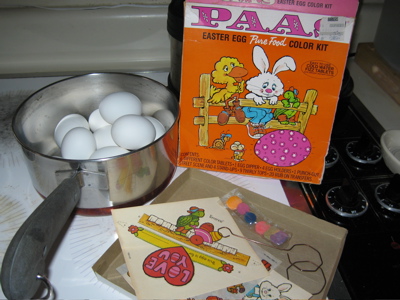
It had been many, many years since I’d dyed eggs for Easter. I think it was probably in the early 80s. I would expect great advances in egg-decorating technology since those times. Remarkably, the package of dye that John’s mother had on hand looked remarkably like the ones I remember from my childhood, though. Here’s our set-up, with pot of hard-boiled eggs and the egg-decorating kit.

img_4691.jpg

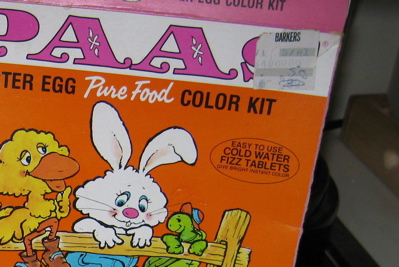
Please look closely at the date on the price tag.

img_4691_2.jpg

In case you can’t make it out, it’s “3/81”. As in March, 1981. Yes, this egg-decorating kit dates back to the egg-decorating days of my youth.

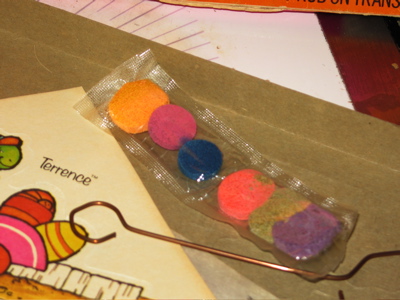
The 26-year-old dye tablets didn’t fare terribly well. Only one of these “fizzing” tablets actually managed to put on a display of fizz.

img_4693.jpg

With a little help from some drops of relatively fresh food coloring (which, judging from its packaging, may have been only 20 years old), we had some dying success. Voila!

eggs.jpg

Of course, all our efforts were made worthwhile by Phoebe’s glowing face on the egg hunt!

high school movies and clique taxonomies

It’s no wonder I’ve been having traumatic high school flashbacks. In my class on Monday, there was an extended discussion of terms used to categorize cliques (and outcasts) at the various schools that people had attended. (Keep in mind, for most of the students in the class I’m taking, high school was fairly recent history.) This was all relating to our assigned reading, primarily a text by Penelope Eckert about an ethnographic study she’d done in an American high school. The Eckert text (the same one that had a sentence that made me laugh out loud) discusses the terms Jocks and Burnouts, terms used by the teenagers in the Detroit area suburban high school she studied.

So the kids (yes, I’m freakin’ old) in the class were all relating the terms used in their schools. “We had jocks and greasers” or “we had preppies and townies”. Terms like “skaters” and “band kids” were bandied about. To be honest, I don’t remember all of what they said. I was too busy feeling old and having flashbacks to various movies that make reference to clique structure and terminology. Which is basically every American high school movie ever made.

But lets go over some examples, with the terminology:

  1. The Breakfast Club (1985)
    This movie featured 5 students of differing categories: Jock, Princess, Criminal, Basket Case and Brain.
  2. Ferris Bueller’s Day Off (1986)
    This quote about sums it up:

    Grace: Oh, he’s very popular Ed. The sportos, the motorheads, geeks, sluts, bloods, waistoids, dweebies, dickheads – they all adore him. They think he’s a righteous dude.

  3. Heathers (1989)
    This movie has the exclusivity (and cruelty) of the popular clique taken to the extreme, with the 4 members (3 of whom are named Heather) called “The Heathers”.
  4. Clueless (1995)
    I don’t remember what terms this movie used explicitly, but I found this reference to the clique structure:

    On paper, Clueless would sound like just about any other high school comedy. It’s got the popular girls and the jocks, the dreamboats and the bitches, the stoners and the slackers.

  5. 10 Things I Hate About You (1999)
    One character gives a tour to another, a new kid at the high school, and explains the who’s-who of cliques:

    Over there you’ve got your basic beautiful people. Now listen. Unless they talk to you first, don’t bother.

    This movie went for somewhat exaggerated cliques, with Audio-video Geeks, Coffee People, White Rastas, Urban Cowboys and Future MBAs.

That’s all I got for now. I’ll have to do more research into this issue at some point. (Translation: I’ll watch some high school movies.) I am on the lookout for new references on this subject matter. If anyone has any clique terminology to add, whether based on your own ethnographic studies, knowledge of the literature, or familiarity with bitchin’ high school movies, please let me know.

Hey, you! What’s-yer-face!

I have a sort of strange confession to make. I don’t know what to call my mother-in-law. I’ve actually known her for almost 15 years. And in that time, I’ve deftly (and sometimes not so deftly) avoided calling her by any term of direct address. I’ve been “you-ing” her for over a decade. She’s of a generation and disposition that doesn’t really invite someone of my age calling her by her first name. She’s never suggested that I do. And I’m of a generation and disposition where calling someone I know well “Mrs. X” seems wrong. At some point, maybe shortly after John and I got married (the first time), she started signing cards “Ma & Pa X”. While I appreciate the effort to give me some forms of address, albeit many years after first running into the issue, I just can’t manage Ma or Pa. They sound straight out of Little House on the Prairie. And nobody else calls them that. John calls his mother “Mom.” (I call my own mother “Mom.” I don’t want to call John’s mother “Mom.”)

So I have to say I found it pretty funny to come across this in my class reading:

Knowing how to address your father-in-law (or mother-in-law) has often been a problem for many people: Mr Smith is sometimes felt to be too formal, Bill too familiar, and Dad pre-empted or even ‘unnatural’. The arrival of grandchildren is sometimes seen as a way out, it being easier to call a father-in-law Grandad than Dad. (Wardhaugh, p. 269)*

Tomorrow, we are heading down to NY to visit Grammy and Grampa. Problem solved.

Yes! This is why people have kids!

Brought to you by Great Moments in Family Planning.

*Wardhaugh, Ronald. 1992. An Introduction to Sociolinguistics. Second Edition. Cambridge, USA: Blackwell.

I asked for it

There’s a thing going around whereby folks ask each other questions, and then write some answers. In response to an offer to spread this thing, I requested questions, and The Amazing KC from Where’s My Cape? answered with some questions. Below I’ve answered the questions. Perhaps you will question my answers.

1. How did you get to live in rural Massachusetts? Is there anywhere else in the country you’d like to live?

We moved up to Massachusetts from Providence once we’d both finished college. John had been working in Massachusetts for several years already while in school, and during time off from school. We started off in a somewhat more suburban area, in a town next to the one where John worked. Then, when it was time to buy a house, we couldn’t find anything we liked in our price range close to Boston. (Things were run-down, on very busy streets with no yards, or hideous 70s split levels with flood-damaged basements.) We kept looking further and farther out. Our realtor was from this town, and tolds us of the charms and history of the small town. He encouraged us to look at houses here. When we did, we suddenly could afford nice houses. With yards and trees. It was the trees that got me. We live in the woods. It’s quiet. The air is clean. The snow stays white as snow until it melts.

I love the physical location of our house, but I wish we could be closer to civilization. Most of my friends live closer to Boston, and I love the city. I love the culture, the food, the activities. Museums, restaurants, indie movie theaters, concerts. I love the mixture of cultures and ethnicities. I’d love for Phoebe to go to school in a city. And I know that I could do more in the city. I would love to do away with this commute, which eats up time and energy, and keeps me from doing things I’d like to do.

My sister is always trying to get me to move back to California, but I’m resistant. For one thing, I’ve become attached to this area, have a lot of friends around. For another, I like seasons. I actually like winter. Plus it’s so crowded out in the Bay Area, where she lives. And so expensive. (I know, Boston is crowded and expensive, too.) Then again, my mother lives out in California now, too…it would be nice to be close to family.

2. You’ve graced the cover of American Hovel Magazine. What’s another magazine you would like to be on the cover on and what would be story about?

So you’ve seen the latest AHM? That’s right, you probably have a subscription.

You know, I don’t really know too many magazines. I don’t really read them. So I’d have to go for something generic or fictitious. Maybe a general news magazine. Time or Newsweek or some such. Or maybe Amazing Stuff Quarterly. I’d like it to be for some accomplishment I’ve done. Some unspecified achievement. Definitely for an intellectual achievement. Maybe something language oriented, or for some ingenious solution I’ve come up with that will address social issues or improve the quality of life of some group of people. I’d like it to be about “the woman who revolutionized X” or “who initiated Y” or “who solved Z.” (I’d really rather not be the person “who slept with X” or “who survived Y disaster.” I wouldn’t even care to be the one “who dazzled Z audience.”)

3. What are the top 3 things you want to accomplish over the next 10 years?

1. Get the PhD.
2. hmm…
3. well….

Um…It’s hard for me to come up with a list beyond that. Continued family development will be involved. There will need to be some sort of job at the end of grad school. I have lots of activities I’d like to get back to and/or develop further, but I don’t have specific goals. I mean, take the violin. I want to keep learning, but there is no specific target for how much or how good I’d like to get. I’d like to get back to painting, jewelry-making, martial arts. I’d like to get back to some sort of volunteer work. I’d like to travel. How odd to realize that my goals are overall somewhat vague right now. Hmm…

4. You seem to like pants. If you were a pair of pants, what kind would you be (details please)?

Ah, yes. Pants. I am actually fairly ambivalent about pants. I like pants. The word, more than the article of clothing. I like to say “pants.” Pants are functional, and more practical to wear than dresses. (I do like dresses and skirts. My tastes can be quite girly in spite of my tendencies to wear men’s clothing.) I actually hate shopping for pants. I shop the sale racks, and buy what fits, as long as it’s fairly plain. Jeans are comfy, but I wouldn’t consider myself to be denim. So, if I were to be a pair of pants, I’d probably be made of some sort of woven cotton blend, durable yet soft. I’d need to have pockets, because it’s important to have a place to put stuff. (I’m not a purse person.) Deep pockets. I’d have simple lines, and hopefully wouldn’t be falling down, tripping the wearer, or exposing the butt crack. I’d be fairly fitted, not actually tight, not really baggy, hopefully flattering to the butt, even for butts of varying sizes or shapes. I’d be loose enough or stretchy enough that the wearer could sit cross-legged comfortably on the floor.

I’d be of a style that wouldn’t reflect the latest fashions, whatever they may be, so I wouldn’t look too dated when you’d wear me years after you bought me. I’d be machine washable, tumble dry low. But if you wanted to line-dry me, I’d be okay with that. I’d be made in a dark color like black or charcoal gray, in part so I’d be stain-resistant, or at least forgiving of stains. (I know things can get messy.) I’d be fairly wrinkle-resistant, so that I’d be good to pack or wear on a trip. I probably wouldn’t be totally wrinkle-free, but you certainly wouldn’t need to iron me. I would be moderately priced, accessible, so that any who wanted to wear me could.

5. You are a superhero. What are your superpowers? What is your Kryptonite? Who is your arch villian?

You’re trying to trick me! You’ve discovered my secret identity!

This is actually a question that I’ve enjoyed playing with since childhood. (I remember daydreaming about being a superhero in kindergarden.) I’d definitely have the power of flight. Telekinesis would be handy. I’d also like to be skillful at some martial art. A showy one. Plus I would have the power to befuddle my enemies with my superior wit. Or perhaps render them helpless with laughter. (Laughing due to my wit, not my clumsiness…But hey, whatever works.)

My Kryptonite? Uncomfortable shoes? No stilettos or pointy toes for me. Or some sort of dissonant or excessive noise. I can’t stand hearing more than one form of music at the same time.

My arch villain? That’s a tricky one. I don’t really like having enemies. They’d have to be bizarre. Absurd. I like Casanova Frankenstein from Mystery Men.

……..

Okay, there are my answers. So I guess I should continue this thing by offering to give questions to anyone who’s up for being asked. Answer, and you shall be asked.

[Note: jenny of baggage carousel 4 and ericalee of something bookish and bluegrass in my pocket have both requested questions. You can see jenny’s answers, and follow along with those who in turn asked her for questions. Stay tuned for ericalee’s answers…]


We made the cover!

A few weeks ago I mentioned that our home was going to be featured in American Hovel Magazine, and offered up a sneak peek at some of the interview that would be featured. I’m pleased to announce that our story has made the cover of the April 2007 issue! Some of you may already have picked up your copy at the newstands, but for those of you who haven’t, I’ve scanned in the cover to share with you here.

American Hovel Magazine, April 2007 cover

crispy flakes of wisdom and crunchy nuggets of knowledge

One of the prize books in my collection is a book by none other than J. H. Kellogg, M.D. Yes, of corn flakes fame. Many have heard of this notable personage from the book The Road to Wellville by T. C. Boyle (and movie based on the same).

I stumbled across this book while browsing in a used book store in East Lansing, Michigan. (I was there for Linguistics Summer Camp.) Having heard of Kellogg, I was intrigued. And with a title like Plain Facts, and a publication date of 1882, I had to see what it was about. I opened the book to a page at random. And laughed out loud. I flipped through more pages, and laughed again. (snort, snicker…) I had to buy the book before I was thrown out.

It turns out that the “plain facts” are all about sex. As written by someone who felt that sex should be avoided whenever possible.

I don’t remember what the first passage I read was. But the beauty of this book is that nearly every page offers some piece of wisdom that I just couldn’t make up. I must share it with the world at large.

For example, we learn from page 87 that young women must not get their feet wet at certain times of the month, or they may do permanent damage:

A young lady who allows herself to get wet or chilled, or gets the feet wet, just prior to or during menstruation, runs the risk of imposing upon herself life-long injury.

Even babies may be in danger from the “stamp of vice,” as we learn from page 183:

Sometimes–rarely we hope–the helpless infant imbibes the essence of libidinous desires with its mother’s milk, and thence receives upon its forming brain the stamp of vice.

And not to leave out the dangers to men, there’s page 366, which offers this dire warning about the perils of auto-eroticism:

Many young men waste away and die of symptoms resembling consumption which are solely the result of the loathsome practice of self-abuse.

So I offer to you a game. Please give me a random (or carefully selected by whatever means you like) number between 1 and 512, and I will attempt to locate some notable nugget of wisdom for you in the vicinity of that page.

[Note: I’ll get back with the nuggets for you next Tuesday, April 10th.]

least expected sentence in a linguistics text

I can’t read this out loud without laughing:

Judy’s tight laugh seemed to match her tight jeans, her speed-thin body, her dark eye liner, and her tense front vowels.

I read it to John (snicker, snicker), and he responded: “What is that? Linguistics porn?”

No, it’s actually from my assigned reading for my class. It’s from a book called Linguistc Variation as Social Practice: The Linguistic Construction of Identity at Belten High, by Penelope Eckert (2000). The line in question is the first line of the main text. (See?)

But hey, porn for linguists. Maybe that’s a writing career I could look into…

She lay back in ecstasy, emitting a series of non-linguistic speech events, first a pharyngeal with a low front vowel, then moving up towards a uvular, followed by a long, drawn-out tense back rounded vowel. [ʕa ʁuuu:] she vocalized. “You just did what?” she asked, her final voiceless alveolar plosive fully released and strongly aspirated, so excited she hadn’t realized she’d left her wh-word in situ…

paper or plastic?

When I lived in France for a couple of years when I was growing up, people generally never got bags with purchases. Sometimes you even had to pay extra to get a bag at the grocery store. People would instead bring their own baskets or bags. Oftentimes, string bags. These really cool, very expandable bags made of a string mesh. They could fit tons of groceries. Well, if not tons, a lot more weight than you’d expect. And certainly a lot more weight than the flimsy plastic grocery bags.

When I saw string bags available for sale at a large health-food oriented grocery store in a nearby town, I was very excited. I bought some.

I was quite pleased with myself, and my new motivation to conserve and reduce waste. Whenever we’d go shopping at that granola store, when we’d get to the checkout counter and they’d ask the big question, “paper or plastic?”, I’d cheerfully answer, “string!” They always took it in stride. Lots of customers were starting to bring their own bags. Not the majority, but I’d look around and see a goodly number of others. After all, this was a store that really marketed environmentalism. They even gave a discount for bringing bags.

But for some reason, going to the closer-to-home (and cheaper) white-bread supermarket felt like going to a different world. Believe it or not, I had to work myself up to bringing out my bags.

I’m a funny bundle of insecurities. One thing about me is that I don’t like to stand out. I like to blend into the crowd. It feels safer. I was never popular through highschool, and was decidedly unpopular in junior high school. I was quiet, shy. Different. I moved around a lot growing up. That was part of what made me different. I was an outsider. And I was also a smart kid. Worse, a smart girl. Social death.

I learned to fade into the background whenever I could. Because in my experience, attention from my peers was usually negative attention. I got picked on. Teased. Ostracized. Occasionally even threatened.

So when I’d go to the white-bread supermarket in this nearby rural Massachusetts town, I’d often feel like I was back in high school. Showing up from out of town in a new school. Seeing what all the other kids were doing. Trying to stay out of their way. Trying not to get noticed. And nobody, I mean nobody, was bringing bags. People were into their disposable bags. “Pack them light,” they’d say. “I don’t want them breaking.” This was the norm.

My first step was to start letting the bagger know I didn’t need many bags. They could leave the big items out of the bags.

“Don’t you want the big bottles in bags? I could double bag them.”

“No thanks,” I’d say. And I’d cringe when they’d still give me a bag for a single loaf of bread or a bottle of shampoo (“to keep it separate”), a dozen bags for a fairly moderate purchase. I’d feel disappointed with myself, unpacking the groceries, and adding the latest wads of bags to the ever-growing stash of plastic bags to reuse.

So I made the leap. One day, I brought out the bags at my white-bread supermarket. And when the bagger asked “paper or plastic,” I explained that I didn’t need either. I had my own bags. I mean, I really had to explain. A pioneer.

It’s been a few years now that I’ve been bringing out the string at my local supermarket. And it’s gotten easier. Some of the cashiers and baggers occasionally don’t even seem surprised when I bring them out. I’d like to think that someone else out there also brings their own bags. Maybe. I’ve actually never seen anyone else.

The funny thing is, I feel like using the string bags does a lot more good than the plastic or paper it saves. It’s been part of finding my voice. I’m making a choice to reduce waste that people can see, that others can notice. And they do notice. The cashiers, the baggers, and the sometimes even the other customers.

And what’s really made me think lately is that this step I’ve made has made it easier for me to take other steps in reducing waste. I notice more when I make wasteful consumer choices. I notice more when I buy products with excess packaging. And I start changing my buying habits.

Then I’ve noticed other ways that I have been allowing wastefulness to happen in my life, in our house. The piles of junk mail. Those catalogs I never look at that usually go right into the recyclables bag. I made the step to call some of the catalog companies, and have them take me off their mailing list. It was liberating. I use fewer household disposables. I’m not perfect, by any means. But I’ve reduced. And each reduction has been a little bit easier.

Taking this one tiny little step has made me think.

And this thinking has me thinking. That in the fight for making change in the world, we can focus on the small things as well as the big. The small battles are worth fighting, too. Those small actions can create ripples of change.