rainbow cupcakes


Over the last couple of years, and several cupcake productions, I came up with a method for making rainbow-topped cupcakes that is easy, fun, and very colorful. (Did I mention they have rainbows? We’re big fans of rainbows in this house.)

What you’ll need:

  • cupcakes (duh)
  • frosting, preferably in a light color (I make the standard butter cream frosting based on the recipe on a package of powdered sugar)
  • decorating sugar in a range of rainbow colors (also called sugar crystals or sugar sprinkles) I used bright pink, orange, yellow, light green, light blue and purple
  • (optional) other candy decorations
  • one or more small round dishes (soy sauce dishes are ideal, as they are the right size for cupcakes, and have a slight curvature)

What to do:
1. Pour out a small amount (about 1 teaspoon) of single color of sugar into the soy sauce dish.
2. With a finger, nudge the sugar over to one side of the dish, making a thick line. Don’t worry too much about shaping it.

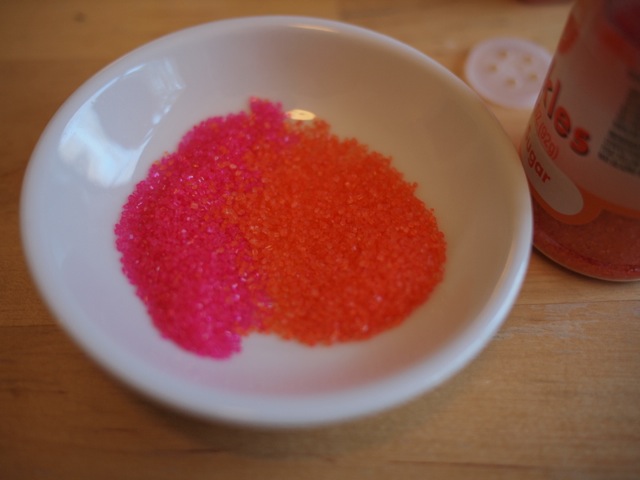
3. Pour in your next color, and again nudge the sugar. The sugar will start to look like stripes.

4. Repeat with each of your next colors until either you have no more room, or until you have put in as many stripes as you like.

Repeat with multiple dishes if you want to make a production line.

5. Frost a cupcake, or a few cupcakes.

6. Invert the cupcake, and carefully lower onto the sugar stripes. Gently roll it around, pressing lightly, so that the whole top of the cupcake makes contact with the sugar.

7. Turn it back right-side up and admire the rainbow. (Here’s where I seem not to have taken a photo.)

If you want to add other candy sprinkles (like these stars), sprinkle a handful onto the top of the sugar stripes. (You’ll need to put the candy sprinkles again each time you dip a cupcake, but the rainbow stripes will last a few dips.)


This time I remembered to take a photo.

8. Frost another cupcake and dip it. With each dipping, the sugar stripes will shrink a bit. You can experiment with rolling the cupcake top around to make different patterns with the stripes. When the sugar gets low, push the stripes aside and start adding more stripes (like in steps 1 through 4.) Or, if you want to keep the stripes more even, you could dump out your sugar and start fresh in your dish. As for me, I enjoyed seeing the way the stripes shifted with each cupcake, and the patterns that emerged from adding additional stripes as the sugar in a dish ran low.

You can see here that the stripes vary, with the colors being more curvy in some parts, or more tightly spaced.

9. I also added white chocolate unicorns to the tops, after the sugaring. (I made these in advance with one of these unicorn candy molds. They were probably more trouble than they were worth, but I am a glutton for punishment. Unicorn-shaped sugary sweet punishment.) These needed a dab of frosting to stick to the cupcakes.

Notes:

  • I don’t know how long it takes to do this project. It’s probably faster if you don’t stop to take pictures a gazillion times. I think it took a good hour, but it was fun.
  • I could imagine doing this as a project with kids, especially if you are flexible about how the stripes will turn out. (And also if you anticipate needing to clean up a lot of spilt sugar.)
  • You could also experiment with making other stripe-based patterns with the sugar, such as for holiday themes (eg. red, white and blue or whatnot) or just in some favorite colors
  • While I’m not super thrilled about using all this artificial color, it does strike me that the sugar-sprinkle topping probably has less food coloring than you’d use to make saturated color frosting, or that you might use to make, e.g., rainbow cake batter. You might also try using natural dye colored sugars, such as those from India Tree.

Other Tips:

  • Wait to frost the cupcakes until you have the sugar ready. You’ll need the frosting to be freshly spread to get the sugar to stick. (If you do frost the cupcakes earlier, or use pre-fosted ones, try giving the frosting a bid of spreading with a knife.)
  • If your sugar came in a container with a shaker top (with little holes), remove the shaker insert to pour. (Or, if you have the kind of container that has the shaker built in, you might want to make the holes bigger using a knife or kitchen scissors. Shaking it out will be tedious and you will feel like stabbing something anyhow. If you do not want to mess with the integrity of your shaker, or if the hole is still too small to really pour, shake your sugar into a separate bowl, and then pour into your soy sauce dish when you have a good amount. If you shake into the soy sauce dish directly, the sugar will fly everywhere, and the integrity of your stripes will be breached.)

  • Why do they do this?


    I was lucky not to have injured myself in this step. They also make sugar that comes in separate jars, which is easier to pour.


These were some that I made a couple of years ago. At the time, I was attempting tie-dye cupcakes. They evolved into rainbows.
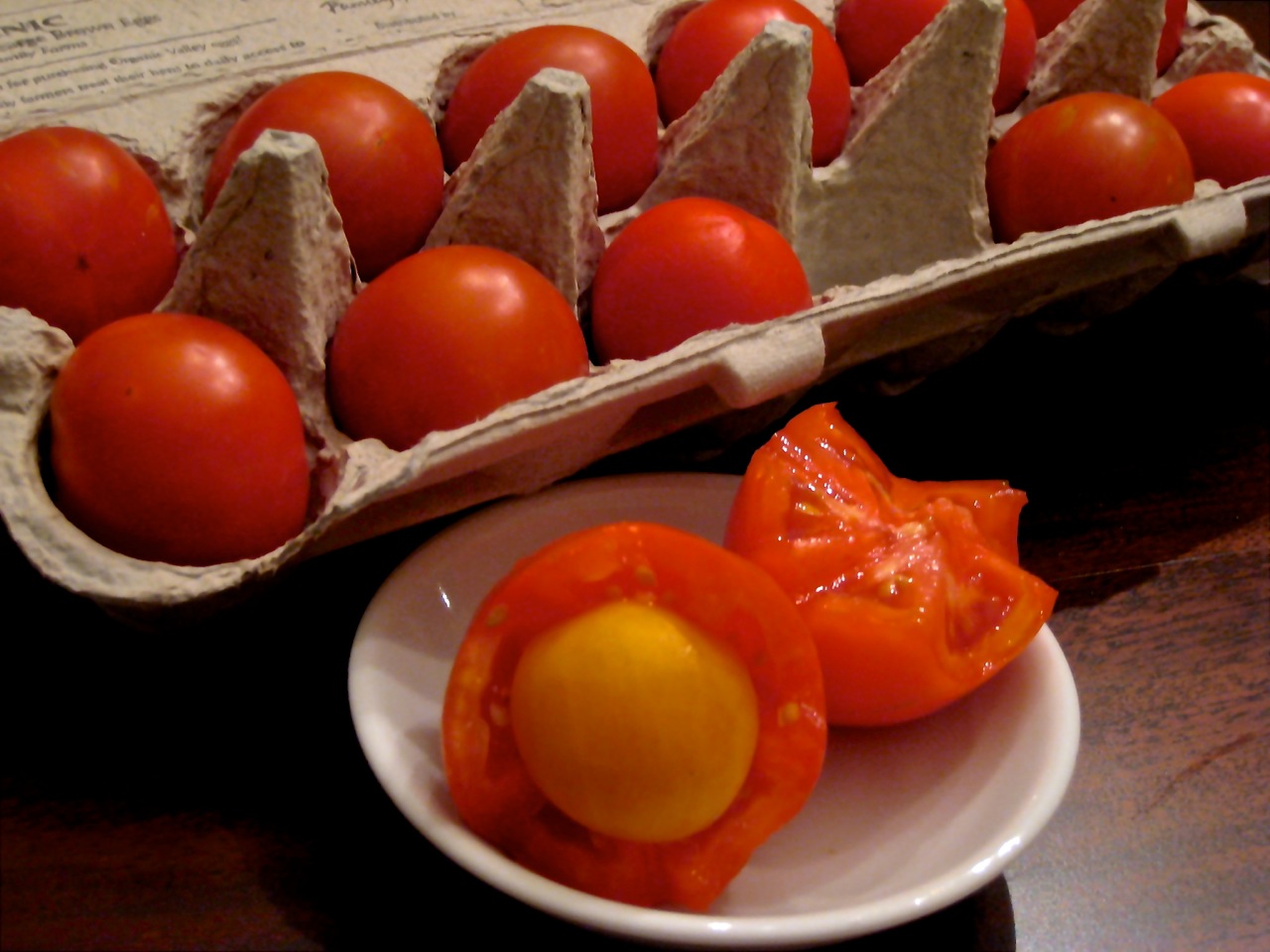
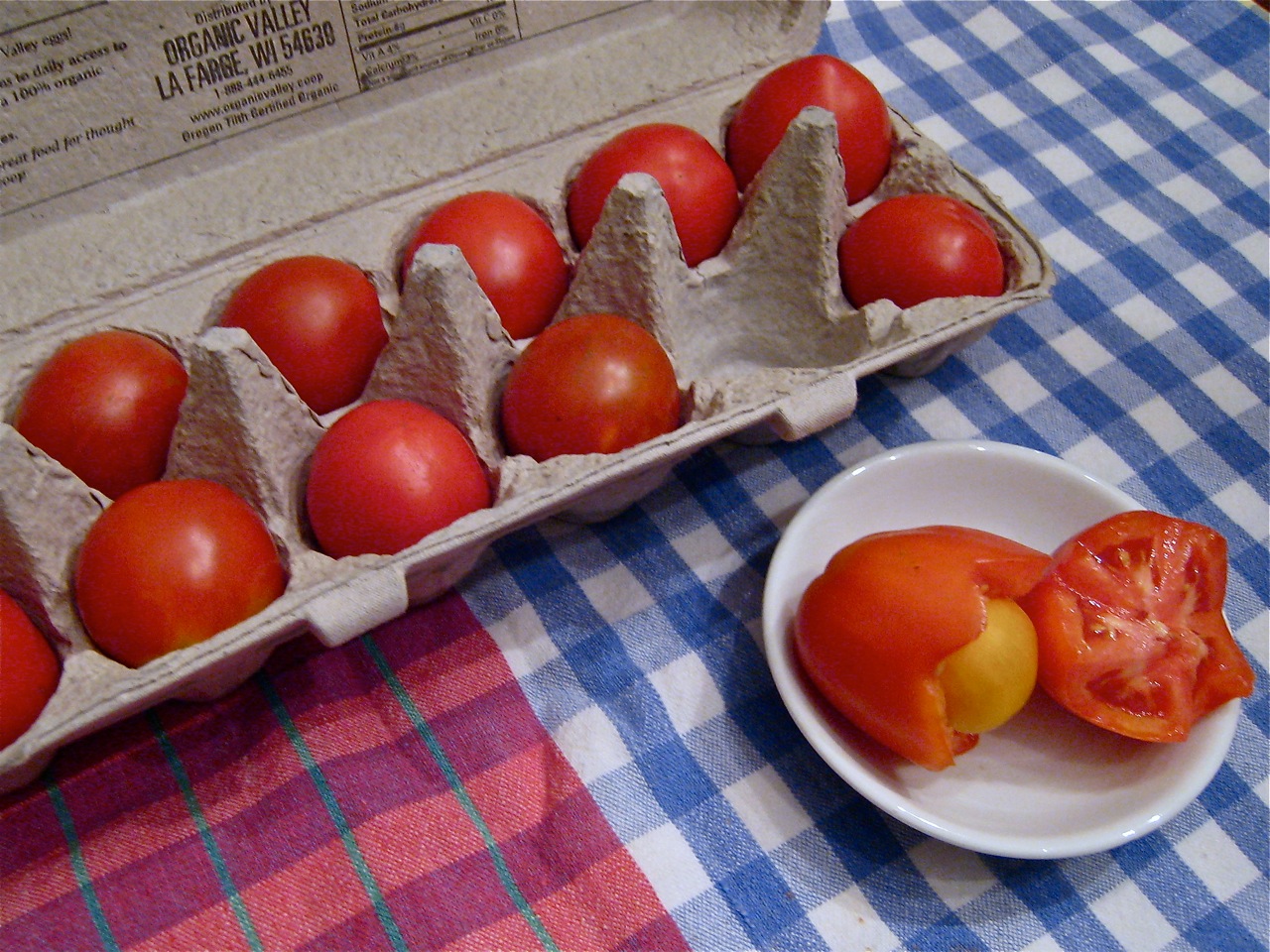
a dozen tomatoeufs

Back in the summer of 2007, I participated in a CSA, and found myself frequently overwhelmed by produce. Case in point: for several weeks in a row, I received 10 pounds of tomatoes a week. For people who do things like make pasta sauce and can it, this sort of bounty probably sounds wonderful. For me, who did neither, it was about 9 pounds of tomatoes too many per week.

I made it through, with many tomatoes shared with friends, many caprese salads, and probably a certain amount of compost.¹

I also had fun taking photos of the tomatoes. One week I had a large number of little egg-sized tomatoes, which inspired me to play with my food. (The yolk is a little round yellow tomato.)

¹ I also produced a fair amount of tomato posts, including a tomato ThThTh list, and a post about excessive tomatoes, in which I actually first posted these photos.²
² It’s so funny to go back and look at some of my old posts. I was a posting maniac back when this blog was in its infancy. Also, I was often pretty damn funny. If I do say so myself.³
³ Apparently, I do.

the great tomato debate

In the US, we are frequently subjected to the debate over the tomato’s status: Is it a fruit or a vegetable?

The answer, of course, is “yes.”

Because the real question is whether you are asking the question from a botanical or a culinary standpoint.

Botanically, it is unquestionably a fruit:

In botany, a fruit is a part of a flowering plant that derives from specific tissues of the flower, one or more ovaries, and in some cases accessory tissues.

But so is a bell pepper. Or zucchini. Or a butternut squash. But because these things are regularly cooked or included in savory dishes, they are considered vegetables. Culinarily, at least in the US and many European countries, tomatoes are treated as vegetables. You find them cooked into sauces and stews, roasted with garlic, or you might eat them raw, chopped up with herbs and olive oil on bruschetta. They go in the salad with lettuce and onion, not the salad with strawberries and melon.

However, in other parts of the world, the tomato’s status as a fruit is more widely accepted. I remember an occasion where we had a bit of a semester-end party on the last day of a particularly intensive class. People signed up to bring things. A guy from Korea signed up to bring some fruit, and he brought a little box of grape tomatoes, and it led to an interesting discussion.

I remembered this when we were served this dessert at the conference banquet¹ in Shanghai back in May:

The fruit salad consisted of chunks of melon, and grape tomatoes. Aside from my interest in the appearance of tomatoes in a fruit salad, it was a thoroughly disappointing dessert. Which, I suppose, was fitting.³

So, do you want to weigh in the debate?⁴

¹ Sadly, as is often the case with large-scale meals, the quality of the food was pretty mediocre. Pretty much everything I tried was bland.²

² Of course, my options were somewhat limited by my largely vegetarian diet constraints. So I didn’t partake, for example, of this soup. I did, however, appreciate that I was able to easily identify this as chicken soup. Other items that were served to us without explanation were more mysterious.

³ Did I mention the food was mediocre? The food was mediocre.

⁴ And if so, do you want to weigh in using pounds or kilograms?

fruit salad with raspberries and doldrums

Some friends invited us over for a pre-Thanksgiving pot-luck feast this evening. (Well, the feast was this evening. They invited us a week ago. Really, it would be a poor plan to invite people over for a spur-of-the-moment pot-luck. You’d probably end up with a lot of crackers and cereal. Probably many fewer casseroles. Which could actually be a good thing, depending on how you feel about casseroles.)

Anyhow, since we didn’t have to go scavenging through our cupboards, and were able to plan ahead, we went with several dishes. (Dishes containing food, even.) One of these dishes was a fruit salad prepared by Phoebe. She had the idea to make one, and even mentioned this before our trip to the grocery store. She worked really hard on it, spending close to 2 hours on it. She included raspberries, strawberries, blueberries, kiwi, apple, pear, clementines, grapes, banana and mango. She did almost all of the cutting herself (I helped halve and core the apple and pear, as well as pitting and peeling the mango, since they were trickier.) I was very proud of her for seeing this task through from idea to finish. And I was proud of myself for minimizing my micromanagement. I let her decide which fruits to use, and let her decide how to cut things. Mostly this hands-off approach of mine was because my own hands were busy cooking the other dishes. (Or the other food things that we put in the dishes.)

The results of all of this included a salad that was both beautiful and tasty, and a Phoebe with a sense of accomplishment.

Phoebe’s phenomenal phruit salad.

As for the doldrums, they are all mine. I was on quite a roll with the daily posting, but I seem to have fallen off my roll. Probably because I spent many hours today cooking and socializing, and now I’m tired. It got to be after 11, and I found that all my post ideas of the previous days seem to have evaporated. (Well, some haven’t evaporated, but I need more time to write them than is available before midnight.) So I went for the low-hanging fruit salad.

Not coming soon to a chocolatier near you. Hopefully.

Last night I discovered that there had been an unfortunate incident in my refrigerator involving my emergency stash of dark chocolate. What, you don’t have an emergency stash? Well, it wasn’t really that I planned it that way. I bought a big stash to give away, and then ate most of it over a period of many months. 2 bars remained, often forgotten. Last night, I remembered them. I eagerly pulled out the plastic bag that wrapped up the 2 bars, and was surprised to find the bag looking wet. I pulled out the chocolate, and the wrappers looked wet, too. Not a good sign. I realized that they were oily. I peered back into the dimly lit recesses of my refrigerator, a scary thing to do even on better days. It did not take long to discover a little tub of pesto, laying on its side, its lid clearly not tightly sealed. The smell confirmed it was the culprit. Ever the optimist, I carefully removed the foil-lined wrapper from the bar of orange-infused 70% cacao fair trade organic dark chocolate, dropping it into a clean container without letting the outside of the wrapper or my oily fingers touch the chocolate surface. I washed my hands, and took an optimistic nibble. A second less optimistic nibble confirmed: the chocolate had been pestoed. Fatally so.

Because you know what is not a winning flavor combination? Dark chocolate with orange, basil, garlic, parmesan, and olive oil. Just in case anyone out there was considering experimenting.

Also, it is very hard to wash the smell of pesto off one’s hands. I keep washing them, but it won’t go away. I’m like Lady MacBeth, but with pesto. (Yet who would have thought the little tub to have had so much oily pesto in it?)

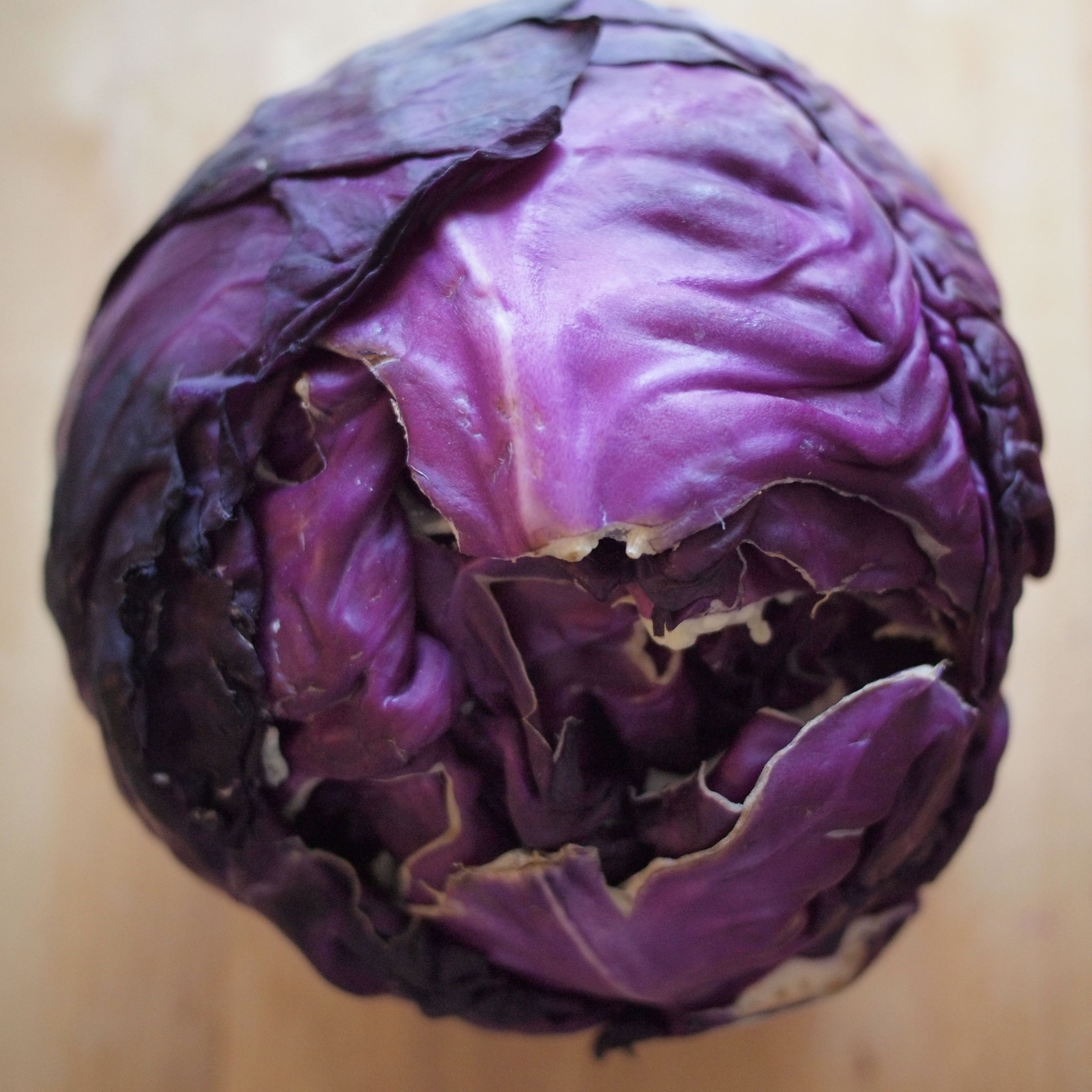
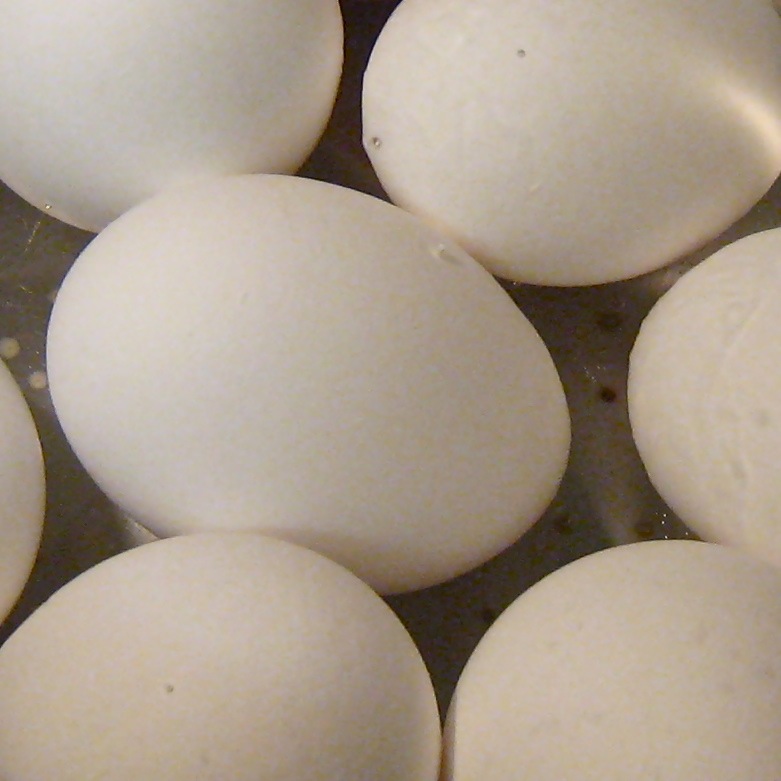
When red + white = blue. (Experiments using red cabbage to dye eggs blue)

Abstract:
+ =

Introduction:
A couple of years ago, I learned that it was possible to dye eggs blue using red cabbage.¹ Typically, we have used a variety of artificial coloring options for our egg-dying needs, whether liquid food coloring or the store-bought Paas-type kits. Last year I was determined to try my hand at doing some natural dyes with vegetables. In the end, I gave up on my plans for using onion skins or artichokes. (The water from steaming artichokes is often an intense bright blue-green, but not from the particular ones I made that day). But I followed through with the cabbage.

I had forgotten how long it took to dye the eggs, but looking back at the photos, I see that it did indeed take a lot longer than the food coloring. So be warned: The eggs took a good couple of hours of soaking to get blue.

Methodology:
I started by cutting up some red cabbage and boiling it in some water.²

The resulting juice was quite purple, and I was doubtful that it would produce blue. It was, however, quite pretty. (6:18 p.m.)

We dunked the first egg and let it soak. 16 minutes later, a peek showed the egg looking somewhat lilac-colored. (6:34 p.m.)

At some point, I added a bit of vinegar to the cabbage juice, inspired by the instructions for dying eggs on the box of food coloring. The purple cabbage juice turned even redder, which made me even more doubtful of achieving blueness. So I poured some more cabbage juice into another glass to have one without vinegar, and dunked another egg to soak.

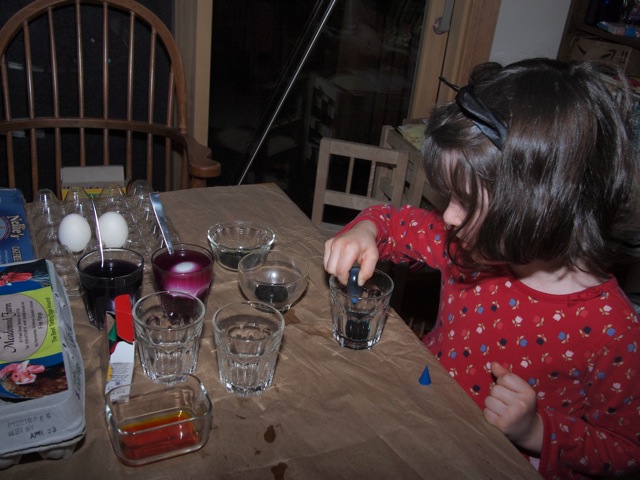
Here we are, almost an hour after first dunk. Getting to be the kids’ bedtime. Time to break out the chemicals. Here’s Phoebe, squeezing out some blue food coloring. (7:22 p.m.)

I don’t have a time for when the first egg (from the vinegar mixture) came out, but it did indeed come out blue eventually. Having read up a bit on red cabbage (as one is wont to do), I had learned that red cabbage juice changes color based on pH levels. Acid leads to redder colors, and adding something alkaline, and raising the pH, should make it bluer. I then tried adding baking soda to the cabbage juice with the vinegar. The change was instant and dramatic, turning from red to greenish blue.

Here we are, hours after the first dunk. (11:27 p.m.) The two glasses show “neutral” cabbage juice (left), and alkaline cabbage juice (right). In the background are the rest of the completed eggs, mostly dyed with food coloring. (I think the first cabbage dyed one is there in the photo, too. Second row, left, behind a yellow egg.)

Results:
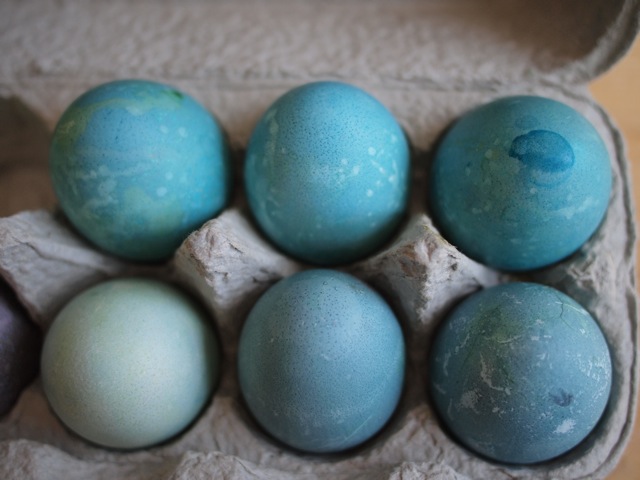
Here are the chemically-dyed (top) and cabbagely-dyed (bottom) blue eggs arranged together. The lighter-colored leftmost cabbage-dyed egg is the one from the baking soda solution. (Blotchiness is due to condensation that happened from putting the previously-refrigerated eggs outside for the egg hunt.)

3 of one, a half half dozen of the other.

Discussion
In the process, I realized why it is that it helps to add vinegar to dye eggs. Egg shells are composed primarily of calcium carbonate. Calcium carbonate is commonly used to neutralize acidity and raise the pH level: it is the main ingredient of antacids such as Tums, as well as agricultural lime. Acids can dissolve calcium carbonate. I’m guessing that adding vinegar starts to break down the egg shell, allowing the color to permeate and bond more quickly to the shell.

This would explain why the redder cabbage juice with added acidity led to a bluer shell (or got there faster) than the bluer-appearing cabbage juice with baking soda added.

Future study:
This year, I’m hoping to try the cabbage dye again, and also to experiment with beets, carrots, berries, and turmeric. I also may play around with acidity levels of the dye solutions again, as well as using brown eggs in addition to white. I wonder if pre-soaking an egg in vinegar would make it more permeable to dyes. (Did you know that you can dissolve the shell off an egg with vinegar? That’s another science experiment for us to do.)

Conclusions:
Can you tell I’ve been wrapped up in academic writing? I need to get to bed.³

References:
More resources on using natural food dyes for eggs can be found at various places around the web:
Natural Easter Egg Dyes on about.com, Making natural Easter egg dye, Three ways to dye eggs, Natural Easter Egg Dyes

Appendix:
Here are all of the photos from above, plus a few more.

This slideshow requires JavaScript.


¹ I think it was from NotSoSage, who sadly, has purged her blog archives. I’m pretty sure she also made red/purple eggs using red onion skins.
² That’s not entirely true, I started by buying a red cabbage. And there were steps leading up to that as well. I had to get up in the morning, for example. Sometimes that is the hardest step.
³ Seriously, I need to get to bed.

Enter the Dragonfruit

On my trip to Hong Kong last August, the morning of the start of the conference, a group of attendees and I arrived at the conference venue in search of breakfast. Winding up in a little cafe in the sprawling convention center, we purchased a variety of baked goods and hot beverages. A colleague of mine also bought a container of mixed fruit slices. Mingled among the identifiable slices of melon and pineapple were a couple of rectangular white slabs, speckled throughout with little black dots. My colleague was kind enough to share her fruit, doling out slivers of the mysterious thing to the half dozen of us sharing the table. I had a little nibble, and found it to be pleasant: quite soft, a bit like a cross between a cantelope and a watermelon in texture, and with a bit of crunch from the seeds. Perhaps it was the presence seeds, but the taste reminded me a bit of kiwi, but much milder. Someone at the table was able to suggest that the fruit was a dragonfruit. I had no idea what such a thing was, or would look like outside of a container of mixed fruit slices. (But I did have a strong suspicion that it didn’t grow in rectangular slabs.)

A couple of days later found me on a fairly cringeworthy bus tour, which in retrospect did get me some good photos and a few stories to tell. It also landed me in front of a fruit stall, where (among other fruit options) there was a big stack of brightly colored dragonfruits (identified to me by my tour companion). I bought one.

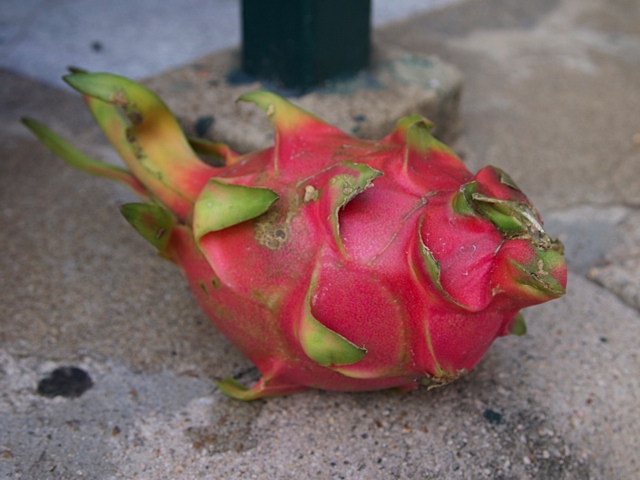
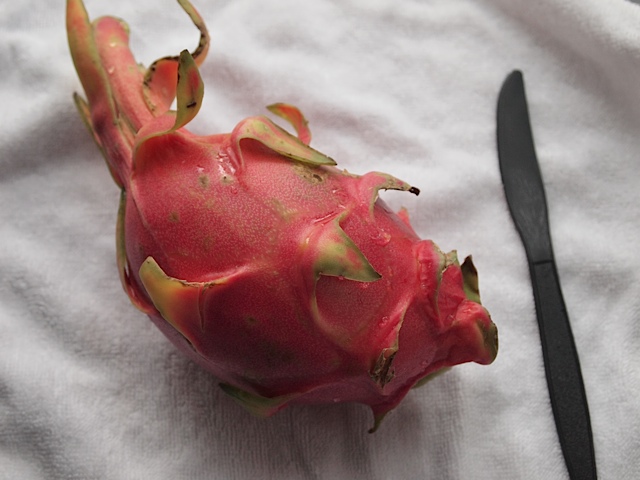
While I intended to eat it, I admired it primarily for its looks. Here are a couple of photos of it as it posed while waiting for the cringeworthy bus. (Actually the tour bus wasn’t the problem. The tour guide was.)

It wasn’t until a couple more days had passed that I had a chance to try it. Here it is, back in my hotel room, sitting on a hotel towel. In spite of its resemblance to dragon scales, I found that the skin to be surprisingly easy to cut with the dull standard plastic knife I had.

It sliced up easily, revealing the the flesh inside with its speckling of black seeds. (I hadn’t been sure yet whether I’d gotten the same kind, as there is also a variety with red flesh inside, and a similar-looking outside.)

I seem to recall that the skin slipped off the fruit easily, but I have no supporting photographic evidence. I didn’t eat the skin, in any case. (I don’t actually know whether one can or should, but I have the impression that people don’t.)

(Sadly, this particular dragonfruit was more photogenic than it was tasty. It didn’t have even the hint of the kiwi-like tartness of the earlier fruit I’d sampled. In fact, it didn’t have much flavor at all.)


More dragon things to come…

holiday traditions and musical interludes


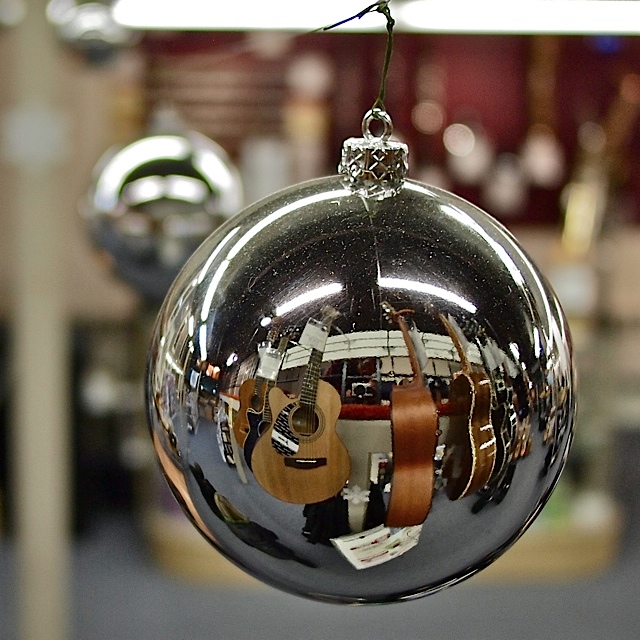
Guitars reflected in a silver ball at the music store.

A few nights ago, John had a company party to go to, so the kids and I started in on the evening routine without him. Inspired by having sampled some delicious latkes at Phoebe’s class holiday party on Monday (which included both Christmas and Hanukkah treats and activities), and having just bought a big bag of potatoes, I decided I would try my hand at making latkes. (Wow, that was a really long sentence.) Anyhow, I made latkes, in honor of Hanukkah. I consulted the great oracle of Google, and got down to business peeling and grating. I have to say, I made some pretty tasty latkes.

The whole process also took probably longer than I’d intended, and it was after 6 by the time the kids and I sat down to eat our meal of latkes, fried eggs, latkes, steamed broccoli, and more latkes. (Phoebe declared the meal so delicious that she high-fived me.) I may have eaten far, far too many latkes. (From what I understand, that is also a Hanukkah tradition.)

After dinner, it was time for Phoebe and I to practice the violin. John usually takes Theo upstairs to start his shower while Phoebe and I practice downstairs. Since John wasn’t home yet, I thought Theo could keep us company in the parlor, which is where we always practice. (Really, some people my call it the living room. But when we moved into this house, we declared the “family room” to be our “living room,” and the official “living room” became the parlor. I like the word parlor. I mean, who would remember something like “‘step into my living room,’ said the spider to the fly.” Not that this is how the actual quote from the poem went. It’s just what people remember. I mean, with “parlor,” in place of “living room.” I suppose “den” might have also worked, for the spider, at least. But not for our house. We have a parlor.) The parlor is also where we have our Christmas tree. (I mention this, because this will be relevant shortly.) (Notice my subtle attempt at foreshadowing.)

When Phoebe and I practice her violin exercises together, we both sit on the floor. However, I had just bought myself a book of Christmas songs for the violin, and since Phoebe putters around a lot as she sets up her violin, I sat in a chair so I could set the book in my music stand, and played a bit. Theo was hanging an ornament he had made at daycare on the tree. Phoebe sat on the floor, opened up her violin case, and then suddenly wandered off to look at her gingerbread house. At that moment, Theo stepped back to look at his ornament on tree…and stepped directly onto Phoebe’s violin.

I’m not sure what noise escaped from me as I looked up and saw his foot land on the neck of Phoebe’s little quarter-sized violin (I think it was some sort of squeak), but I remember the exceedingly alarmed look on Theo’s face. I jumped up, and hurriedly set down my own violin. The trouble is, you can’t really hurriedly set down a violin. I basically dropped it. It made a loud crack and thwong noise as a couple of the pegs hit the coffee table and came unwound. I may have made additional noises.

Both children wailed.

In the end, I was able to assess that both violins were pretty much okay, if seriously out of tune. Happily, Theo managed to step on one of the less fragile parts of the instrument, and his weight was probably somewhat taken by the case, since the violin was still in it. He still felt awful. And so did Phoebe, for having left her violin open and on the floor. And so did I, for not having been paying enough attention to the actions of my small children around rather fragile instruments. And for having dropped my violin. Phoebe, though, was much comforted by the fact that we had, all three, made mistakes, which she enumerated repeatedly.

Did I mention I made latkes? They were delicious.

In case you didn’t manage to check out of all Neil’s fantastic Christmahanukwanzaakah Concert, which had musical contributions from a variety of different holiday cultural traditions, I wanted to share with you this trio of lovely ukelele productions. These talented women inspired me so much that I looked longingly at the ukeleles at the music store when I went to my violin lesson. (Not that I expect that ukeleles are much sturdier than violins.)

I’m totally smitten with the uber-catchy “we like to celebrate chrannukah,” by Jenny Mae.

Then there’s Elly of Buggin’ Word, Rockin’ around the Christmas Tree. (Please check out the adorable “shuke” (shirt uke) her son is wearing)

And lest the southern hemisphere feel left out, here’s Juli Ryan with her charming rendition of a New Zealand folk song: “Haere Mai Everything is Ka Pai”

The Spud Who Loved Me

James Bond: Do you expect me to chop?
Auric Goldfingerlings: No, Mr. Bond. I expect you to dice. And then panfry with some onions.

The Bond Franchise meets the fast food franchise in these lesser-known action movies. Hold on to your seats and grab your ketchup.

  • Licence to Peel
  • From Russia with Latkes
  • Octopierogi
  • Quantum of Solanaceae
  • On Her Masher’s Secret Service
  • Dumplings Are Forever
  • The Living Homefries
  • Dr. Gnocchi
  • Live and Let Fry
  • Thunderbulbes
  • The Hashbrowns Are Not Enough
  • A View Tuber Kill
  • The Man with the Golden Spud Gun
  • Moontater
  • Goldfingerlings
  • You Only Bake Twice
  • Tuber Never Dies
  • Kartoffel Royale
  • Yukon Goldeneye
  • The Spud Who Loved Me
  • Fry Another Tater
  • For Your Eyes Only

No time to include synopses this time, as I’m beat and need to get my synapses some rest. Please feel free to contribute any plot summaries in the comments.