
(Et ceci n’est pas une vraie blog post, non plus. I have a big deadline coming up this week, and I have to get crackin’. This will have to stand in for my NaBloPoTaTo post of today.)

(Et ceci n’est pas une vraie blog post, non plus. I have a big deadline coming up this week, and I have to get crackin’. This will have to stand in for my NaBloPoTaTo post of today.)

This morning, I decided to do an art project with the kids. Specifically, we made potato prints. (I’ll let you guess what inspired me to do this particular project…) We’re at my in-laws’, and I didn’t want to risk getting paint on the furniture (or walls), so we worked out in the backyard. It was a beautiful day to be outside, but a bit windy for a project involving paper. Phoebe’s tendency to collect piles of rocks came in handy, providng us a ready supply of paperweights.
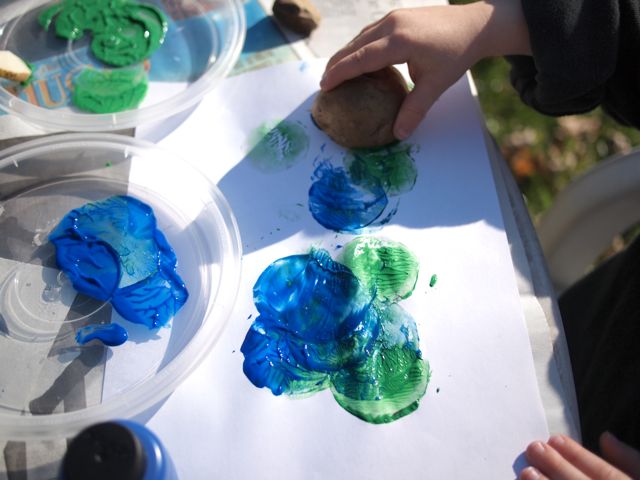
I can’t remember when I last made potato prints. I’m not sure I have done this as an adult, even. It was a lot of fun. (It would have been more fun if not for the wind.) And I did like the way the prints came out. I loved the way the thick paint made veiny patterns on the prints. (We used some washable Crayola paints that John picked up at the grocery store.)

See the slideshow, below, for more photos from this morning, and this morning’s results. I put even more photos up on Flickr.
Here are the leftover potatoes from yesterday.
A skin have I, more eyes than one. I can be very nice when I am done. What am I?
And if that’s still not enough potatoes, then there are these:

Okay. That was a lot of potatoes. I’m full now.
My post of last night, with my flourishing root vegetables, reminded me of a painting I did in an art class a number of years ago. (I think that number may be greater than 10.) I can’t remember what the class was, as I had many classes with the same teacher over several years. For this particular assignment, though, we were to paint something in response to a poem my teacher read to the class. The poem was one by her husband, a poet, and involved memories of his mother and potatoes. (Sadly, I don’t have a copy of the poem, nor do I remember the title.)
Here is what my brain cooked up:
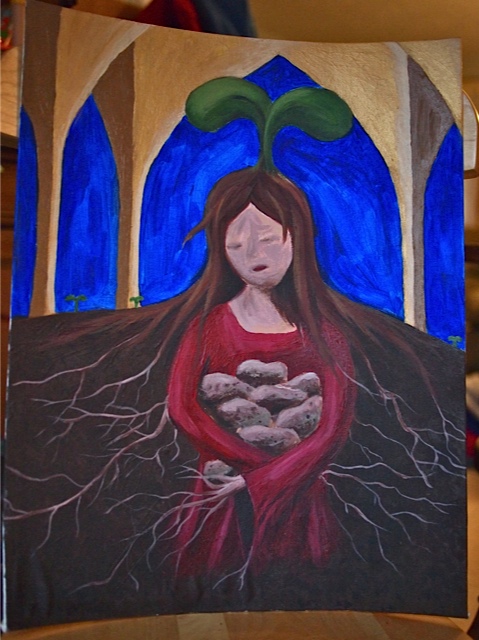
The painting is somewhat modelled after Medieval or Renaissance Madonnas. It wasn’t quite finished, as I’d originally imagined a more ornamental/ornate background. It’s been sitting in my basement for quite a few years, and has curved in the dampness. This was before I started stretching my own canvas, and would just buy whatever cheap canvas or canvas boards. Cheap canvas boards really don’t last well. On the other hand, I think the wrinkling and the warping rather suit the subject matter. As does the musty basement smell…
I don’t know about you, but I can’t keep a houseplant alive to save my life. Happily, I have never had the need to, nor can I envision those scenarios. (Well, actually I can envision them. My imagination likes to come up with all sorts of improbable scenarios. Like one in which my very life is tied to the life of a spider plant. Or maybe a ficus. Like some sort of living, leafy voodoo doll. A bug climbs on a leaf, I feel my skin crawl. I get weird cravings for plant food. I forget to water it too long, and suddenly I don’t even have the strength to reach the watering can…I imagine I’d last 2 weeks, tops.)
Seriously, though, we have no houseplants. I have killed many houseplants over the years. I like plants. Don’t get me wrong. I just seem to be unable to consistently remember their existence for a long enough period of time to keep them alive. Pets I could handle, because they would typically make their needs known. Well, not itemizing their needs. But they would make it known that they had needs. By making noise, or looking at me with sad faces, or chewing on things, or getting smelly. Or piddling on the floor. Houseplants are just too quiet and too immobile. They just sit there in a pot. They might drop a leaf here and there, especially when they’ve gone a few weeks without water, but beyond that they don’t intrude. And then before you know it, you happen to glance over at the shriveled corpse of the thing.
Surprisingly, I’ve had some success in my life with gardening. Not that the plants are any noisier, but somehow the greater needs of a garden are easier for me to remember than the occasional needs of a potted plant. I wouldn’t call myself a gardener, by any stretch, but the handful of times I’ve gardened, I’ve kept the plants alive long enough to get some sort of rewards.
I also seem to have a remarkably green thumb when it comes to growing vegetables. Not vegetables that I’ve planted, but those vegetables that I have purchased with the intention of using them as food. But then they grow into plants. In the house.
That makes them houseplants, right?
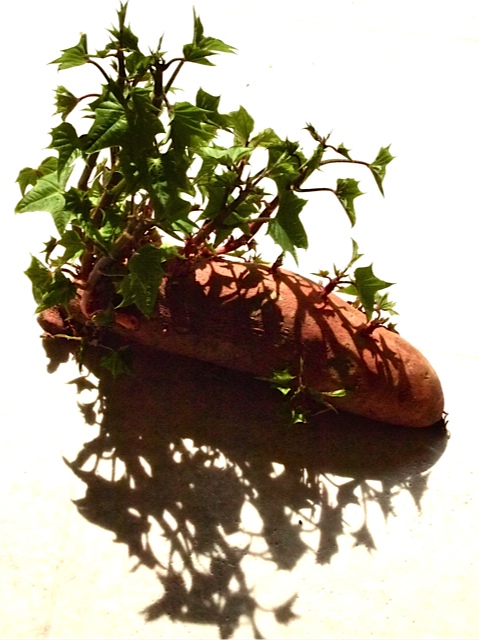
We kept this sweet potato around for several months, and it was the healthiest looking plant this household has seen in years. It stayed on the kitchen windowsill for several weeks. (Eventually, though, we released it to the wild.)
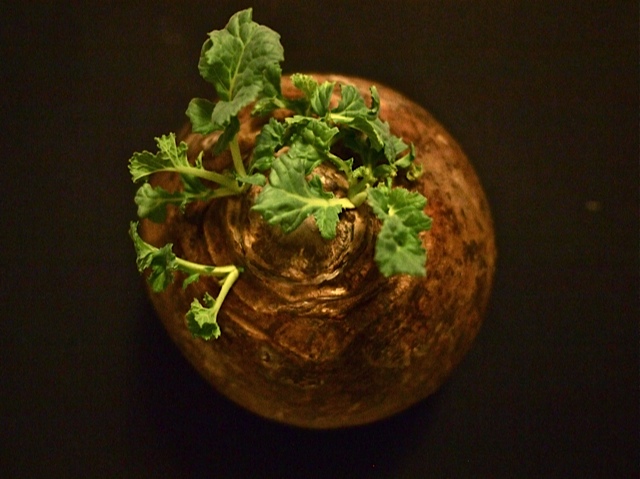
This is our current project. This rutabaga sprouted while I was in California.
How about you? Have you the thumbs of green? Or are you a plant-killer like me?
This shifty-looking character was discovered at a Massachusetts farm stand this September, trying to pass itself off as an ordinary eggplant. It was taken in for questioning regarding the brutal dicing of a carrot, the decapitation of several fiddleheads, and the deflowering of a cauliflower. It was eventually implicated in the death of sweet potato, and was convicted of yamslaughter. While the tubers all demanded that the eggplant should fry, it was instead given a life sentence in the cooler.
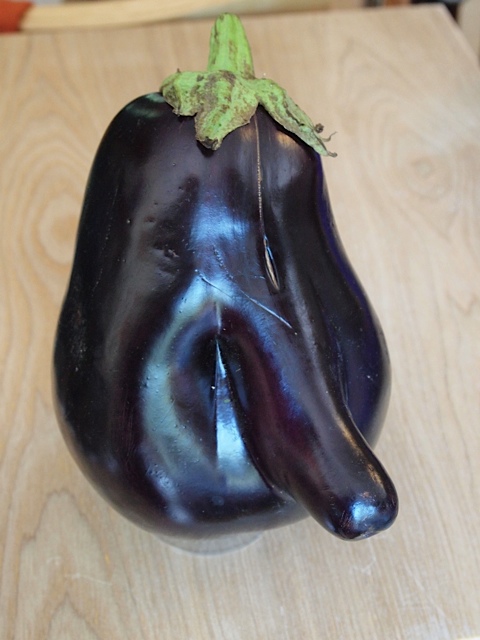
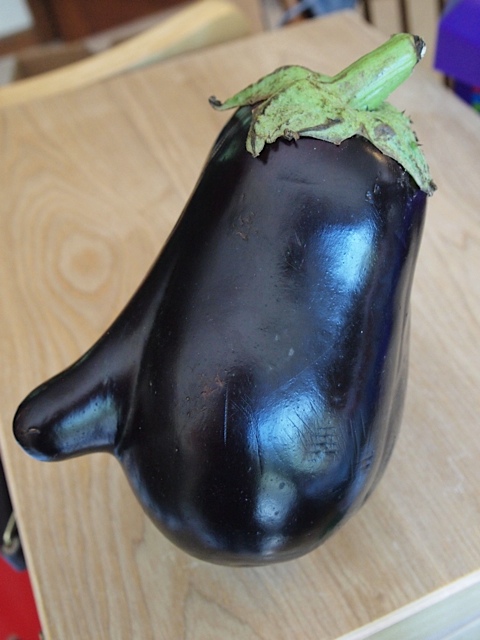
It’s after 11:00 p.m., and I needed something to post for my daily posting commitment. I’m trying to focus on work and I need to get to bed so that I can be productive tomorrow. Naturally I did what most people would do: found photos of ridiculous vegetables in my photo library.
Seriously, though, who does this guy remind you of? I do see a bit of Nixon in the top photo, but the profile reminds me of a cartoon character that I can’t quite place.
Having just posted pictures of artichokes two days in a row, I might as well go one further. In fact, I might as well come right out and confess: I love artichokes. My list of 40 things I like would be incomplete if I did not include artichokes.
I don’t remember the first time I tried an artichoke. I was born in California, where artichokes grow on trees. Well, not really. They grow from the ground in big spiky plants. (They are thistles, and the part you eat is a flower bud.) But in California, they do at least grow. And so it was that I got to have them on occasion. I loved them. They weren’t just my favorite vegetable, they were my favorite food. (You may recall my anecdote about being featured in a class newspaper under the headline “Girl Likes Artichokes.”)
I’m not terribly fond of marinated artichokes. They are okay, but not at all in the same league as fresh artichokes. My favorite way to have artichokes is steamed, accompanied by a small bowl of melted butter for dipping. (I’m even appending my own instructions.)
I can’t say what it is about artichokes that I love so much. I know what it is, but I’m not going to say. (No, not really.) They are just ineffably yummy.
Some people don’t understand the appeal of eating a vegetable that is so much work. (In case you’ve never eaten a fresh artichoke, the typical way to eat one is to peel off the leaves one by one, and scrape the small tender bit at the base of each leaf with your teeth.)
For me, the process is part of the appeal. You start of by eating the outer leaves, which are typically a bit tougher, and work your way in to the more tender and flavorful ones. Then you pick up speed, as the leaves get soft enough to bite through. Then you pluck off the ring of spiky inner leaves, and then scrape out the hairy choke with the utensil of your preference, finally reavealing the heart, which is worth all the trouble. I cut it up and roll the pieces around in whatever’s left of my little bowl of melted butter after I’ve dipped each leaf. Then I try to eat it as slowly as I can, because it is always over too quickly.
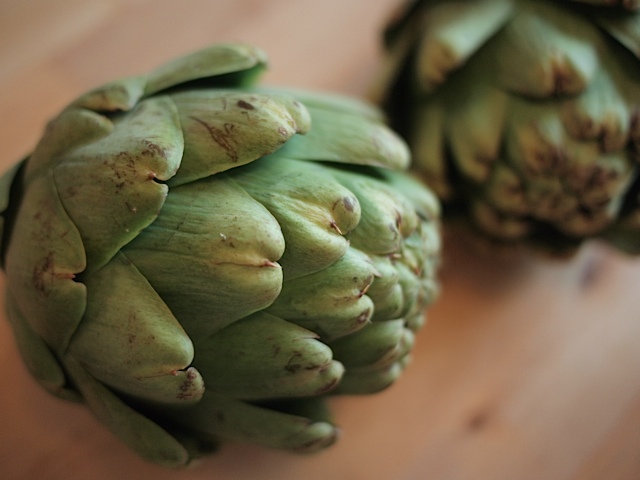
How I cook artichokes:
A note of warning: whatever you do, wash your hands after you handle a raw artichoke. The residue is extremely bitter. If you, say, lick your fingers, you will get a nasty shock. On the other hand, some people may like this bitterness. I once bought a bottle of Cynar, the liqueur flavored with artichoke. I was curious, naturally. I can safely say that it was one of the nastiest tasting beverages I’ve ever tried. It tasted like licking a raw artichoke. (Not that I’ve ever done that.)
This post is the second in my generally unordered series of 40 posts about things I like.

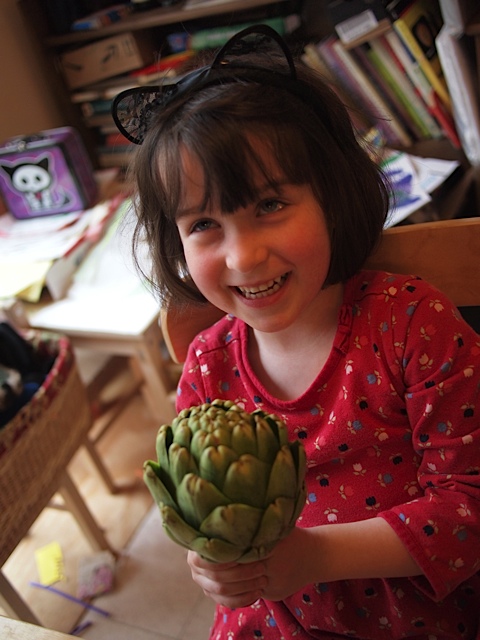



I’m not sure I was ever that cute, but Phoebe certainly takes after me in many ways. For one, she has inherited my deep love of artichokes. (These were some photos from April. I had this idea to try using the water from steaming artichokes as an Easter egg dye. Usually the water is an intense, often bluish, green. Of course, that time the water was a dingy gray brown, so we opted not to try for olive drab eggs. Remind me to tell you about the cabbage experiments, though. They were more colorful.)
Tonight, we finally got around to eating the artichokes I trimmed yesterday, the most lethal-looking of which was featured on America’s Most Dangerous Vegetables. Theo, who loves to eat breakfast but has decreasing interest in food over the course of the day, has been wary of trying new foods at dinnertime. This was the first time we managed to get him to try artichoke. I’m quite happy to say that he was instantly taken with them, too. (Though it is a happiness tinged with sadness, as we will no longer be able to eat his unclaimed artichoke. And, alas, our pan can only hold 4 artichokes.)
(I have more to say, about artichokes, even, but I need to get to bed. I’ve had an exhausting day of digging through cabinets and closets looking in preparation for Saturday’s event of terror.)
I think that would be a catchy name for a TV show. America’s Most Dangerous Vegetables. Each week, the show could highlight some sort of menacing produce: murderous-looking rutabagas, carrots with vicious points, or dainty new potatoes that pose a threat as choking hazards. All of them would pale in comparison with this week’s monster:
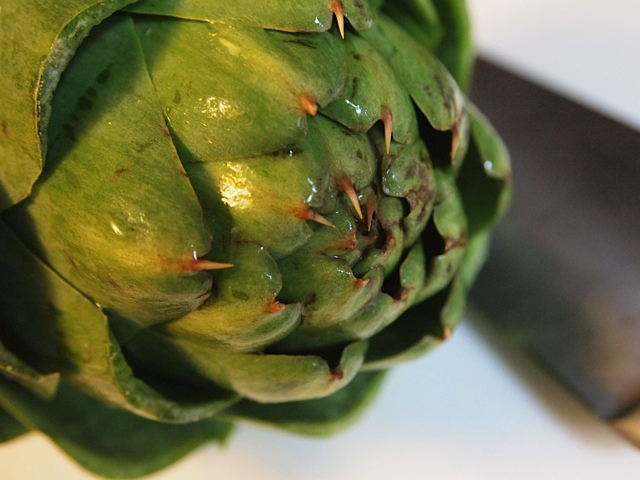
This artichoke does not want to be eaten.
Check out the size of those spikes! This thing tore through a reusable produce bag…and drew blood! I felt like I was declawing it rather than trimming it.
 collecting tokens