My baby is a cross-dresser

Phoebe has a lot of clothes. Some of them girly. But many of them what I would consider gender-neutral. However, if it’s not girly (pink, purple, princessy and/or with hearts, flowers, butterflies or fairies), it’s apparently considered downright boyish. And we’re not even talking just blue or patterned with footballs or monster trucks. Or even stripes or plaid. We’re talking about animal prints. Teddy bears? Boyish. Doggies? Boyish. (Though kitties seem to be girlish) Hippos? Boyish. Owls? Boyish. (But other birds are girlish.) Frogs, turtles, alligators, lizards? Boyish. Bugs? Boyish. (Except for girly dragonflies, ladybugs and butterflies.) Green, yellow, or orange? Boyish. You’d be amazed at how many people take it as an affront when they discover that Phoebe is a girl when we have her dressed in [gasp] blue or [shudder] hippos.

For example, yesterday, when I took Phoebe to my old Tae Kwon Do school, I saw a bunch of people I hadn’t seen in ages. Some of whom didn’t know about the whole baby business. Phoebe was wearing jeans with a gray hoodie and gray socks, and had her beige jacket with teddy bear motif, and a pair of mary janes. And in two separate incidents, a couple of women asked, more or less, “who’s this guy?” To which I responded, more or less, “she’s Phoebe.” (n.b. They were like “who’s this guy,” and I was like “she’s a girl.”) One woman responded, with a look of shock: “But you have her in blue! I thought she was a boy.” (The bear jacket has blue details. The jeans are blue.) With the other, the jacket was off, so the reaction was “I saw the gray and black.” Each woman was a bit uncomfortable, apparently embarrassed for having made such a gaff. However, I didn’t mind. You see, Phoebe is a baby. And as far as I’m considered, her sexuality is not really an issue at this point.

Another time, when Phoebe was even smaller, there was a similar incident. At the Home Despot (a monstrously large hardware store, for those not in the know). A young woman (or perhaps teenager) who was working there stopped to look at Phoebe, who was wearing a yellowish orange outfit with fishies. And she (the employee, not Phoebe) said something like: “What a cute baby. I can’t tell if it’s a boy or a girl.” To which I replied, “Yeah, we tend to dress her gender-neutrally.” And then the young woman suggested that we could get Phoebe’s ears pierced so people could tell she was a girl. Hello? If I felt so strongly that people absolutely must never ever mistake my baby for a boy, why would I dress her gender neutrally? I would be capable of, for example, finding some article of pink clothing with which to label her, or slap a bow on her head. Without actually resorting to poking holes in her.

Anyhow, while Phoebe does have her share of girly clothes (and she does look terribly cute in them), she often dresses a lot like me. (Except for the animal prints. No teddy bears emblazen my coat, or anything else I wear.) I wear a lot of gray. Black. Dark colors. And actually, I like to wear men’s shirts. And men’s sweaters. And fairly recently, I also discovered men’s pants. You see, I can get great deals on clearance pants because my size is not a common size for men. So for instance, I got a couple of pairs of men’s pants at the Gap for $5.00 each from a clearance rack. Which is handy for my transitional pants needs. (When I tried the women’s clearance rack I was displeased both with the size I would need to get, and the styles available. Plus the women’s pants were way more expensive.) I also wear shoes that would not be described as girly. I like to wear Docs, and ones that could be either men’s or womens. So actually, many days, I wear outfits that are basically entirely men’s outfits. (Aside from the undies. Let’s not go there just now.) So, I guess I’m a bit of a cross-dresser myself.

Cross-dressing has quite a lot of representations in theater, film and TV. We have men dressing as women, and women dressing as men. Sometimes, it’s a case of pretending to be the opposite gender, other times it’s wearing oppositely-gendered clothes as a style choice. Or perhaps lifestyle choice. And sometimes there are other reasons. I’m working on a list, with some attempts to categorize. (And perhaps cross-categorize. Which is appropriate for cross-dressing, I suppose.) But as my list is getting quite long, and as I have work I need to do tonight, I’ll have to save the list for another day. (Those damn lists take a long time…)
Some kicks

I stopped by my old Tae Kwon Do school for a bit this morning, with Phoebe in tow. They were having an open house and demo. (I haven’t been training there regularly for at least a couple of years, but I still keep in touch with some folks. In case you’re wondering, I was, and I guess technically still am, a blue belt…And in case you’re wondering, I wasn’t particularly good. Totally not athletic. Also not terribly coordinated. But I enjoyed it.) Anyhow, the demo was very cool, and Phoebe got to see some real-live martial arts action. Several of the instructors demonstrated some impressive breaking techniques. Mostly breaking boards. The chief instructor even broke a stack of 5 or 6 concrete slabs. Very impressive.

But I have to say that the high point of the demonstration for me was when one of the instructors called up some of the students to show some advanced kicks. He asked for a couple of young red belts to come up (those are students that are a couple of tests away from being black belts). He had them show some jumping and “flying” kicks. So they did a few flying side kicks and jumping crescent kicks, and it looked very cool. And then the instructor called up another red belt to join to the two in the demonstration. And he made the comment: “just so that everyone can see that boys can do these, too.” Because the first two students were girls. I hadn’t even thought about that fact until the instructor’s comment.

My TKD school is very supportive of women and girls who train in martial arts. In fact, it’s never even particularly been an issue there. And it was nice to be reminded of this. While most of the kids who train there are boys, four out of the maybe eight people who have become blackbelts training at the school are women. I never felt like my gender held me back. (Other things did. See aforementioned lack of athleticism and coordination. Also overcommitment to other things. While I’m not the only woman that’s trained there, I may possibly be the only grad student…) Anyhow, I’m hoping to try to get back into the training there soon. In my copious spare time.

goodbye, tokens

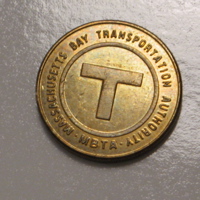
token11.jpgRecently, the MBTA (Boston’s public transit system, also called the T) underwent some major changes, which can be boiled down to a single big change: you no longer use tokens. They’ve converted to a an electronic system involving the use of cards. Last week I mentioned that I got my first Charlie Card. Previously I’d unwittingly bought a Charlie Ticket. What’s the difference? Let me lay out the differences and similarities for you:

Charlie Card: Hard plastic, like a credit card. Very sturdy.
Charlie Ticket: Stiff paper, like a business card. Somewhat flimsy.

Charlie Card: Available for free, then you pay to add credit to it.
Charlie Ticket: Available for free, then you pay to add credit to it.

Charlie Card: Can be reused by adding credit to it.
Charlie Ticket: Can be reused by adding credit to it.

Charlie Card: Can be registered in case it gets lost.
Charlie Ticket: Can’t be registered. If you lose it, you lose. (Loser.)

Charlie Card: A T ride costs $1.70
Charlie Ticket: A T ride costs $2.00

tokens_3.jpgYes, this paper version of the MBTA card lets you ride the T for 30 cents more than if you take the same ride using the Charlie Card. Why would anyone want to do that? Why did I buy one? The short answer is cluelessness. I hadn’t even realized there were two different kinds of tickets. The Charlie Ticket is what’s available from the machines. To get your Charlie Card, you must know to seek out a distribution point and ask for one. Easy enough, as long as you know. The Charlie Ticket must be meant especially for newbies and tourists. A tax on cluelessness, as it were. Perhaps it should be called the Sucker Ticket, or the Clueless Card. But I suppose that would spoil the fun.
And so that this post won’t end up being just a rant, I should bring up some fun trivia that folks not around Boston may not know about. The name of the Charlie Card actually refers to a song: “The M.T.A. Song,” by the Kingston Trio, a song about a guy named Charlie who gets stuck riding around on the T. Funny thing is, it’s a song written in protest of a fare increase in the Boston T system, then called the MTA. (And by the way, all these recent changes to the T system have also been accompanied by a big hike in fare.) And here, how about a list. A list of songs that relate to my T adventures:

  • “The M.T.A. Song,” by the Kingston Trio (Also known as “Charlie on the M.T.A.”)
  • “Skinhead on the MBTA,” by the Dropkick Murphies (An updated punk reinterpretation of the Kingston Trio classic.)
  • “Ambition,” by Subway Sect
  • “The Metro,” by Berlin
  • “She’s got a ticket to ride,” The Beatles
  • “She’s got her ticket,” Tracy Chapman
  • “Brand New Sucker,” Jonathan Coulton
  • “Ain’t Got a Clue,” The Lurkers
  • “Loser,” Beck
  • I’m a Jedi Knight, apparently

    You know how there are those formulas you can use to determine your Star Wars name? A bunch of them are available on the web. Most of them involve formulas along the lines of this:

    For your new first name:
    1. Take the first 3 letters of your 1st name & add
    2. the first 2 letters of your last name
    For your new last name:
    3. Then take the first 2 letters of your Mom’s maiden name & add
    4. the first 3 letters of the city you were born.

    How to determine your Star Wars honorific name & title:
    1. Take the last three letters of your last name & reverse them.
    2. add the name of the first car you drove/owned.
    3. insert the word “of”
    4 Add the name of the last medication or supplement you took.

    But you see, I don’t even need to do that. Because apparently, my name is already plenty starwarsesque. Behold!

    Alejna ignited her yellow lightsaber and positioned herself in the Makashi form, Garden dropped into a Niman form and ignited his two blue lightsabers. Garden jumped into the air and started swinging at Alejna fueling every swing with force speed. She blocked hit after hit…

    Yes, in the last few weeks, someone in the Star Wars role-playing universe has created a character named Alejna. Jedi Knight. And I’m happy to say that she can kick some ass. (What a relief.)

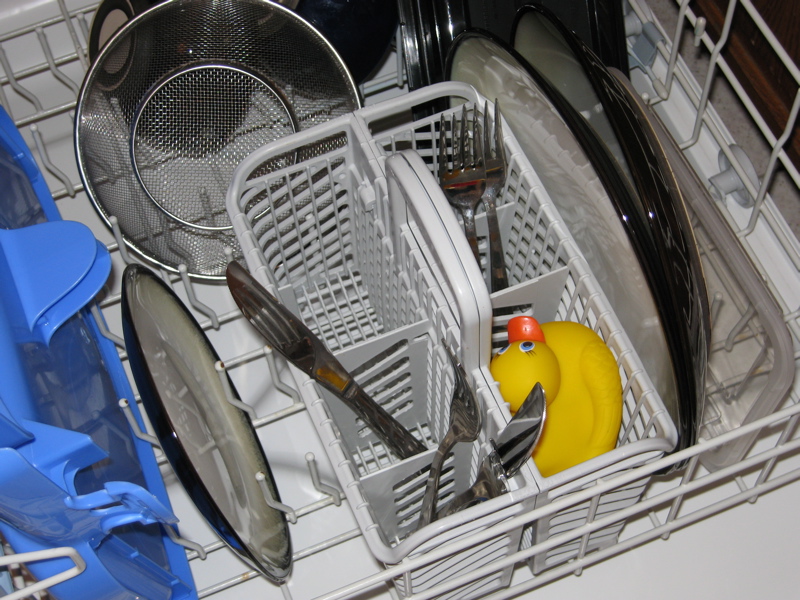
    There’s a duck in the dishwasher.

    These are words I spoke soon after arriving home last night. “There’s a duck in the dishwasher.” And as is a common curse with those working in linguistics, I (sometimes) actually listen to the words that come out of my mouth. “There’s an unlikely sentence,” I said to John. And googling “duck in the dishwasher” in fact brings up only one (two if you count the archive of the same) hit, with the following line: “…and so before I clean the duck (in the dishwasher) I first have to squeeze the water out.”

    So I bring to you this duck in the dishwasher. My own duck in the dishwasher. (Thus increasing the frequency of the sequence of words “duck in the dishwasher” on the web.) And I hope to start a collection of highly improbable-sounding, but spontaneously and appropriately contextually-oriented, sentences. So if you have any to share with me, please do so. (Before you duck in the dishwasher.) (Did I mention I need to nap? Haven’t done that yet.)

    duck.jpg

    And by the way, this post is largely an excuse to set up my Technorati Profile.

    …and then she was all like “that’s what I’m sayin’. Quotative ‘be like’ is used all the damn time.”

    A couple nights ago, I posted a bit about the quotative use of “be like.” That’s the usage of the verb to be plus like to signal a quotation, like in the following constructed example:

    So I ran into this guy I know, and he was all like “hey, baby,” and I was like “huh? what’s your deal.”

    So I posted some stuff, based on some reflections I’ve had about an assignment for a class I’m taking. (And by the way, I haven’t yet done the readings relating to that assignment. There’s actually fairly extensive literature on this topic.) And anyhow, a friend of mine from school made some interesting comments. She uses the quotative “be like” as an example to illustrate prescriptive vs. descriptive grammar with her intro to linguistics students. Here’s some of what she says:

    Two points I make are: 1) quotative “be like” is used far more widely and by much more of the population (and extends into much older segments of the population) than we assume, 2) quot. “be like” could be grammatical someday. Both points surprise the students.

    She’s got her students keeping an ear out for uses of the quotative “be like,” and particularly paying attention to the age/generation of the speaker. (‘Cause she’s all like, “I totally use ‘be like’ all the time, and I’m as old as dirt.” Well, what she said was that she has “fallen out of the traditional ‘youth’ demographic.” As so many of us have fallen.) Maybe we’ll get to hear more about this later. (I mean, the use of “be like” across generations, not the falling out of demographics.)

    As far as the second point goes, I totally agree that the quotative “be like” could be grammatical some day. I actually expect it will be. What with the way its use is ramping up, I don’t even think it will be that far in the future. My friend comments that she believes that the use of “said” is already getting rarer, and that she expects she only uses it in more formal situations. I would posit that it’s not only about formality. It actually serves a function that isn’t directly covered by other verbs in English. I mean, it allows you to quote someone without committing to the actual verbiage. I guess we could otherwise say “said something like” or “thought something like,” but really I think “was like” means “spoke words and/or produced gestures and/or had thoughts indicating an attitude/reaction/emotional state that could be characterized by the following linguistic expression, which may or may not have actually been uttered by the person to whom it is attributed.” The verb “say” implies more of a commitment to actual spoken words, while “be like” doesn’t. I’m imagining possible dialogs (which I apparently enjoy doing…):

    A: He was all like “you suck.”
    B: Did he say that?
    A: No, but he gave me that look.

    vs.

    A: He said “you suck.”
    B: Did he say that?
    A: WTF? Are you actually listening to me? Yeah, I said he said it. You suck.

    Okay. There are my musings for now. I still have some fun googling results to share, but right now I think I’m going to try to get a wee bit of a nap. (Phoebe woke me up around 5:00 this morning.) And then I should probably do some of my actual work.

    …and I was like “dude, that’s the quotative use of ‘be like’.”

    As I mentioned recently, I’m taking a class. While it’s been a bit of a trip getting back into the swing of attending classes, I’m actually enjoying the class. It’s a sociolinguistics class. A course I’ve been wanting to take for years. I missed taking it as an undergrad, though it was very relevant to one of my majors (linguistic anthropology). (It was offered only every couple of years, and happened to be offered the semester I was studying abroad.)

    Anyhow, we’re going to be doing some sort of assignment on the quotative use of be like in English. That is, the use of the verb to be + like to mean, more-or-less “to say.” As in:

    I was talking to this guy, and he was like “what’s that all about,” and I was like “How the hell should I know.” And he was like “get over yourself.” And I was like “whatever.”

    Of course, this does not necessarily translate into the following dialog:

    A: What’s that all about?
    B: How the hell should I know.
    A: Get over yourself.
    B: Whatever.

    Unlike when the verb say is used, using be + like doesn’t imply direct quotation. It usually suggests that the speaker is paraphrasing either a quotation, or an attitude or emotional response. It’s also generally used informally. This use of the quotative be like is extremely common not only in American English, but also in Canadian and British English. In spite of its wide use, it’s not always popular and is subject to some discussion even among those who don’t formally study language.

    Anyhow, for my class, my professor is like “find an example. Use Google.” And I’m all like “dude, I can find a gazillion examples using Google.”

    So, not satisfied with finding just one example for tomorrow’s class, I find myself wanting to dig into the search. And I thought I’d share some things I’ve learned and stumbled across. First, I found this great example of someone playing with the usage of “be all like,” a variant of “be like”:

    …the high court ruled 6-3 that former Attorney General John Ashcroft’s play to put Oregon’s assisted suicide law out of business was unconstitutional. See, Ashcroft was all like, “Physician-assisted suicide is not a legitimate medical practice under the Controlled Substances Act and prescribing such lethal medication violates federal law!” But then the Supreme Court was all like, “Ashcroft’s directive is both unlawful, and unenforceable, and the attorney general has overstepped his authority.”

    Here are some issues that come up in looking for use of the quotative “be like.”

  • it can be used with different tenses (I was like “dude”, I’m like “dude”, I’ll be like “dude”…) and subjects (I was like “wtf”, you were like “wtf”, he was like “wtf”, we were like “wtf”, Sally was like “no way,” the governor was like “yuh-huh.”)
  • it can be used with a couple of different modifiers (my mom was all like “yo”, he’s totally like “you rock”, I was just like “oh my god”)
  • In searching for some examples of one tense and conjugation, such as “was like,” you run into, like, a medley of other uses of like (eg. “he was like a sloth” or other, “I thought he was, like, amazing” “what life was like back then”)
  • Not all quotative uses co-occur with quotation marks (He was like, no way.), and not all apparent quotations mean a quotative use (The show was like “Repo Man”)
  • I’ve actually found some other cool stuff in my googlings, but since I have to go to bed. I’ll spare you. For now, that is. (Bwa ha ha ha.)

    (occasionally) going through the motions

    Breaking news! I got a bit of exercise today.

    John and I have some exercise equipment in the basement. An elliptical machine and some weights. Believe it or not, we’ve actually gotten a lot of use out of them. And not just for hanging laundry. For several years, we’ve had a tradition of heading down to the basement in the evening, 4 or 5 nights a week, to work out. We’d largely alternate doing weights and using the elliptical. And part of our tradition is to watch episodes of Buffy as we work out. We have the whole series on DVD. And we’ve watched them through a number of times. We’ll sometimes put in other DVDs once we get to the end of the series. But usually, we just watch Buffy. It helps to have something familiar on in the background, so we don’t need to pay too much attention. And the show, with its blend of suspense, comedy and action, tends to suit our mood. Part of our motivation for comes from looking forward to the good episodes. (Because, let’s face it, some episodes are better than others.)

    We’ve had periodic lapses over the years, sometimes of several months, even. But more often than not, we’ve managed to keep the schedule going. I even kept up a pretty decent workout schedule through my pregnancy, albeit less rigorous. But last February, something happened. Our lives were totally turned upside-down. And we haven’t been down to the basement too often. (Actually, we even lost a DVD player due to our inactivity. We must have left the disc in with the menu screen on, which meant that the disc was spinning. When we went back down to the basement, a month or so later, the motor was burned out. And then there was the time we discovered mold growing on the equipment, inspiring us to find even more excuses to avoid going back down to the basement.) Anyhow, I’ve been trying to get back to the workout schedule once more, even if slowly. And tonight, I got rewarded with one of my favorite Buffy episodes: Once More With Feeling. Hurray!

    A Message from the Ministry of Pants

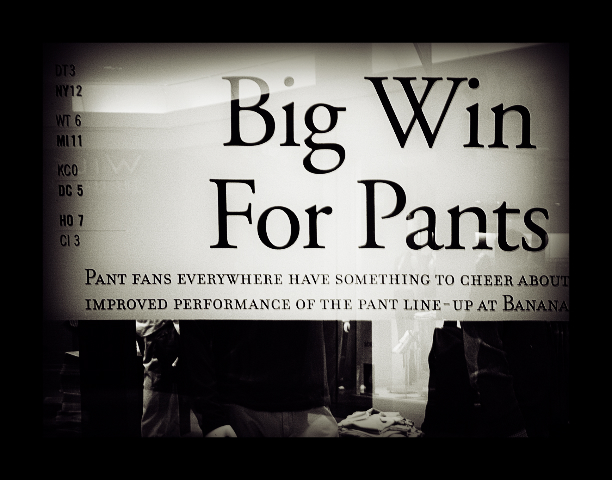
    We interrupt our regularly scheduled program to bring you the following important message: Pants are everywhere. We bring you this pair of pants images:

    changed-my-life.jpg

    big_win_for_pants.jpg

    John and I saw these pants window banners at the mall a couple of weeks ago at Banana Republic. Neither of us had our cameras with us. I’ve been meaning to get back there to take a picture before they pull down their pants. But I haven’t had time. Yesterday, John, love of my life, heart of my heart, stopped by the mall again on his way to a meeting. Just so he could get me these pants.