As you may know, I just got back from a 2 week trip to Europe, involving a week in Saarbrücken, Germany and a week in Paris (the one in France). On Wednesday two weeks ago we made a trip from Saarbrücken over to the town of Völklingen to visit the legendary ironworks there. The conference I was attending had a half day, giving me a bit of an opportunity for some site-seeing. John, Phoebe and I took the train over in the afternoon, leaving a bit later than we’d planned. The trains left twice an hour, making it a pretty stress-free trip, though. And then the actual train ride was only about 10 minutes, and then the ironworks was only about 5 minutes on foot from the Völklingen train station.
The Völklinger Hütte, or the Völklingen Ironworks, is an enormous relic of the boom of the industrial age. First built in 1873, and with many additions over the following decades, it was last operational in 1986. It was named a UNESCO World Cultural Heritage site in 1994, and was opened to the public in 2000.
With the listing of the Völklinger Hütte as the first industrial monument on the UNESCO World Cultural Heritage sites list a new phase begins in the history of the ironworks. It is the only surviving ironworks in the world from the heyday of iron and steel production and a unique testimony to an industrial epoch of the past.
It is really hard to grasp the enormity of the ironworks. It spreads over 100 acres, and the parts of the monument that are open to the public now contain over 5 kilometers of paths and walkways for visitors to explore.
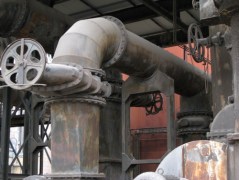
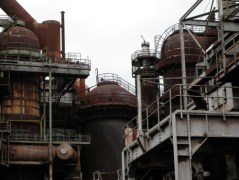
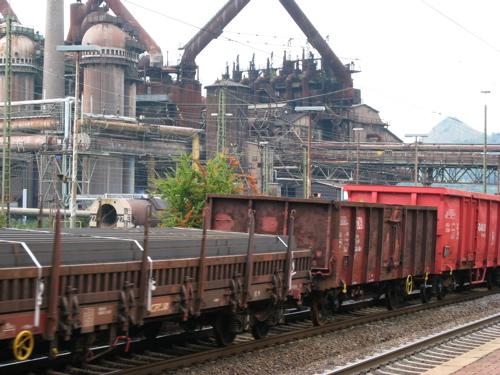
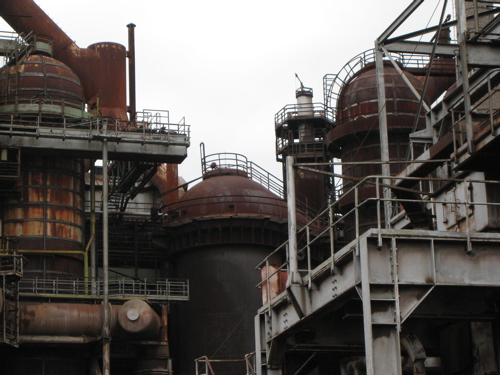
The ironworks looms on the horizon like a surrealist matte painting from a science fiction movie, its dark, hulking presence and complex shape seeming improbable. With its domed towers and elaborate tangles of pipes and tubes, it has a nearly organic look. Up close, it becomes even more awe-inspiring. Now out of service for 2 decades, the domes and towers and tubes are all covered with a patina of rust, layers of paint from decades past peeling away, plants and even trees growing in crevices and on high platforms. I found myself awed by not only by the size and scope of the place, but also by its unexpected beauty. I was startled to find myself describing a place so forboding and monstrously large as beautiful.
Everywhere we looked was something interesting to see. The colors, the textures, the lines. The oversized machinery, enormous gears and tracks. The dangling chains, and exposed wiring. We spent a couple of hours there, but could have stayed many more. We only walked the lower paths and walkways, not having time to climb to the towers and high paths before the monument closed.
I’ve put together a selection of some photos I took on our visit, and I’ve posted a slideshow. Here’s a bit of a sampling of some of the photos:


We had some good food in Völklingen, too, by the way. There is a restaurant called Platform 11 3/4 in the old train station building, which is right next to the current train station building. The building was very cool, and they seem to have some sort of theater in it. (Possibly for puppet shows?) The staff was very friendly, and our waitress helped us navigate the menu for things we could eat. (They actually had vegetarian options marked out as “rabbit food,” or the German equivalent, which was handy.) The food was creative, and more importantly, quite good. I had vegetable ravioli served on a bed of lentils in a creamy basil sauce. John had some other pasta dish, which I’ve already forgotten the details of. We shared a salad with mixed field greens, cherries, nuts and warm goat cheese streudel.
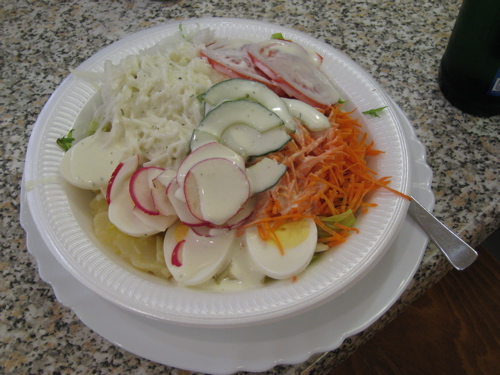
We also had some good salads for lunch at a little ma & pa seafood restaurant we passed while straying into the town in search of food. The salads, which caught our eye in as we passed the restaurant’s glassed-in counter, had a nice selection of raw veggies, plus some potato salad (Kartoffelsalat!) and a bit of hard-boiled egg. The whole thing was topped with a light yogurt dressing. One of the vegetables was one that I wasn’t able to identify: it was a shredded, or thinly julienned, crispy white vegetable. I wondered if it might have been some sort of large radish or maybe turnip. It was definitely neither celeriac nor kohlrabi. The texture reminded me a bit of jicama. There were also some other sliced crunchy bits that reminded me a lot of bok choi, which I didn’t expect to find in a German salad.
Here’s a picture of my Salat:

 Phoebe and I got to have a leisurely day together today, after a long week of not having much time together. We celebrated by going to the local playground. It was a bright beautiful day. I had fun following Phoebe around on her rounds.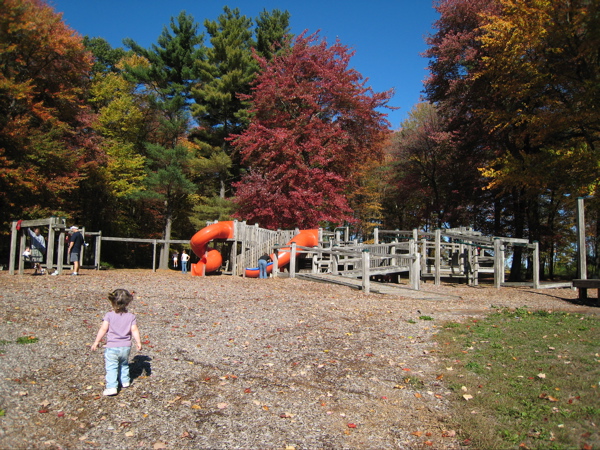
















 collecting tokens